News
Why we insist on state police, by Southern governors

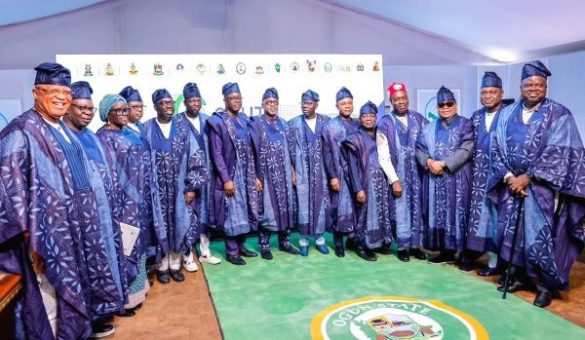
Southern governors yesterday said having state police will give them more control over security decisions in their states.
They believe locals are better placed to fight crime because they understand the terrain and language.
The state helmsmen met under the Southern Governors Forum (SGF) in Abeokuta.
They appointed host Governor Dapo Abiodun as chairman.
Anambra State Governor, Charles Soludo, was named Vice Chairman.
Also in attendance were Babajide Sanwo-Olu (Lagos), Seyi Makinde (Oyo), Biodun Oyebanji (Ekiti), Alex Otti (Abia), Godwin Obaseki (Edo) and Ademola Adeleke (Osun).
Others are Bassey Otu (Cross River), Francis Nwifuru (Ebonyi), Peter Mbah (Enugu), Duoye Diri (Bayelsa) and Umo Eno (Akwa Ibom).
Deputy Governors Chinyere Ekomaru (Imo), Monday Onyeme (Delta) and Olayide Adelami (Ondo) represented Hope Uzodimma, Sheriff Francis Orohwedor Oborevwori and Lucky Aiyedatiwa.
Rivers State Governor, Similayi Fubara, was absent and was not represented.
Abiodun replaced former Ondo governor, the late Rotimi Akeredolu.
The governor, who featured on a national television last night, said the forum deliberated on state police, the political upheaval in Rivers, infrastructure and agriculture, among others.
He said the 17 Southern governors were united in their call for state police.
Abiodun said: “We all spoke with one voice in support of state policing.
“We spoke with one voice in support of regional security outfits which almost all regions have set up.
“The outfits are working hand in glove with the law enforcement agencies and providing them with intelligence and support.
“We all know that we cannot have any meaningful development in the atmosphere of insecurity.
“We all spoke with one voice in support of state policing, and regional security outfits, working hand-in-glove with the security outfits.
“The governors are called state chief security officers. But, we know that the Commissioner of Police is appointed by the Inspector General of Police and is only answerable to the IG.
“And when the governor needs to call the attention of the CP on an urgent task in his state, the governor will have to first clear with the IG.
“What have we discovered? In most cases, a policeman from Borno, Maiduguri, posted to Lagos or Ogun states, for instance.
“Such an officer doesn’t understand the terrain, he doesn’t speak the language and he does not get the level of intelligence he needs.
“By the time he is settling down to understand these factors, he is transferred to another state.
“We’re calling for community police to tame insecurity in the state and the nation.
“Under the state police arrangement, a policeman posted to his ward won’t have problems with language and intelligence.
“In that case, the policeman understands the community and the locals, language, the sentiments and, he knows the criminals within his territory.
“It is also common knowledge that the federal police have a shortage of manpower.
“We, as governors, are not in charge or control of our states as far as security is concerned.
“Yet, we fund the federal police operations, yet we are not getting the best from them. They don’t have enough personnel.
“State policing is not something new.
“We have several types of policing structure in other climes where we took our democracy from.”
Speaking on local government tenure, Abiodun said it was unconstitutional for anybody to extend the tenure of constitutionally elected public servants.
Referring to Rivers political quagmire where the House of Assembly extended the tenure of the local government chairmen, Abiodun said: “On local government administration, it is a constitutional issue that will be put to rest at a point in time.
“When your tenure has expired, it stands to reason that your tenure has expired.
“It is not up to the governor of that state or anybody else to extend the tenure of the local government chairmen.
“The collective position of the governors is that it would be a dangerous precedent and an abuse of the democratic ethos for the tenure of an elected local government chairman to expire and for anyone to imagine that their tenure can be extended by one day.
“I think that puts that matter to rest. If that is not the case, that becomes a precedent, a reference point, and the thing is that somebody will ask for a tenure extension.
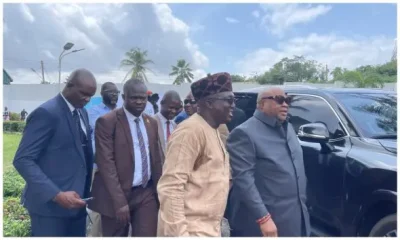


Former Delta State Governor Dr. Emmanuel Eweta Uduaghan is dead. He passed away on the morning of Monday, October 19, 2026, at the age of 71, after a period of illness.
A family statement announced his death, describing it as a devastating loss. Uduaghan, a medical doctor, served as Delta State Commissioner for Health (1999–2003) and Secretary to the State Government (2003–2007) before becoming governor from 2007 to 2015. He was known for contributions to infrastructure and human capital development in the state.
Delta State Governor Sheriff Oborevwori has expressed deep sadness over the passing. In a condolence message, he described Uduaghan as a detribalised leader whose service left a lasting mark on Delta State.
Oborevwori extended heartfelt condolences to Uduaghan’s wife, Roli, his children, the Uduaghan family, the Itsekiri nation, and the people of Delta State, praying for the peaceful repose of his soul.
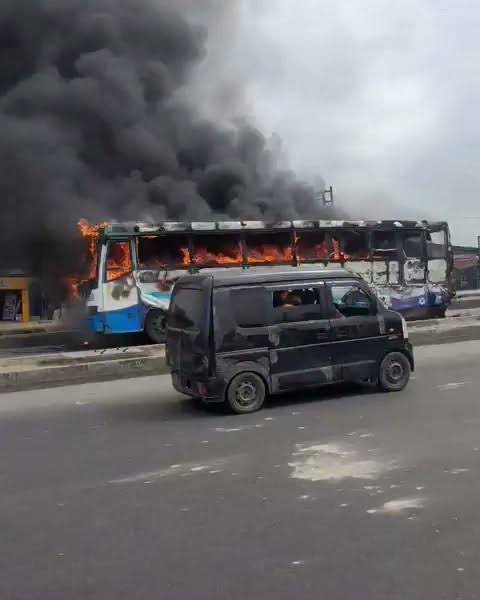
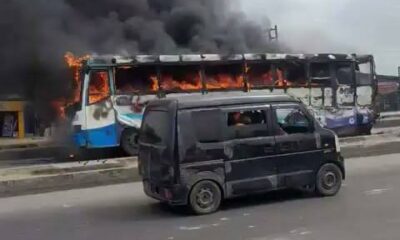
An angry mob has set a Bus Rapid Transit (BRT) bus on fire after it reportedly crushed a commercial motorcyclist to death at Ogolonto Bus Stop along Ikorodu Road in Lagos State.
The incident occurred on Friday, October 16, 2026. Eyewitness accounts and social media reports indicate that the motorcyclist was riding alone along the restricted BRT lane when the collision happened. He died at the scene.
Enraged residents and youths then attacked the bus driver and set the vehicle ablaze. Police officers and officials of the Lagos Neighbourhood Safety Corps (LNSC), who were nearby, intervened promptly and rescued the driver unharmed.
The identity of the deceased motorcyclist and the exact circumstances of the crash had not been officially confirmed at the time of filing this report. It was also unclear whether any arrests had been made in connection with the burning of the bus.
News
ARISE News Wins Seven Honours At Nigerian Broadcasters Merit Awards
The awards recognised the network’s achievements in television journalism and programming, with ARISE News winning the Best TV Channel (Viewer’s Choice) category.


• ARISE News Anchor and host of What’s Trending Ojy Okpe was named Best Newscaster (TV – Female)
ARISE News has emerged as one of the major winners at the just ended Nigerian Broadcasters Merit Awards (NBMA).
ARISE News won seven honours across television broadcasting, news reporting, presentation and production during the ceremony.
The awards recognised the network’s achievements in television journalism and programming, with ARISE News winning the Best TV Channel (Viewer’s Choice) category.
The network’s flagship breakfast programme, The Morning Show, also won the Best TV Talk Show award, further strengthening its recognition in television broadcasting.
ARISE News Anchor and host of What’s Trending Ojy Okpe was named Best Newscaster (TV – Female).
Rufai Oseni was named Nigerian Broadcaster of the Year (Male), while Vimbai Mutinhiri-Ekpeyong received the Nigerian Broadcaster of the Year (Female) award.
The recognition extended to the network’s newsroom, with Ovieteme George winning Best TV News Reporter (Male) for his contributions to television news reporting.
Behind the camera, Sam Adeyemi received the Best Camera Operator/Cinematographer award, recognising his work in television production and visual storytelling.


JUST IN: Ex-Delta Gov Uduaghan Dies at 71, Oborevwori Mourns

JUST IN: Mob Sets BRT Bus Ablaze After Motorcyclist’s Death in Lagos

BREAKING: DSS Arrests Fugitive Maina Son, Hands Him to EFCC

BREAKING: Lagos Govt Declares Today, Thursday Work-Free to Mark 2026 Ìṣẹ̀ṣe Day

Tech Expert, Zuckerberg trains with UFC champions, Adesanya, Alexander