
Politics
Why People Power Still Matters in Politics, By Emeka Monye
Mobilization doesn’t happen for free. But the mistake is to confuse funding with influence, and influence with consent.Money can get you into the room.

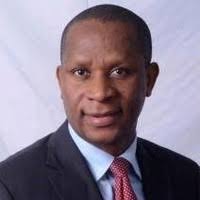
Image: Emeka Monye
IT was Abraham Lincoln, 16th President of the United States, who gave democracy one of its most enduring definitions: government of the people, by the people, for the people.
The phrase is short, almost plain. But it carries a radical idea at its core — that legitimacy in politics comes not from palaces, military barracks, or the size of a bank account, but from the consent of the governed.
That idea continues to shape political thought across continents.
From Washington to Warsaw, from Nairobi to New Delhi, the notion that power ultimately rests with the people has become the baseline against which political systems are judged. It’s not perfect.
No definition of democracy is. But it gives us a standard to measure how well, or how poorly, a society is governed.
Viewed through the lens of African politics, Lincoln’s formulation feels both aspirational and urgent. On paper, most African constitutions echo the language of popular sovereignty and equality.
In practice, many democracies on the continent still bend under the weight of money-bag politics, elite pacts, and a culture where access to power is often auctioned to the highest bidder. Yet even in that environment, people power refuses to die.
It shows up in unexpected places, at inconvenient times, and reminds the political class that no amount of money can permanently substitute for legitimacy.
Across Africa, the common assumption among new entrants into politics is simple: if you have the money, you can buy the structure, secure the ticket, and win the election.
There’s some truth to that. Campaigns cost money. Structures require funding.
Mobilization doesn’t happen for free. But the mistake is to confuse funding with influence, and influence with consent.Money can get you into the room.
It can rent a campaign office, pay for billboards, and move buses of supporters on election day. What it struggles to do is manufacture belief.
Voters, especially in environments where promises have been broken repeatedly, have developed a sharp radar for transactions masquerading as politics.
They know when a candidate shows up only when the votes are needed, and they remember who was absent when the hospitals had no drugs and the roads washed away.
This is why so many high-profile, well-funded candidates crash in primaries and general elections.
The political class assumes that because they have the bucks, they can determine who gets what, when, and how. But the electorate has learned to separate the performance of power from its substance. And when the gap between the two becomes too wide, people power steps in.
People power is not always dramatic. It doesn’t always look like mass protests or civil disobedience.
Sometimes it’s quieter — the refusal to sell a vote, the decision to stay home on election day, the way communities organize to protect their own interests when the state fails.
At other times it’s loud and visible, as we’ve seen in Nigeria’s #EndSARS movement, Kenya’s 2024 finance bill protests, and countless local uprisings against bad governance.
What these moments share is a rejection of the idea that politics belongs only to the political class.
They are reminders that democracy, however imperfect, is still rooted in the consent of the governed. When that consent is withdrawn, even the most entrenched power structures begin to wobble.
The corrective function of people power matters precisely because formal institutions in many African democracies are weak.
Courts are slow, electoral commissions face trust deficits, and legislatures often rubber-stamp executive decisions.
In that gap, citizens become the check and balance. They don’t replace institutions, but they force institutions to respond.
” The South East of Nigeria, for example, has shown repeatedly that defections and big-money campaigns don’t automatically translate into votes.”
A government that can ignore a court order for months cannot easily ignore a city that refuses to move.
African democracies operate in a context shaped by history and identity. Colonialism left centralized states with weak legitimacy. Post-independence leaders often prioritized control over participation.
The result is a political culture where patronage and ethnicity can override policy. Money thrives in that environment because it lubricates the system of patronage.But even here, people power finds footholds.
Voters may vote along ethnic or religious lines, but they also punish candidates who take that loyalty for granted.
The South East of Nigeria, for example, has shown repeatedly that defections and big-money campaigns don’t automatically translate into votes.
The electorate demands a reason beyond “he’s our son” or “he has money.”
They want to know what you’ve done, what you stand for, and whether you’ll be accountable after the election.
This is where Lincoln’s definition becomes practical. Popular sovereignty means the people are not just a source of legitimacy during elections.
They are the audience that judges performance afterward.
Equality means that a market trader’s vote counts the same as a billionaire’s. Consent means that governance without the people’s buy-in is unstable, no matter how many structures you control.
Three things explain why people power remains relevant despite the odds.
First, information spreads faster than control. Social media has lowered the cost of organizing and documenting abuse of power
. A video of a ballot box snatching in a remote village can now shape national discourse within hours.
The political class no longer has a monopoly on the narrative.
Second, the cost of disengagement is rising.
Young Africans are more educated, more connected, and less willing to accept politics as a closed shop.
They may be cynical, but they are not apathetic. When they engage, they do so on their own terms — issue-based, networked, and impatient with patronage.
Third, people remember. African electorates are often accused of having short memories, but that’s not true. What they lack is the luxury of forgetting.
When a community lives with bad roads, erratic power, and insecure schools for years, those failures become part of the political calculus.
No amount of cash on election eve erases that ledger.People power is not a magic solution.
It can be manipulated, co-opted, and turned into mob justice if it lacks organization and clear demands.
It can also burn out if it remains episodic — flaring up in anger and fading without building lasting structures.That’s why the responsibility cuts both ways.
Citizens have to move beyond protest to participation: joining parties, contesting positions, monitoring budgets, and holding representatives to account between elections.
Politicians, in turn, have to recognize that legitimacy cannot be rented. It has to be earned through delivery, consistency, and respect for the voter as more than a transaction.For political parties, especially those trying to break into regions where they have no historical base, this is the lesson.
Defections and endorsements make headlines, but they don’t move voters unless they are backed by work on the ground. People power means that the ground matters more than the press release.
If democracy is to mean anything in Africa beyond the ritual of elections, it has to return to Lincoln’s core idea: government by consent.
That doesn’t require perfection. It requires responsiveness. It requires a political class that listens when people speak, not just when they chant slogans at rallies.
People power still matters because it is the only check that works when all other checks fail. It is messy, unpredictable, and sometimes inconvenient for those in power.
That’s the point. Democracy was never meant to be convenient for the powerful. It was meant to be accountable to the people.
The money-bag politician who believes he can buy his way into permanent relevance will always face a moment when the money runs out and the crowd stays home.
The activist who believes a single protest can change a system overnight will learn that institutions don’t move that fast.
But the synthesis of the two — organized citizens engaging consistently with a political class that knows it can be removed — is how democracy becomes real.In the end,
Abraham Lincoln’s phrase survives not because it describes every democracy perfectly, but because it describes the direction every democracy must move toward.
Government of the people, by the people, for the people. Not government of the moneyed, by the connected, for the few.
That’s why people power still matters. It’s not a slogan. It’s the reminder that without consent, power is just force wearing a suit. And force, in politics, never lasts.
• Emeka Monye Is A Journalist




Politics
NDC Plans Fresh Congresses To Replace Defector Members
The NDC alleged that some of its candidates had been induced to defect to the APC through financial offers, political appointments and other material incentives.
The Nigeria Democratic Congress (NDC), has announced plans to conduct fresh congresses to replace candidates, who have defected to the ruling All Progressives Congress (APC).
The party, in a statement in Abuja by its National Publicity Secretary, Osa Director, said it would immediately begin the process of electing new candidates in the affected constituencies , assuring that the development would not derail its preparations for the 2027 general election.
The NDC alleged that some of its candidates had been induced to defect to the APC through financial offers, political appointments and other material incentives.
It, however, did not identify the affected candidates or provide details of the alleged inducements.
Describing the defections as a setback that would not undermine its political objectives, the party said those who had left lacked the ideological commitment and values it expected of its members.
,
Politics
Exclusion of candidates from INEC list: CD cautions INEC against manipulation by politicians
The organisation maintained that it was deeply troubling that candidates who emerged through primaries monitored by INEC itself could be so brazenly excluded without immediate explanation.
• Demands untainted integrity ahead of 2027 elections
A leading pro-democracy group in Nigeria, the Campaign for Democracy (CD) has raised concerns over the omission of some political parties’ candidates from the list of candidates to contest in the 2027 general elections, particularly some governorship candidates.
The pro-democracy group warned the Independent National Electoral Commission against manipulation by desperate politicians, saying any threat to what it described as “political pluralism and participatory democracy” would be resisted.
In a strongly worded statement, signed by its President, Comrade Ifeanyi Odili, and released on Wednesday, CD wondered how the candidates’ names were excluded from the final list, without any immediate explanation, and when INEC, in its earlier list made available to the public on August 29, 2026, had cleared and published them.
The statement made particular reference to the Peoples Democratic Party’s governorship candidate in Gombe State, Isa Pantami; the party’s governorship candidate in Ogun State, Ladi Adebutu, and his deputy, Yemi Sowunmi-Kolapo.
The Campaign for Democracy said the development was particularly disturbing in Ogun State, where citizens had witnessed repeated boasts and triumphalism by members of the All Progressives Congress in the state that the PDP governorship candidate would be excluded from the final list.
According to CD, as if to validate that boast, INEC went ahead to publish a list that excluded both the PDP candidate, and his deputy, Hajia Yemi Sowunmi-Kolapo, without stating any reason for their omission.
CD said, “The timing of the omissions was even more disturbing, and this was where we became concerned and alarmed. A particular instance was that of Ogun State where the state’s citizens had witnessed repeated claims and apparent triumphalism by elements within the All Progressives Congress (APC) and their supporters that the PDP governorship candidate would be disqualified from participating in the forthcoming election.
“As if to validate that boast, INEC published a list that excluded both PDP candidates without stating the reason for their omission.”
“This troubling sequence of events raises legitimate questions about the independence and impartiality of the Commission that Nigerians cannot afford to ignore,” the pro-democracy group added.
It said, “Under your leadership, Mr. Chairman, INEC bears an enormous responsibility to demonstrate impartiality, transparency, and strict adherence to the law. Unfortunately, this development has raised serious doubts about the Commission’s preparedness to conduct a credible, transparent, and inclusive election in 2027.
“The clarification by the Commission published late yesterday, three days after the incident was belated.”
The group stated, “To the best of our knowledge, these are candidates that emerged through the primaries conducted by their various political Parties which were monitored by the Independent National Electoral Commission (INEC). Information in the public domain shows clearly that these candidates were on the earlier list published on the 29th of August, 2026.
“Even though the Commission has just published a belated clarification on the incident, we consider this development deeply troubling and a serious blow to public confidence in the electoral process, particularly because the published list provided no immediate explanation for the omissions of the governorship and other candidates.”
CD, which was formed in 1991 and was among the prominent civil society organisations that fought the military for restoration of civil rule in 1999, said it decided to intervene because the omission threatens Nigeria’s democratic credentials, warning INEC Chairman, Joash Amupitan, to avoid orchestrating anything that could set the nation on fire.
The organisation maintained that it was deeply troubling that candidates who emerged through primaries monitored by INEC itself could be so brazenly excluded without immediate explanation.
The group warned that an electoral umpire must not only be independent but must be seen to be independent.
CD said information from the affected states already showed heightened anxiety that could have exploded into intractable violence before the Commission’s belated clarification, describing the delay as inexcusable tardiness.
The pro-democracy body further demanded an immediate investigation into allegations circulating in the public that some candidates’ names were electronically removed after they were duly submitted.
It vowed that as a committed pro-democracy group, it would not hesitate to mobilise citizens and pro-democracy organisations across the nation for lawful mass civic action against any threat to political pluralism and participatory democracy.
“We remind INEC that elections belong to the Nigerian people, not to any political party, individual, or governing interest.
No institution should take actions that create the impression that opposition participation can be determined by administrative discretion without transparent, constitutional justification and due process,” CD stated.
Politics
APC Makes Wike, Soludo, Adeleke State’s Campaign Coordinator
Wike belongs to the Peoples Democratic Party (PDP), Soludo is a member of the All Progressives Grand Alliance (APGA), while Adeleke won re-election as Osun governor in 2026 under the Accord Party.
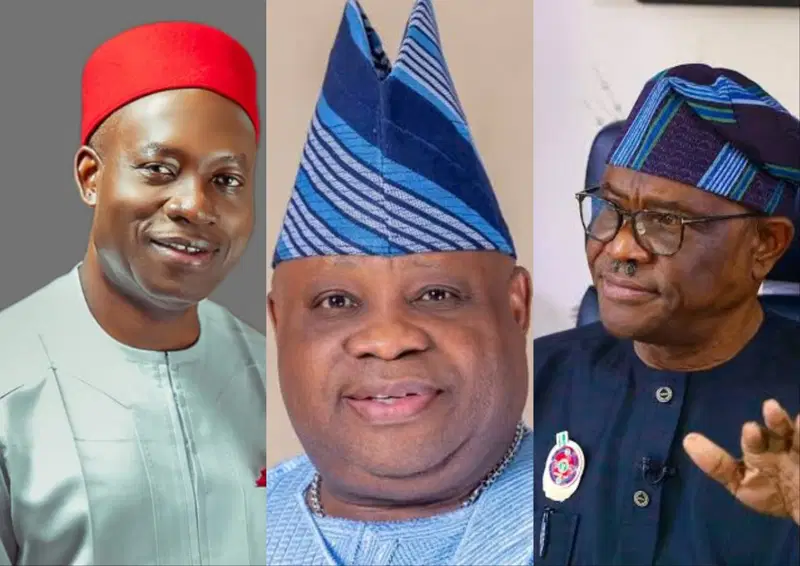
• [L-R] A collage of Soludo, Adeleke and Wike
The All Progressives Congress (APC) has named Nyesom Wike, minister of the Federal Capital Territory (FCT); Ademola Adeleke, Osun governor; and Chukwuma Soludo, Anambra governor, as state campaign coordinators in its expanded presidential campaign council for the 2027 general election.
This is despite their affiliations with other political parties.
Wike belongs to the Peoples Democratic Party (PDP), Soludo is a member of the All Progressives Grand Alliance (APGA), while Adeleke won re-election as Osun governor in 2026 under the Accord Party.
Under the new arrangement, Wike will coordinate the APC campaign in Rivers State and the FCT, Soludo will oversee Anambra, while Adeleke will coordinate the campaign in Osun.
The expanded list is scheduled for inauguration by President Bola Tinubu at the Presidential Villa in Abuja on Wednesday.
The APC initially released its campaign council list on August 22, naming Abdulaziz Yari, former Zamfara governor, as director-general. Senate President Godswill Akpabio, House of Representatives Speaker Tajudeen Abbas and Yobe Governor Mai Mala Buni were appointed deputy director-generals.


History of Naira Revaluation and Devaluation (1973–2026) (Part 1)

JUST IN: 1 Dead, 3 Rescued in Fadeyi Building Collapse, Lagos

Obasanjo Accuses Tinubu : “You Made Every Nigerian Poor By 300% Naira Devaluation”

BREAKING: Lagos Govt Declares Today, Thursday Work-Free to Mark 2026 Ìṣẹ̀ṣe Day

Tech Expert, Zuckerberg trains with UFC champions, Adesanya, Alexander

Organ Trafficking: Ekweremadu bags 10 years in UK prison
-
 Business3 days ago
Currency Words You Should Know
-

 Business3 days ago
NCC, CBN To Warn Companies By Flagging Fraudulent Phone Numbers
-
 Business3 days ago
JPMorgan Eyeing Entry Into Nigeria’s Banking Industry
-

 Business3 days ago
Naira Exchange Rates Wednesday, October 21, 2026
-

 Business2 days ago
RMRDC Taking 2027 Africa Raw Materials Summit To Kenya
-

 Health2 days ago
Ebola In Nigeria: Symptoms, Spread and How To Protect Yourself
-
 News2 days ago
JUST IN: Gas Emissions Hit Ogun Schools, Hundreds of Pupils Hospitalised
-

 Health2 days ago
Ebola Outbreak: Don’t Panic, FG Assures Nigerians