
News
Tinubu urges North to fight insurgency in unison


President Bola AHmed Tinubu yesterday said he appointed Northerners into major defence positions because of their knowledge of the region.
“Our first decision was to task our brothers from the Northwest and the Northeast to rise in defence of the security of the region. “Who else can better understand the complexity of the region than the people themselves,’’ he said.
President Tinubu spoke at the opening of a two-day United Nations Development Programme ( UNDP)-sponsored Northwest Peace and Security Summit in Katsina.
He was represented by Vice President Kashim Shettima.
Some Northerners holding sensitive security posts are Minister of Defence Abubakar Badaru; Minister of Defence (State) Bello Matawale; National Security Adviser (NSA) Nuhu Ribadu; Chief of Defence Staff (COAS) General Christopher Musa and Chief of Air Staff Air Marshal Hasan Abubakar.
For insecurity in the North to abate, people of the region must rise in unison against terrorists and other criminal elements that have for over a decade denied them peace, President Tinubu said.
This position was supported by the Sultan of Sokoto Muhammadu Sa’ad Abubakar III.
They stated that doing so would complement the strategies adopted by the government and the Armed Forces to restore peace in the region hitherto known for its tranquillity and cohesion.
The theme of the summit graced by eminent personalities like former President Muhammadu Buhari, four of the seven Northwest governors, and Defence Minister Mohammed Badaru, is: “Regional cooperation for securing lives and livelihoods in Northwest Nigeria.’’
President Tinubu said even though the various strategies adopted by his administration to tackle the security challenges in the North were yielding results, the people needed to complement the success.
Tinubu, whose address at the event was titled: “Securing stability: uniting for peace in Northwest Nigeria,” reiterated his administration’s commitment to completely eradicating terrorism and other forms of crime.
Describing the summit as a communal gathering to address “the afflictions that have threatened the stability and unity” of the North, the President attributed the lingering crisis in the zone to a fractured relationship by a people “rooted in a culture and bond of shared interests and common pursuits.’’
He said: “What we are witnessing across the North is an explosion of damaged relationships, and we have come to say: enough is enough.
“I am proud to share that the strategies we have employed have begun to provide redemption. We are not slowing down until we achieve our aim.
“Beyond the economic rationale that drove the amalgamation of the Northern and Southern parts of Nigeria, the formation of our great nation was inspired by the need for mutual protection.
“But, I ask, how can we achieve this sacred objective if one part is afflicted?“We have long established that whatever ails any part of this federation destabilises the other.
“So, the issue of national security in the Northwest is not a sectional agenda.
“We promised to make Nigeria safer, and this aim has been our topmost priority since we came to office over a year ago.”
Noting that the steps taken to combat the security challenges his administration inherited were mapped out even before embarking on the journey, President Tinubu observed that achieving security and peace would require that the historical injustices that have torn communities in Nigeria apart are fully addressed.



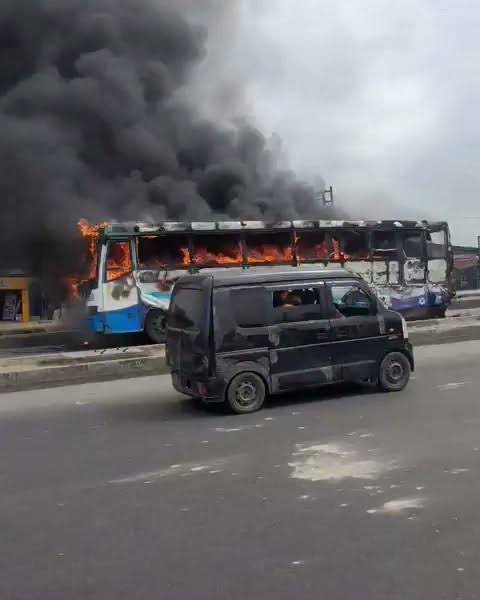
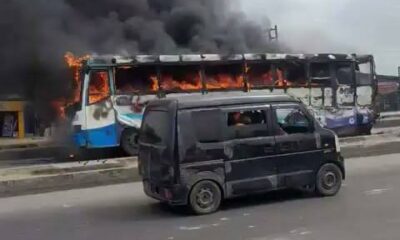
An angry mob has set a Bus Rapid Transit (BRT) bus on fire after it reportedly crushed a commercial motorcyclist to death at Ogolonto Bus Stop along Ikorodu Road in Lagos State.
The incident occurred on Friday, October 16, 2026. Eyewitness accounts and social media reports indicate that the motorcyclist was riding alone along the restricted BRT lane when the collision happened. He died at the scene.
Enraged residents and youths then attacked the bus driver and set the vehicle ablaze. Police officers and officials of the Lagos Neighbourhood Safety Corps (LNSC), who were nearby, intervened promptly and rescued the driver unharmed.
The identity of the deceased motorcyclist and the exact circumstances of the crash had not been officially confirmed at the time of filing this report. It was also unclear whether any arrests had been made in connection with the burning of the bus.
News
ARISE News Wins Seven Honours At Nigerian Broadcasters Merit Awards
The awards recognised the network’s achievements in television journalism and programming, with ARISE News winning the Best TV Channel (Viewer’s Choice) category.


• ARISE News Anchor and host of What’s Trending Ojy Okpe was named Best Newscaster (TV – Female)
ARISE News has emerged as one of the major winners at the just ended Nigerian Broadcasters Merit Awards (NBMA).
ARISE News won seven honours across television broadcasting, news reporting, presentation and production during the ceremony.
The awards recognised the network’s achievements in television journalism and programming, with ARISE News winning the Best TV Channel (Viewer’s Choice) category.
The network’s flagship breakfast programme, The Morning Show, also won the Best TV Talk Show award, further strengthening its recognition in television broadcasting.
ARISE News Anchor and host of What’s Trending Ojy Okpe was named Best Newscaster (TV – Female).
Rufai Oseni was named Nigerian Broadcaster of the Year (Male), while Vimbai Mutinhiri-Ekpeyong received the Nigerian Broadcaster of the Year (Female) award.
The recognition extended to the network’s newsroom, with Ovieteme George winning Best TV News Reporter (Male) for his contributions to television news reporting.
Behind the camera, Sam Adeyemi received the Best Camera Operator/Cinematographer award, recognising his work in television production and visual storytelling.
News
Meta removes 3.7 million accounts in West Africa scam crackdown
The joint operation led to 28 arrests, identified more than 30 suspected scam centres and rescued 117 people allegedly trafficked and forced to work in scam compounds in Ghana.
Meta, the parent company of Facebook and Instagram, has removed more than 3.7 million Facebook and Instagram accounts, pages and groups linked to suspected scam networks operating in West Africa.
The joint operation led to 28 arrests, identified more than 30 suspected scam centres and rescued 117 people allegedly trafficked and forced to work in scam compounds in Ghana.
The company announced the crackdown in a statement on Tuesday, October 13, 2026. It involved 14 technology companies and law enforcement agencies from 10 countries.
The United Kingdom’s National Crime Agency coordinated the operation with the US Department of Justice, the Federal Bureau of Investigation and other agencies. Nigerian authorities were involved.
Other countries included Ghana, Australia, Canada, New Zealand and India.Tech companies that took part included Google, Microsoft, OpenAI, Coinbase, Starlink and Adobe.
Meta said the partnership let participants share intelligence across digital platforms, countries and financial systems to identify criminal networks.


JUST IN: Mob Sets BRT Bus Ablaze After Motorcyclist’s Death in Lagos

BREAKING: DSS Arrests Fugitive Maina Son, Hands Him to EFCC

BREAKING: 5 Arrested Over Imo NYSC Abduction

BREAKING: Lagos Govt Declares Today, Thursday Work-Free to Mark 2026 Ìṣẹ̀ṣe Day

Tech Expert, Zuckerberg trains with UFC champions, Adesanya, Alexander

Organ Trafficking: Ekweremadu bags 10 years in UK prison
-
 Crime2 days ago
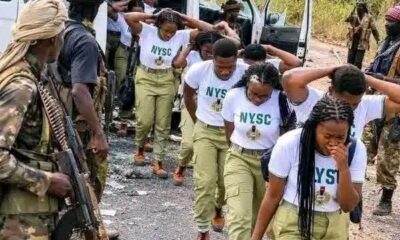
BREAKING: 5 Arrested Over Imo NYSC Abduction
-

 News3 days ago
ARISE News Wins Seven Honours At Nigerian Broadcasters Merit Awards
-
 Crime2 days ago
BREAKING: DSS Arrests Fugitive Maina Son, Hands Him to EFCC
-
 News2 days ago
JUST IN: Mob Sets BRT Bus Ablaze After Motorcyclist’s Death in Lagos