
Politics
Senate’s Proposal to Elevate Ooni, Sultan Sparks Nationwide Debate

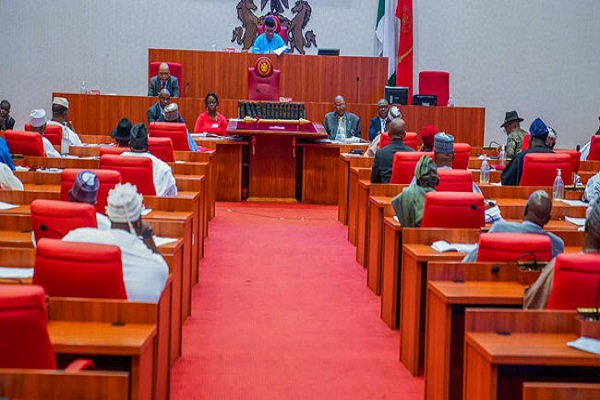
A proposed bill in the Nigerian Senate seeking to establish a constitutionally recognized National Council of Traditional Rulers has triggered widespread criticism across the country—particularly over a controversial clause that elevates the Ooni of Ife and the Sultan of Sokoto as permanent heads of the Council.
While the bill—sponsored by Senator Simon Bako Lalong (Plateau South)—is intended to formalize the role of traditional rulers in national development and peacebuilding, its provision giving the Ooni and Sultan precedence over all other monarchs has been condemned as divisive, undemocratic, and a threat to Nigeria’s federal character.
The bill, which passed second reading in March and is currently before the Senate Committee on Establishment and Public Service, has drawn sharp opposition from several groups, including Ohanaeze Ndigbo, the Middle Belt Forum (MBF), the Alaigbo Development Foundation (ADF), and Concerned Hausa Stakeholders, among others.
Ohanaeze Ndigbo: “This is injustice and ethnic bias”
The apex Igbo socio-cultural group, Ohanaeze Ndigbo, rejected the bill outright, calling it unjust, ethnocentric, and a violation of equity, fairness, and federal character principles.
Dr. Ezechi Chukwu, the group’s National Publicity Secretary, stated:
“The bill threatens to marginalize traditional institutions in the South-East, South-South, and Middle Belt. It disregards the diverse ethnic makeup of Nigeria and reduces the Senate to a promoter of executive lawlessness.”
Ohanaeze insisted the bill should be reviewed to reflect ethnic diversity and promote inclusive governance, rather than institutionalizing “ethnic hierarchy.”
Middle Belt Forum: “Sultan has no seniority over our monarchs”
The Middle Belt Forum also issued a strong rejection, particularly the clause elevating the Sultan of Sokoto. National Publicity Secretary Luka Binniyat said the move undermines historically older and culturally distinct institutions in the region.
“The Sultan of Sokoto is junior to ancient Middle Belt monarchies such as the Attah of Igala, the Tor Tiv, and the Etsu Nupe. This bill is a distortion of historical facts,” the group stated.
The MBF also criticized the Sultan’s role as primarily religious—not traditional—arguing that assigning him national traditional authority violates Nigeria’s secular character and marginalizes Christians and traditional worshippers.
They warned that if the clause is not removed, Middle Belt traditional rulers will boycott the Council and form their own autonomous body reflecting their heritage.
Concerned Hausa Stakeholders: “Nigeria is not a Fulani-Yoruba federation”
In a parallel rejection, a group of Concerned Hausa Stakeholders described the bill as ethnically biased and historically misleading. The group insisted that the Sultan of Sokoto does not represent the Hausa ethnic group culturally or traditionally.
“The Sultan is the Sarkin Musulmi, a religious leader of Fulani extraction, not a traditional Hausa monarch. He cannot speak for Hausa or northern traditional institutions,” the group said.
They argued that ancient Hausa city-states like Daura, Kano, and Zaria predate the Sokoto Caliphate, and it is insulting to subordinate them under the Sultan’s authority.
They further questioned the exclusion of other prominent monarchs, including the Oba of Benin, the Shehu of Borno, and Eze Nri in the East, saying the bill entrenches ethnic favoritism and risks igniting national disunity.
Alaigbo Development Foundation: “A slap on Nigeria’s cultural diversity”
The Alaigbo Development Foundation (ADF) also condemned the bill, describing it as provocative and subjugative. They warned that it disrespects Nigeria’s cultural diversity and could provoke ethnic tensions.
“This bill is an insult to the Igbo people and to Nigeria’s cultural heritage. We urge all Igbo lawmakers to reject it and protect the integrity of our traditional institutions,” the group said.
Individual Reactions from South-West and South-South
Despite the elevation of the Ooni of Ife under the bill, some Yoruba voices also expressed disapproval.
Femi Adebowale, a university lecturer, questioned the assumption that the Ooni could speak for the entire Yoruba nation:
“Historically, the Alafin of Oyo is senior to the Ooni of Ife. So how can he be placed above all other Yoruba monarchs? This is divisive and historically inaccurate.”
Similarly, Caleb Osazuwa, a lawyer from Edo State, said the idea that the Ooni could represent southern traditional rulers—including the Oba of Benin—was laughable.
“It’s the greatest joke of the century. The Oba of Benin cannot and will never be placed under the Ooni. Nigeria must respect its ethnic and historical realities.”
Proposed Alternatives
In their responses, several groups and individuals offered suggestions to preserve equity and national unity:
- Rotational chairmanship of the Council across Nigeria’s six geo-political zones or ethnic blocs.
- Democratic selection of leaders by traditional rulers themselves, through an inclusive process.
- Clear separation between religious and traditional leadership to reflect Nigeria’s secular constitution.
Conclusion
As the Senate continues deliberations on the bill, growing nationwide backlash underscores Nigeria’s deep ethnic and historical complexities. Many fear that elevating two monarchs as permanent leaders of a national council could spark tensions, marginalize diverse ethnicities, and derail efforts toward unity.
While the creation of a national body for traditional rulers is seen as a positive step, critics argue that any structure must be inclusive, fair, and reflective of Nigeria’s pluralistic identity—not one that institutionalizes ethnic hierarchy.







Politics
Exclusion of candidates from INEC list: CD cautions INEC against manipulation by politicians
The organisation maintained that it was deeply troubling that candidates who emerged through primaries monitored by INEC itself could be so brazenly excluded without immediate explanation.

• Demands untainted integrity ahead of 2027 elections
A leading pro-democracy group in Nigeria, the Campaign for Democracy (CD) has raised concerns over the omission of some political parties’ candidates from the list of candidates to contest in the 2027 general elections, particularly some governorship candidates.
The pro-democracy group warned the Independent National Electoral Commission against manipulation by desperate politicians, saying any threat to what it described as “political pluralism and participatory democracy” would be resisted.
In a strongly worded statement, signed by its President, Comrade Ifeanyi Odili, and released on Wednesday, CD wondered how the candidates’ names were excluded from the final list, without any immediate explanation, and when INEC, in its earlier list made available to the public on August 29, 2026, had cleared and published them.
The statement made particular reference to the Peoples Democratic Party’s governorship candidate in Gombe State, Isa Pantami; the party’s governorship candidate in Ogun State, Ladi Adebutu, and his deputy, Yemi Sowunmi-Kolapo.
The Campaign for Democracy said the development was particularly disturbing in Ogun State, where citizens had witnessed repeated boasts and triumphalism by members of the All Progressives Congress in the state that the PDP governorship candidate would be excluded from the final list.
According to CD, as if to validate that boast, INEC went ahead to publish a list that excluded both the PDP candidate, and his deputy, Hajia Yemi Sowunmi-Kolapo, without stating any reason for their omission.
CD said, “The timing of the omissions was even more disturbing, and this was where we became concerned and alarmed. A particular instance was that of Ogun State where the state’s citizens had witnessed repeated claims and apparent triumphalism by elements within the All Progressives Congress (APC) and their supporters that the PDP governorship candidate would be disqualified from participating in the forthcoming election.
“As if to validate that boast, INEC published a list that excluded both PDP candidates without stating the reason for their omission.”
“This troubling sequence of events raises legitimate questions about the independence and impartiality of the Commission that Nigerians cannot afford to ignore,” the pro-democracy group added.
It said, “Under your leadership, Mr. Chairman, INEC bears an enormous responsibility to demonstrate impartiality, transparency, and strict adherence to the law. Unfortunately, this development has raised serious doubts about the Commission’s preparedness to conduct a credible, transparent, and inclusive election in 2027.
“The clarification by the Commission published late yesterday, three days after the incident was belated.”
The group stated, “To the best of our knowledge, these are candidates that emerged through the primaries conducted by their various political Parties which were monitored by the Independent National Electoral Commission (INEC). Information in the public domain shows clearly that these candidates were on the earlier list published on the 29th of August, 2026.
“Even though the Commission has just published a belated clarification on the incident, we consider this development deeply troubling and a serious blow to public confidence in the electoral process, particularly because the published list provided no immediate explanation for the omissions of the governorship and other candidates.”
CD, which was formed in 1991 and was among the prominent civil society organisations that fought the military for restoration of civil rule in 1999, said it decided to intervene because the omission threatens Nigeria’s democratic credentials, warning INEC Chairman, Joash Amupitan, to avoid orchestrating anything that could set the nation on fire.
The organisation maintained that it was deeply troubling that candidates who emerged through primaries monitored by INEC itself could be so brazenly excluded without immediate explanation.
The group warned that an electoral umpire must not only be independent but must be seen to be independent.
CD said information from the affected states already showed heightened anxiety that could have exploded into intractable violence before the Commission’s belated clarification, describing the delay as inexcusable tardiness.
The pro-democracy body further demanded an immediate investigation into allegations circulating in the public that some candidates’ names were electronically removed after they were duly submitted.
It vowed that as a committed pro-democracy group, it would not hesitate to mobilise citizens and pro-democracy organisations across the nation for lawful mass civic action against any threat to political pluralism and participatory democracy.
“We remind INEC that elections belong to the Nigerian people, not to any political party, individual, or governing interest.
No institution should take actions that create the impression that opposition participation can be determined by administrative discretion without transparent, constitutional justification and due process,” CD stated.
Politics
APC Makes Wike, Soludo, Adeleke State’s Campaign Coordinator
Wike belongs to the Peoples Democratic Party (PDP), Soludo is a member of the All Progressives Grand Alliance (APGA), while Adeleke won re-election as Osun governor in 2026 under the Accord Party.
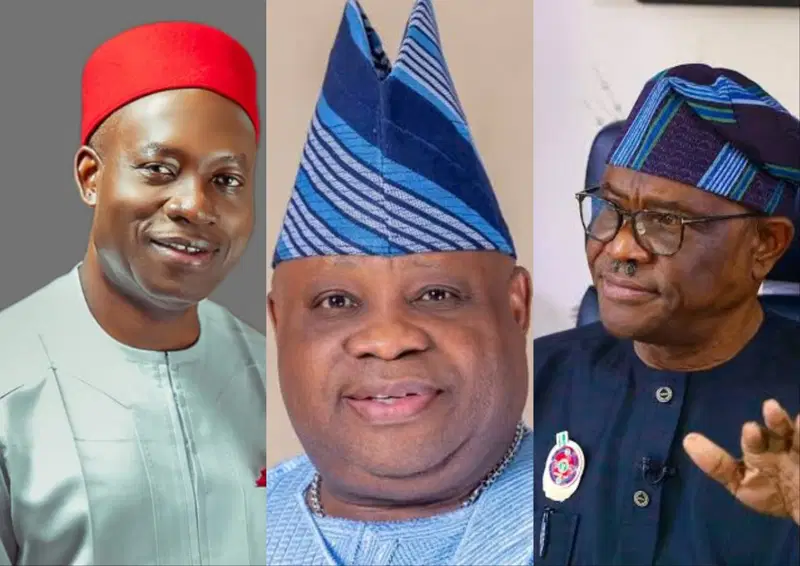
• [L-R] A collage of Soludo, Adeleke and Wike
The All Progressives Congress (APC) has named Nyesom Wike, minister of the Federal Capital Territory (FCT); Ademola Adeleke, Osun governor; and Chukwuma Soludo, Anambra governor, as state campaign coordinators in its expanded presidential campaign council for the 2027 general election.
This is despite their affiliations with other political parties.
Wike belongs to the Peoples Democratic Party (PDP), Soludo is a member of the All Progressives Grand Alliance (APGA), while Adeleke won re-election as Osun governor in 2026 under the Accord Party.
Under the new arrangement, Wike will coordinate the APC campaign in Rivers State and the FCT, Soludo will oversee Anambra, while Adeleke will coordinate the campaign in Osun.
The expanded list is scheduled for inauguration by President Bola Tinubu at the Presidential Villa in Abuja on Wednesday.
The APC initially released its campaign council list on August 22, naming Abdulaziz Yari, former Zamfara governor, as director-general. Senate President Godswill Akpabio, House of Representatives Speaker Tajudeen Abbas and Yobe Governor Mai Mala Buni were appointed deputy director-generals.
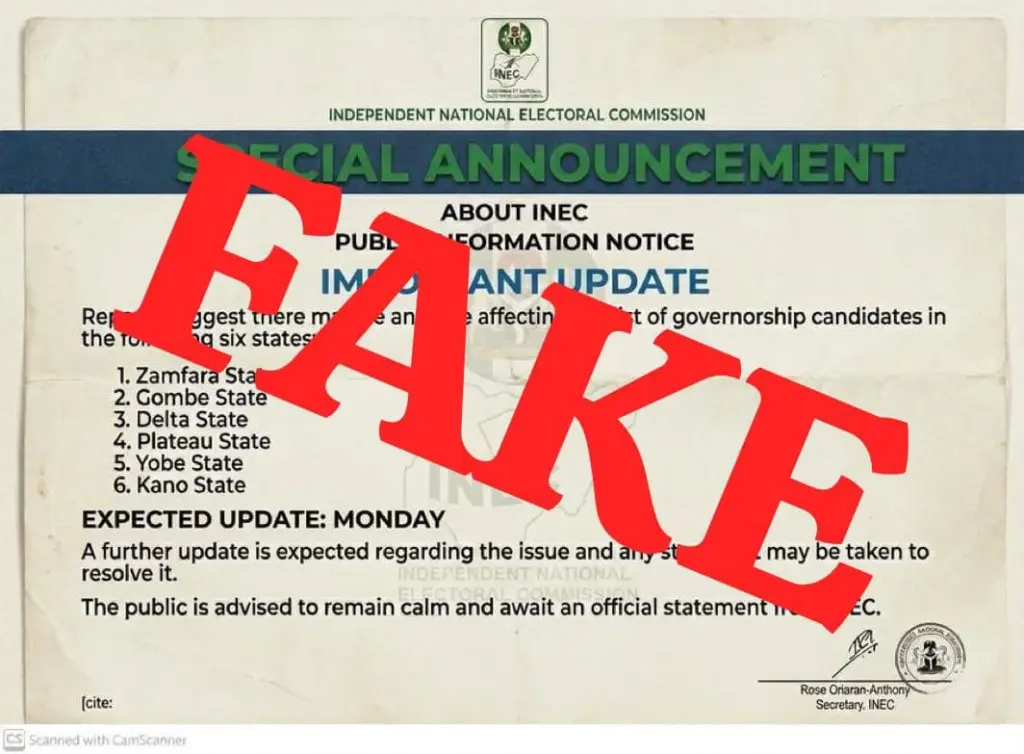
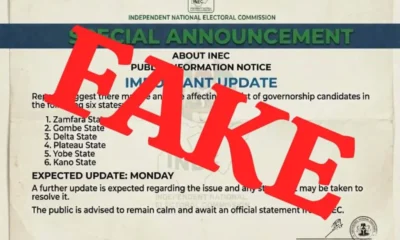
The Independent National Electoral Commission (INEC) has raised the alarm over a fraudulent publication circulating online that claims to be a special announcement about governorship candidates for the 2027 elections.
In a public notice issued on Monday, October 12, 2026, the electoral body described the document as “FAKE” and stressed that it did not originate from the Commission.
The circulating material purports to address issues affecting the list of governorship candidates in six states: Zamfara, Gombe, Delta, Plateau, Yobe, and Kano.
“The Commission wishes to categorically inform the general public that the publication is FAKE and did not originate from INEC. INEC therefore urges members of the public to disregard the fraudulent publication and refrain from sharing it,” the notice stated.
INEC further clarified that any information suggesting it has issued a special announcement concerning governorship candidates in those states is false.
The warning comes just days after the Commission published the final lists of candidates for the February 6, 2027 governorship elections.
The electoral umpire advised Nigerians, political parties, and candidates to rely solely on official notices, press releases, and information released through its verified channels.
These include the INEC website (inecnigeria.org), its Facebook page (INEC Nigeria), X and Instagram handles (@inecnigeria), and the INEC News Portal.
INEC reiterated its commitment to providing accurate electoral information and called on the public to remain vigilant against misleading publications as preparations for the 2027 elections intensify.


Exclusion of candidates from INEC list: CD cautions INEC against manipulation by politicians

Oyedele Chairs G-24 Call for Fairer Global Financial System, Affordable Development Financing

NAFDAC scolds fake manufacturers: “You are killing Nigerians in order to make money”

Tech Expert, Zuckerberg trains with UFC champions, Adesanya, Alexander

BREAKING: Lagos Govt Declares Today, Thursday Work-Free to Mark 2026 Ìṣẹ̀ṣe Day

Organ Trafficking: Ekweremadu bags 10 years in UK prison
-

 Business2 days ago
Nigeria’s ₦33bn Fruit Import Bill Exposes Missed Opportunities in Jos
-

 Business2 days ago
Naira To Dollar, Pound ,Euro …Rates For Monday, October 12
-

 International3 days ago
‘Up to our people’ to pick leader, Zelenskyy responds to Trump’s pledge for new elections in Ukraine
-
 Politics2 days ago
BEWARE: Fake 2027 Gov’ Candidates List Circulating Online — INEC Raises Alarm
-

 Opinions3 days ago
Human Capital Africa Statement For International Day of the Girl Child 2026
-
 Politics2 days ago
2027: 119 Women Jostle For State’s Governors
-

 Business1 day ago
Dangote Refinery IPO Attracts N8.61trn in Subscriptions, Four Times Offer
-

 News2 days ago
Forbes Scores GTBank Best Employers 2026