
News
Senate to Hold Emergency Plenary Sitting on Tuesday Amid Electoral Reform Backlash

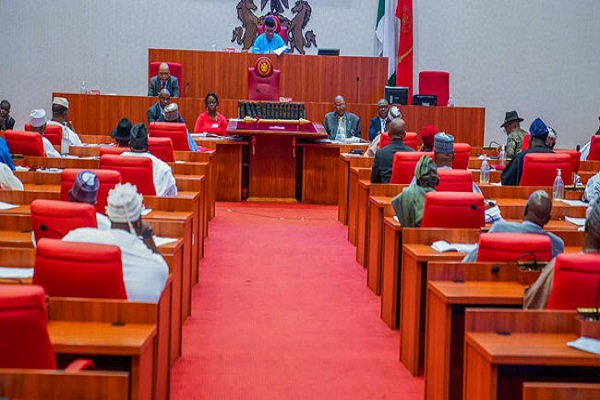
The Nigerian Senate will convene an emergency plenary sitting on Tuesday, February 10, 2026, at 12:00 noon, following intense public criticism of its recent decision on electoral amendments.
In a statement issued on Sunday, February 8, 2026, Clerk of the Senate Emmanuel Odo announced that Senate President Godswill Akpabio had directed the immediate reconvening of the chamber. The notice called on all senators to attend the special session in the Senate Chamber.
The emergency meeting follows widespread outrage over the Senate’s February 4 passage of the Electoral Act 2022 (Repeal and Re-enactment) Amendment Bill 2026.
During the third reading, lawmakers rejected a proposed amendment to Clause 60(3) that would have required presiding officers to transmit polling unit results electronically in real time directly to the Independent National Electoral Commission’s (INEC) Result Viewing (IReV) portal.
Instead, the Senate retained the existing provision from the 2022 Electoral Act, which gives INEC discretionary power to electronically transfer results only after votes are counted and publicly announced at polling units.
The decision has drawn strong condemnation from civil society organizations, opposition leaders including Peter Obi, election monitoring groups, and bodies such as the Nigerian Bar Association.
Critics argue the move weakens electoral transparency, increases the risk of manipulation, and sets back progress ahead of the 2027 general elections. Protests have been announced outside the National Assembly starting Monday to pressure the Senate to reconsider, with some stakeholders indicating possible legal action.
Senate President Godswill Akpabio has defended the chamber’s position, stating over the weekend that the Senate did not reject electronic transmission of results.
He explained that lawmakers only removed the mandatory real-time requirement due to practical challenges, including network issues in insecure areas affecting several states, while preserving the overall electronic transmission framework used in past elections.
Akpabio added that the Senate would not be swayed by intimidation and emphasized that the legislative process on the bill remains active.
The official agenda for Tuesday’s session has not been made public, but it is widely expected to address the controversy, respond to public pressure, and possibly revisit elements of the disputed clause in light of calls for stronger electoral safeguards.









News
Forbes Scores GTBank Best Employers 2026
Forbes said companies did not pay to participate or secure selection.

Guaranty Trust Bank has emerged as the only Nigerian company among the 10 highest-ranked African businesses on Forbes’ World’s Best Employers 2026 list.
The bank ranked 277th globally and seventh among African companies, breaking South Africa’s near-total dominance of the continent’s top 10 entries.
Nedbank led the African contingent at 26th globally, followed by Standard Bank Group at 54th.
Absa Group and FirstRand occupied 98th and 104th positions respectively, Business Insider reported.
African top 10 and global positions
The African top 10 was drawn from Forbes’ worldwide ranking, rather than a separate competition assessing every employer on the continent.
The leading African entries span financial services, telecommunications, energy, chemicals and healthcare.
The full African positions were: Nedbank at 26th, Standard Bank Group at 54th, Absa Group at 98th, FirstRand at 104th, MTN Group at 133rd, Investec at 197th, Guaranty Trust Bank at 277th, Sasol at 298th, Mediclinic International at 460th and Sanlam at 470th.
GTBank was Nigeria’s sole representative in this group, while the remaining nine entries were South African companies.
The positions stretched from Nedbank’s 26th place to Sanlam’s 470th.
Financial services dominated, accounting for seven of the 10 companies when Sanlam is included alongside the six banking groups.
How Forbes compiled the ranking
Forbes compiled the ranking with research company Statista, surveying more than 300,000 employees across over 50 countries.
The research covered multinational businesses employing more than 1,000 people.
Ultimately, 900 companies headquartered in 52 countries made the final list.
Participants assessed benefits, talent development, working conditions and training opportunities.
They also indicated whether they would recommend their employers to friends and relatives.
Respondents could evaluate former employers they had worked for within the previous two years, alongside other companies they knew through professional or personal connections.
The scoring incorporated earlier survey data, with greater weight assigned to recent responses and assessments from current employees.
Forbes said companies did not pay to participate or secure selection.
The Court of Appeal in Abuja on Friday stalled the hearing of two appeals filed by the Incorporated Trustees of the Socio-Economic Rights and Accountability Project (SERAP) and its Deputy Director, Kolawole Oluwadare, against a ₦101 million judgment debt.
The appeals challenge the May 5 judgment of a High Court of the Federal Capital Territory (FCT), which held that SERAP and Oluwadare defamed two Department of State Services (DSS) officials through a false publication on September 10, 2024.
A three-member panel led by Justice Danlami Senchi first took the SERAP appeal marked CA/ABJ/CV/1114/2026. When the related appeal by Oluwadare (CA/ABJ/CV/1105/2026) was called, counsel Hannah Ayanwale informed the court that it was not ripe for hearing. She said the appellant’s brief was only filed on Thursday and served on the respondents in court on Friday morning, just before sitting began.
The justices expressed displeasure that the court had not been informed earlier that the sister appeal was not ready. Because both appeals arose from the same judgment, the panel set aside the proceedings already conducted on the SERAP appeal and ordered that the two matters be heard together.
The court adjourned both appeals to October 13. It directed the respondents to file their briefs by October 12 and the appellants to file any reply briefs before the next sitting.
In the May 5 judgment, Justice Halilu Yusuf of the FCT High Court found that SERAP and Oluwadare made false claims on the organisation’s website and social media platforms alleging that DSS officials Sarah John and Gabriel Ogundele invaded SERAP’s Abuja office on September 9, 2024, and subjected staff to harassment.
The judge held that the claimants established all the ingredients of defamation. He rejected the defence of justification, noting that the defendants admitted at trial that the DSS officials did not forcibly enter the premises or brandish weapons. Words such as “invasion,” “forceful entry” and “harassment” were therefore used inaccurately.
Justice Yusuf ruled that the publications injured the claimants’ professional reputation and standing. He awarded ₦100 million in damages and ₦1 million as costs, ordered a public apology to be published on SERAP’s website, its X handle, two national newspapers and two television stations, and directed that the judgment sum attract 10 per cent interest per annum until fully paid.
The Omi Eko Project Management has dismissed as misleading a circulating online report claiming that no physical infrastructure has been delivered seven months after the project’s kick-off.
In a statement signed by Dr. Segun Alabi, Head of Communications and Media, the management said the narrative fails to recognise the established processes required for a project of this scale and complexity.
The Omi Eko Project is being implemented in line with global best practices for major infrastructure development. These involve a structured progression through planning and procurement, design, infrastructure development, implementation, and evaluation phases. Such preparatory stages are essential to ensure the project is technically sound, financially responsible, environmentally sustainable, and capable of delivering its intended benefits.
“The absence of visible physical structures at an early stage should therefore not be misconstrued as an absence of progress,” the statement noted. Infrastructure projects of this magnitude require extensive technical assessments, detailed engineering designs, procurement processes, stakeholder engagement, and other essential groundwork before major construction activities begin.
The Omi Eko Project is a transformative initiative aimed at modernising Lagos State’s waterways transportation system. It is being pursued with a long-term vision of delivering a safer, more efficient, and environmentally sustainable transport network for residents.
Project management urged the public and media practitioners to verify information through official channels rather than circulating narratives that could misrepresent the implementation process. It reaffirmed its commitment to transparency, accountability, and the successful delivery of the project for the benefit of Lagosians.


HAPPENING NOW: Lagos E-Hailing Drivers Begin Indefinite Strike Over Fares, Welfare Others

2027: 119 Women Jostle For State’s Governors

Afreximbank Hails Africa Credit Rating Agency

Tech Expert, Zuckerberg trains with UFC champions, Adesanya, Alexander

Organ Trafficking: Ekweremadu bags 10 years in UK prison

SAINT OBI: Between his marriage and his death
-
 News3 days ago
JUST IN: Omi Eko Project Debunks Claims of Zero Progress
-
 News3 days ago
South African Human Rights Lawyer, Navi Pillay, Wins 2026 Nobel Peace Prize •”It must be a joke,”she reacts
-
 News3 days ago
JUST IN: A’Court Stalls SERAP, Oluwadare Defamation Appeals Over Late Briefs
-
 Business3 days ago
JUST IN: NNPC Clarifies Petrol Discount: Relief Initiative, Not Subsidy Restoration
-

 Business3 hours ago
Naira To Dollar, Pound ,Euro …Rates For Monday, October 12
-

 International16 hours ago
‘Up to our people’ to pick leader, Zelenskyy responds to Trump’s pledge for new elections in Ukraine
-

 Business3 hours ago
Nigeria’s ₦33bn Fruit Import Bill Exposes Missed Opportunities in Jos
-

 International17 hours ago
Time for Ukraine to get a new president’, says Trump