
News
Nigeria Customs Service, Manufacturers Association Hold Meeting on High-level Strategic Consultation

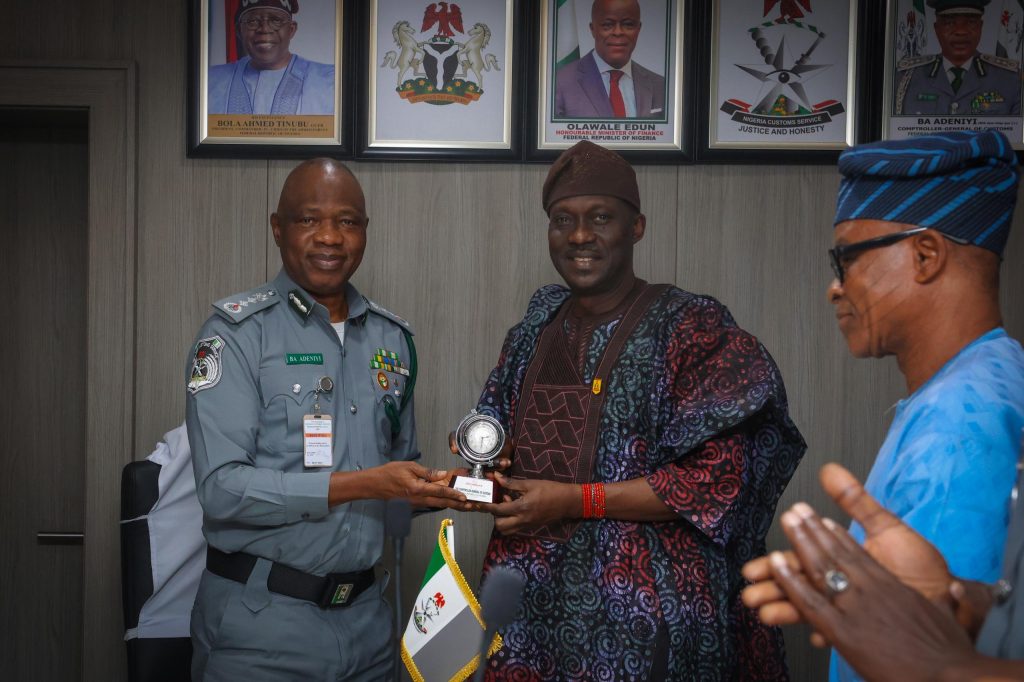
In a significant move to strengthen industrial growth and economic development, the Nigeria Customs Service (NCS) and the Manufacturers Association of Nigeria (MAN) held a high-level strategic consultation today in Abuja.
The meeting followed a directive from the Federal Ministry of Finance regarding the temporary suspension of the 4% Free on Board (FOB) surcharge, creating a platform for broad stakeholder engagement as mandated by the Nigeria Customs Service Act, 2023.
The session featured frank and constructive dialogue on critical issues affecting Nigeria’s manufacturing environment. Both parties reaffirmed their shared commitment to advancing Nigeria’s economic transformation through improved manufacturing performance and enhanced trade facilitation.
Key Outcomes from the Consultation
One of the major announcements from the meeting was the approval of strategic exemptions from the 4% FOB surcharge for several categories of manufacturers. This followed consultations between the NCS and the Honourable Minister of Finance.
The exemptions cover:
- Manufacturers importing raw materials, spares, and machinery under Chapters 98 and 99 of the Customs Tariff.
- MAN members not currently under these chapters will be onboarded to enable access to the exemption.
- The tripartite collaboration between the Federal Ministry of Finance, NCS, and MAN will expedite this onboarding process.
- Any 4% FOB charges already paid by manufacturers awaiting onboarding will be credited for future transactions.
- Exemptions also extend to:
- Government projects with Import Duty Exemption Certificates (IDEC)
- Goods imported for humanitarian and life-saving purposes
- Beneficiaries of the Presidential Initiative on unlocking the healthcare value chain
- Spare parts for commercial airlines
Issues Raised by MAN
The Manufacturers Association identified several pressing challenges impacting industrial operations, including:
- Implementation concerns around the 4% FOB funding model
- Multiple checkpoints hampering trade facilitation
- Redundant alerts within the customs clearance system
- Glitches on the B’Odogwu platform
In response, the NCS detailed its ongoing trade facilitation initiatives, which include:
- Authorised Economic Operator (AEO) scheme
- Advance Ruling system
- Time Release Studies aimed at improving cargo clearance efficiency
The AEO programme, in particular, was lauded by MAN, with a mutual agreement that NCS would issue a clear guideline for participation.
A Shift Towards Modern Trade Infrastructure
Further discussions centered on future-focused initiatives such as:
- Development of a one-stop shop framework to streamline regulatory processes
- Reduction of excessive checkpoints and elimination of unnecessary bottlenecks
- Deployment of digital solutions for real-time clearance and risk assessment
- Strengthened technology partnerships to support seamless trade operations
Institutionalizing Regular Dialogue
To sustain momentum, both organizations agreed to institutionalize regular consultations through:
- Pre-implementation engagement on policy changes
- Real-time feedback mechanisms to assess impact
- Scheduled review meetings to evaluate progress and identify new collaboration areas
A Unified Vision for Economic Transformation
The engagement concluded with a unified commitment from NCS and MAN to support:
- Job creation
- Export promotion
- Import substitution
- Foreign exchange conservation
- Development of industrial clusters
Both institutions emphasized that predictable regulatory environments, underpinned by robust dialogue and innovation, are crucial to sustaining growth.
The Nigeria Customs Service pledged to maintain ongoing consultations with manufacturers, implement technology-driven reforms, and provide regular policy updates. MAN, in turn, committed to supporting regulatory compliance among its members and contributing industry insights to shape effective customs policies.
This engagement marks a renewed partnership between two key institutions, demonstrating that structured collaboration can deliver measurable outcomes for national economic advancement.








News
Eko Electricity blames Lekki-Ajah power outages on feeders disruption
The following feeders are currently out of supply: Ibeju, Ajah Local 1, Medallion Data, Urban Prime, Main One, Maroko, Chevron, Oke-Ira, Ikate Express, Ilasan, NTDA 1, Eleko,” the company said.


Eko Electricity Distribution Plc (EKEDP) has announced a power outage across parts of Lagos, including Lekki, Ajah and Ibeju-Lekki, following a loss of supply affecting 12 feeders.
The affected feeders are Ibeju, Ajah Local 1, Medallion Data, Urban Prime, Main One, Maroko, Chevron, Oke-Ira, Ikate Express, Ilasan, NTDA 1 and Eleko.
In a notice to customers, EKEDP said the VGC, Oke-Ira and Agungi injection substations were also affected by the disruption.
The distribution company attributed the outage to a fault affecting electricity supply within the Lekki, Ajah and Ibeju-Lekki axis.
The following feeders are currently out of supply: Ibeju, Ajah Local 1, Medallion Data, Urban Prime, Main One, Maroko, Chevron, Oke-Ira, Ikate Express, Ilasan, NTDA 1, Eleko,” the company said.
EKEDP said it was working with the Transmission Company of Nigeria (TCN) to restore the affected transformer and reconnect all the impacted feeders.
News
IGP Disu Launches Nigeria Police Force Vigilant App, for Tracking Crimes
” The police cannot be everywhere at the same time, but through technology and partnership with the citizens, we can significantly expand our capability to prevent and respond to crimes,” he noted.

The Inspector-General of Police, IGP Olatunji Disu, has launched the Nigeria Police Force Vigilant App as part of efforts to strengthen public engagement, internal communication and the fight against increasingly sophisticated crimes.
Disu also unveiled MTN Closed User Group (CUG) Network for strengthening communication among police commands, formations, divisions and specialised units nationwide.
Speaking during the launch ceremony in Abuja, IGP Disu said that the changing nature of crime and the speed at which information travels have made it necessary for the police to embrace technology.
The policing environment is changing rapidly. Crime is becoming more sophisticated. Information moves faster, and citizens increasingly expect public institutions to be accessible and respond to technology,”said Disu.
He explained that the Vigilant App was designed to improve communication between the police and members of the public by enhancing information sharing and citizen engagement.
The IGP urged Nigerians to use the platform responsibly to report suspicious activities, provide useful information and seek assistance when necessary .
Disu also charged officers managing the platform to operate with professionalism and integrity, stressing that information received through the system must be handled responsibly, investigated diligently and protected appropriately.
“The police cannot be everywhere at the same time, but through technology and partnership with the citizens, we can significantly expand our capability to prevent and respond to crimes,” he noted.
Disu observed that effective communication often determines the success of operations, emergency responses and investigations.
“In policing, information delayed can be information lost,” the IGP declared.
News
Edo Influential Politician, Daniel Orbih, dies at 64 •Obaseki mourns
Obaseki said Orbih’s contributions to Nigerian politics and the PDP remained significant, particularly during his years of service in Edo.

•Chief Daniel Osi Orbih
Chief Daniel Osi Orbih, a chieftain of the Peoples Democratic Party (PDP) is dead, aged 64.
Orbih, known by his traditional title, the Kulukulu 1 of Ogoni Land and Oduma of Uzairue, reportedly died on Monday, 31st August 2026.
His death was confirmed in a statement issued by his family and signed by Francis Udukhomoi Orbih, Esq., on behalf of the Orbih family.
Orbih was born on the 27th of October, 1961, to Chief and Mrs M.C.K. Orbih of Ogbona in Etsako Central Local Government.
He ventured into politics in 1999, and was the deputy governorship candidate of the All Peoples Party (APP) in Edo State, describing Orbih as a prominent figure and influential voice in Edo politics.
Condolences
Former governor of Edo, Godwin Obaseki, lamented that Orbih ‘s death represents a significant loss to Edo.
Obaseki said Orbih’s contributions to Nigerian politics and the PDP remained significant, particularly during his years of service in Edo.
“For many years, he provided leadership to the Peoples’ Democratic Party (PDP) in Edo State as its State Chairman and subsequently served as the PDP National Vice Chairman, South-South.
“Through these roles, he contributed significantly to the development of the party in the Edo State and Nigeria, ” he said.
He emphasised that the former PDP chairman’s death represented a significant loss to Edo State and Nigeria, while commiserating with his family, friends and political associates.


Uber introduces robotaxi services in London after exiting Nigeria

Entrepreneurship: “How I Made N10m Monthly From Akara Burger” – Gov Eno

Forest Sector Employs 42m People Globally – FAO

Tech Expert, Zuckerberg trains with UFC champions, Adesanya, Alexander

Organ Trafficking: Ekweremadu bags 10 years in UK prison

SAINT OBI: Between his marriage and his death
-

 Business2 days ago
Commercial Banks Borrowing From CBN Drops By 89% in August
-

 Sports3 days ago
Romero Replaces Messi As Argentina’s New Captain
-

 News2 days ago
EFCC Summons Sylva for Questionings
-
 News2 days ago
Olukoyede Sacks 40 EFCC Staff Over Corruption
-

 Business1 day ago
Naira Exchange Rates Wednesday, September 2
-

 Business2 days ago
Naira Exchange Rates Tuesday September 1
-

 Business2 days ago
Dangote, NMDPRA Clash Over Refinery’s Free Zone Status
-

 News2 days ago
Death Toll in Nepal Floods Exceed 1,000