
Business
“We Will Open Africa” — A Conversation with Aliko Dangote
We will open Africa by demonstrating that we believe in Africa, by investing our money in Africa. Because if I don’t invest my own money, I can never go to any conference and convince people that Africa is a good place to come and invest.

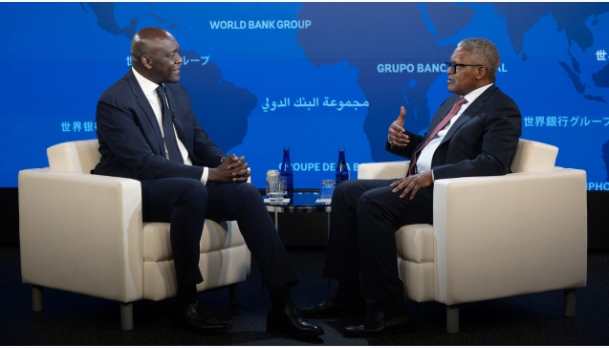
In this conversation with IFC Managing Director, Makhtar Diop, Aliko Dangote, Africa’s leading industrialist, lays out a vision rooted in African-led investment across cement, energy and fertilizer, logistics, agriculture and water.
Excerpt:
Makhtar Diop: Aliko, this is a huge pleasure to have you at IFC. I don’t need to introduce Aliko Dangote, who is the largest investor in the continent, but not only in the continent, but one of the largest investor in the world and has been a transformative industrialist in the continent. We have been working with Aliko Dangote Group. But I want just today to have a conversation about your vision of Africa. Last year, you set up a group called African Renaissance. Tell us, why did you put this group together?
Aliko Dangote: Well, thank you very much Makhtar, I must really thank you for doing a great job. My own vision of Africa – because I sat down one day and I said, okay, fine, everything is about potential, potential, potential.
How do we get this potential into reality? How do you really, you know, make sure we translate our potential to real economic growth. And I said, let me get all the big guys in Africa who really care much about Africa, like-minds, and see how do we really sit down together and craft a vision for Africa.
Because when you look at it, every single thing you know is like, people are just putting roadblock for Africa to not escape our own cage, where we are.
So we set up this group, which I’m very happy that you have accepted to be a member. You know, to say ok fine, you look at Africa today, um, you know, somebody like myself, I need 38 visas to move around. How do I now invest, if I’m not able to move around?
I mean 38 visas? It doesn’t make sense. Nobody has time to go and apply for a visa, take your passport and whatever. And most of them, they don’t do visa on arrival. So we look at that one: free movement of people, free movement of goods and services.
These are critical areas. Without this, there’s no way we are going to have a very prosperous Africa, you know. Because with this I cannot move my goods from Nigeria, from Lagos to Republic of Benin.
And when you try to cross the border, you can be there for a week if you are lucky. If you are not lucky, you don’t know anybody. You’re going to be there for two weeks. There’s no way you can do a trade with your neighbours like this.
Then we look at the sector of transportation. When you look at it, most of the people who own ships that move goods around, they are owned by other nationalities, not Africans. And it costs us, for example, to go from Lagos – I mean port – to Accra, more than coming from Spain to Lagos.
Then you talk about aviation. When you talk about aviation from Lomé to Accra, somebody will charge you $600. How do you move around? People cannot afford this kind of, you know, I mean, $600 is a lot of money.
Makhtar: Yeah but Aliko as usual, you are not taking a lot of credit for what you did. Let me push you a little bit on something. Yes, a lot of people have been talking about these ideas and there is a diagnostic. But the difference is that you’re making it happen.
Aliko: That’s true.
Makhtar: It’s a different story. We all, in our professional careers, have seen a lot of discussion, diagnostics about the problems. But when we come to crossing the line and making it a reality.
Aliko: Delivery is an issue.
Makhtar: You go and did something which is quite amazing. Say, Nigeria now they need to use more value addition on something that it has in abundance, which is oil. And you build a refinery, I understand more than $20 billion. So, how did this big idea came to you? And what were the steps? Because it was the first time you say that, people say, you know, Aliko is just dreaming, its not possible to do that. But you were persistent and did it. Why did you do it?
Aliko: Okay. You see, first of all, when you look at it, Nigeria, you’re right. We have a lot of oil. At one point, we were exporting 2.4 million barrels per day and not processing one barrel. Every single, you know product that we use, whether it’s gas, oil, gasoline, jet fuel, everything is imported.
You know, Makhtar, to tell you the truth, Dangote Refinery was always on the agenda of discussion. Always. And when you hear 650,000 barrels all the trading companies, all the big corporations, they always tell people openly ‘this refinery will never happen’. You know, at the end of the day, fast forward, Makhtar we as an African company, we’ve been able to deliver.
But let me tell you what will surprise you more, because, I mean, I must thank you for IFC taking also a risk on us because you are part of our pool of funding.
And to tell you the truth, at the time when I started this refinery, I have never, ever seen crude oil in my life. Never. Yes, never. I always avoid crude oil because for us in Nigeria, once you say that you are in oil, it’s a dirty business.
And I wanted to do a clean business, so I left the oil. It is just because I’ve seen my country suffering.
I’ve seen that when I look at it, all African countries apart from Algeria and Libya, at that time, when we started – everybody was importing.
Nobody had sufficiency in petroleum products. And I said, no, no, this cannot continue.
You know, we had to establish a company where we did the EPC, which is engineering, procurement and construction.
Every single nut and bolts we bought – we shipped. Ordering of the equipments – we did. We put every single thing together to now achieve that.
And now people have seen the benefit of it. Today the refinery, we have tested the refinery up to 661,000 barrels per day. But we have been now stable for the last two months at 650,000 barrels per day, and every single department is working. So you can see that’s what we have actually done.
And when we look at it, Makhtar we say that okay, fine.
You know, this thing now has removed fears in us. And we’re saying that, you know, for Africa to develop, some of us, we must take that risk in terms of opening up Africa.
How do we open up Africa? We will open Africa by demonstrating that we believe in Africa, by investing our money in Africa. Because if I don’t invest my own money, I can never go to any conference and convince people that Africa is a good place to come and invest.
But right now, I have a voice. Right now I have a mouth to say, hey, come and invest in Africa because I have demonstrated that, look, these things are possible.
“Our own mission in Dangote is to look at critical needs of Africa and make sure that, yes, we make those critical areas a reality. “
Makhtar: I see that you have been very deliberate in supporting African countries.
Aliko: You know, I feel much more satisfied as a human being to now take my continent out of trouble. How do I take my content out of trouble? Because we cannot continue. Every day we import food, we import whatever that we consume.
Okay, so we decided that, look, the best thing that for us to do is to look at what are the needs of Africa. And the needs of Africa is petroleum products, fertilizers. You know, today we are going to be – in about two and a half years – the largest fertilizer company in the world.
We are putting up 12 million tons of urea. We are opening up a mines of potash and phosphate in Congo-Brazzaville. We are now going into power – 20,000MW. We are building the biggest deep sea port of 80m draft.
Okay. We are doing LNG. So why? Because we have now actually freed up our assets and we can actually raise more money.
Our cash flow now is very, very strong. But what do you want to do with all this money. What we are trying to do is to now say, okay, fine. How can African countries and Africans most especially benefit from this?
Our own mission in Dangote is to look at critical needs of Africa and make sure that, yes, we make those critical areas a reality.
Because if you don’t do that, it’s just like now you look at it, how can we in Africa be exporting 80% of the cocoa of the world? Every single cocoa is being shipped in beans. Simple. You process it.
How much would it cost? And if you keep waiting for foreign investors; foreign investors are very smart.
They are not going to come. They will only come when they see our own commitment.
So that’s why for us now. We have also changed because if you look at it, most of our companies we own super majority 89%, 90%, 92%, some 100%.
And we are saying that no, for us to grow up at scale, we need to make sure that we have partnership.
We should also collectively get Africans to buy shares. Like now the refinery we are going to list.
When we list, we are going to ask Africans to do… and we want to de-risk also their own capital. So when we are paying dividend, all our dividends will be in dollars.
And you can choose either you want naira or you want dollars or you want, uh, South African rand, whatever that you need, we will pay. But it is going to be calculated and paid for in dollars.
Credit: IFC


Business
Dangote Refinery’s IPO Ends Tomorrow
“The level of investor interest reflects growing confidence in our business and in the strong financial results we have delivered,” the company said.
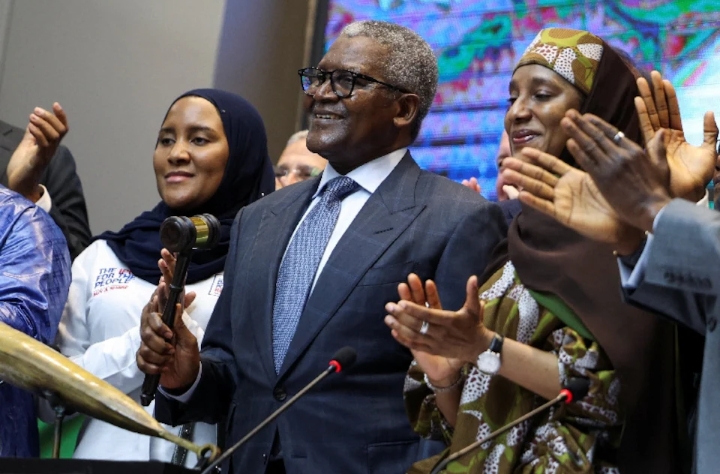
[File photo] Opening ceremony of Dangote Refinery’s IPO on the NGX, September 14,2026
Dangote Petroleum Refinery & Petrochemicals has confirmed that its Initial Public Offering (IPO) will close on Tuesday, 27 October 2026 as scheduled, with no extension.
In a statement, the management said that the IPO has become a historic ownership moment, an opportunity for Africans at home and abroad to own a stake in one of the continent’s most strategic industrial assets.
“Investors recognise that this refinery is not merely an energy asset. It is a platform for industrial growth, foreign-exchange generation, regional trade, energy security and economic development across Africa,” management said.
The offer was structured to ensure ordinary investors participate alongside institutions, broadening ownership of the world-class asset.
“The level of investor interest reflects growing confidence in our business and in the strong financial results we have delivered,” the company said.
Business
Dangote Visit London Stock Exchange Ahead of November Cement Listing
Unlike an initial public offering, a secondary listing would let Dangote Cement, already listed on the Nigerian Exchange, set up an additional presence in London.
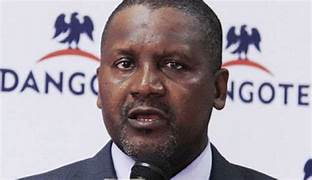
Aliko Dangote visited the London Stock Exchange on Friday, October 23, 2026, as Dangote Cement Plc prepares a proposed $1 billion share sale and a secondary listing in the United Kingdom.
The company is reportedly targeting November 2026 for the listing, subject to market conditions and regulatory approval.
A video circulating on social media captured the visit, with exchange officials and attendees welcoming Africa’s richest man.
The trip is part of efforts to pull international investment into his business empire.
The proposed deal could see Dangote Cement offer about 10% of its equity to international investors, potentially raising roughly $1 billion.
The final timetable is not fixed and remains subject to market conditions and regulatory requirements.
Unlike an initial public offering, a secondary listing would let Dangote Cement, already listed on the Nigerian Exchange, set up an additional presence in London.
That could raise the company’s visibility with international institutional investors, including pension funds, asset managers and other investment firms.
The share sale has not been completed. Its final structure, valuation and pricing are still subject to confirmation.
Business
Olagunju to head JPMorgan’s Proposed Nigerian Merchant Bank
The proposed bank would expand JPMorgan’s presence beyond its representative office in Lagos. It could undertake a broader range of regulated banking activities after securing a final licence.

The Central Bank of Nigeria has granted JPMorgan approval-in-principle to establish a merchant bank in Nigeria.
The regulator also approved Adedapo Adedayo Olagunju as Managing Director of the proposed JPMorgan Merchant Bank Nigeria Limited.
The approval came on Friday, October 23, 2026. The bank has not received its final operating licence.
Olagunju has led JPMorgan’s West African operations since 2018.
He is an Oxford-trained banker with more than two decades of experience in treasury management, financial markets, institutional banking and structured finance.
His appointment puts him in line to head the American bank’s proposed Nigerian merchant bank once final licensing is completed.
The CBN also approved four non-executive directors and three independent non-executive directors for the proposed institution.
The proposed bank would expand JPMorgan’s presence beyond its representative office in Lagos. It could undertake a broader range of regulated banking activities after securing a final licence.


Suffocation, Overcrowding Kill 37 Niger Miners – Panel

Nigeria’s First Imported Ebola Patient Moved to Switzerland

Dangote Refinery’s IPO Ends Tomorrow

BREAKING: Lagos Govt Declares Today, Thursday Work-Free to Mark 2026 Ìṣẹ̀ṣe Day

Tech Expert, Zuckerberg trains with UFC champions, Adesanya, Alexander

Organ Trafficking: Ekweremadu bags 10 years in UK prison
-

 News1 day ago
BREAKING: Former Arise News Anchor, Constance Ikokwu Appointed NDC National Campaign Council Spokesperson
-

 International1 day ago
Brazil’s Lula Wins Fourth Term In Presidential Runoff
-

 Business1 day ago
Naira To Dollar, Pound, Euro…Rate Monday, October 26
-
 Business1 day ago
Dangote Visit London Stock Exchange Ahead of November Cement Listing
-
 Health2 days ago
EBOLA: Lagos Heightens Watch at Airports After Abuja Case
-

 Business2 days ago
History of Naira Revaluation and Devaluation (1973–2026) (Part 2)
-
News1 day ago
Sanwo-Olu: Opebi-Ojota Link Bridge Will Open Before Christmas
-

 Health1 day ago
Ebola: Nigeria Sends Back Swiss Woman Via Medivac Plane