
Business
Dangote Refinery Clarifies Alleged ‘Mass Sack’ in Leaked Memo

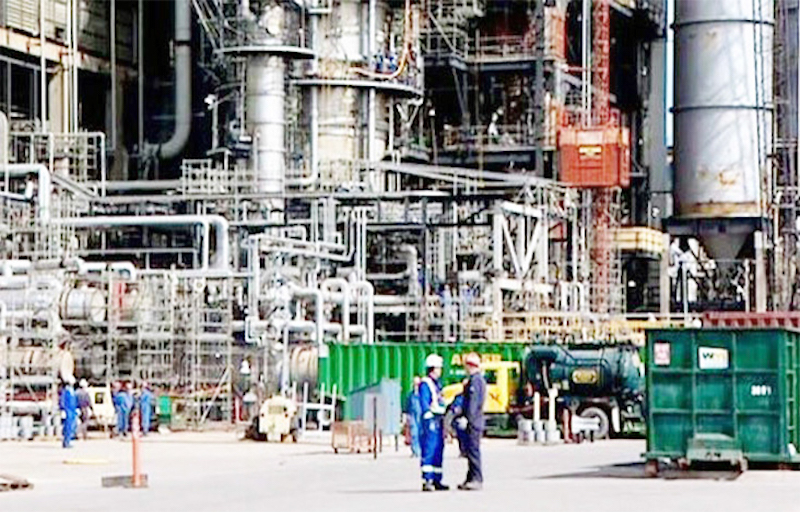
The Dangote Petroleum Refinery has responded to recent reports regarding an ongoing internal reorganisation, clarifying that the move is a strategic response to safeguard the facility from repeated acts of sabotage that have posed serious safety risks and disrupted operations.
In an official statement released on Friday, September 26, the refinery management emphasised that the reorganisation was not arbitrary but driven by the need to protect the integrity and stability of what it described as a “strategic national asset.”
“The decision was taken in the best interest of the refinery,” the company noted, citing intermittent cases of sabotage within various operational units, which it said had endangered lives and impacted operational efficiency.
The company reaffirmed its commitment to the safety of its staff and the continuity of its mission to serve Nigerians and Africa’s broader energy needs.
The statement reads: “The Dangote Petroleum Refinery wishes to clarify recent reports concerning the ongoing reorganisation within its facility. This exercise is not arbitrary. It has become necessary to safeguard the refinery from repeated acts of sabotage that have raised safety concerns and affected operational efficiency.
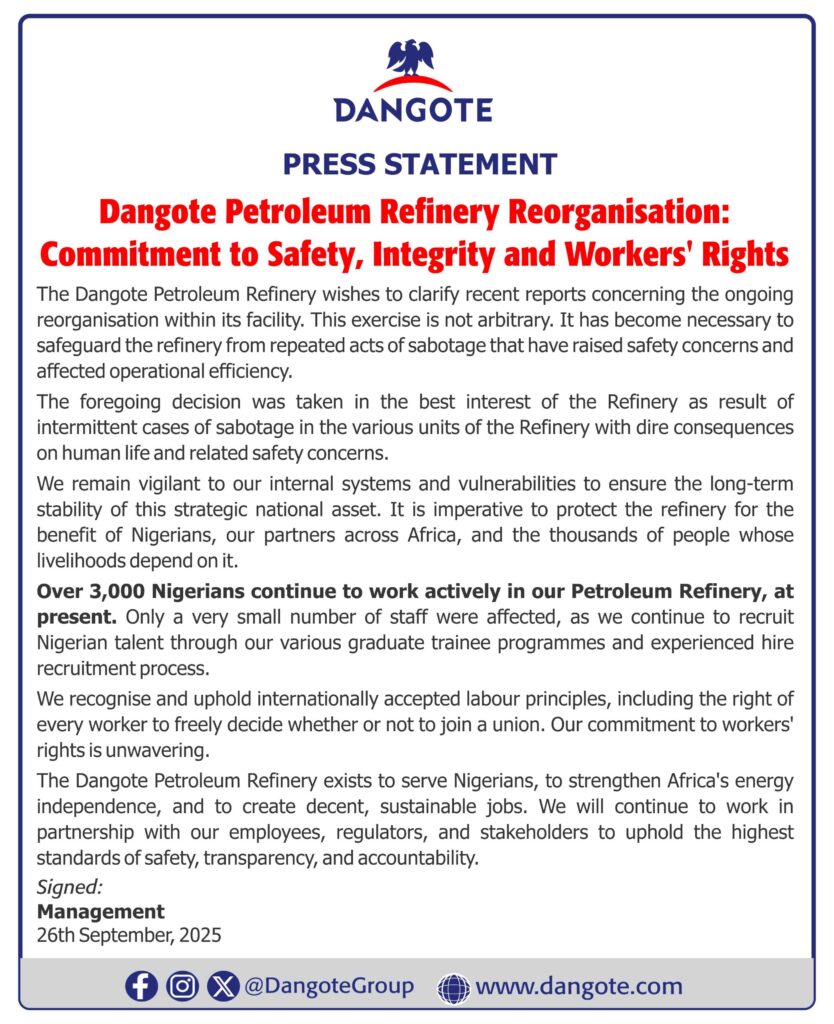
“The foregoing decision was taken in the best interest of the Refinery as result of intermittent cases of sabotage in the various units of the Refinery with dire consequences on human life and related safety concerns.
“We remain vigilant to our internal systems and vulnerabilities to ensure the long-term stability of this strategic national asset. It is imperative to protect the refinery for the benefit of Nigerians, our partners across Africa, and the thousands of people whose livelihoods depend on it.
“Over 3,000 Nigerians continue to work actively in our Petroleum Refinery, at present. Only a very small number of staff were affected, as we continue to recruit Nigerian talent through our various graduate trainee programmes and experienced hire recruitment process.
“We recognise and uphold internationally accepted labour principles, including the right of every worker to freely decide whether or not to join a union. Our commitment to workers’ rights is unwavering.
“The Dangote Petroleum Refinery exists to serve Nigerians, to strengthen Africa’s energy independence, and to create decent, sustainable jobs. We will continue to work in partnership with our employees, regulators, and stakeholders to uphold the highest standards of safety, transparency, and accountability.”







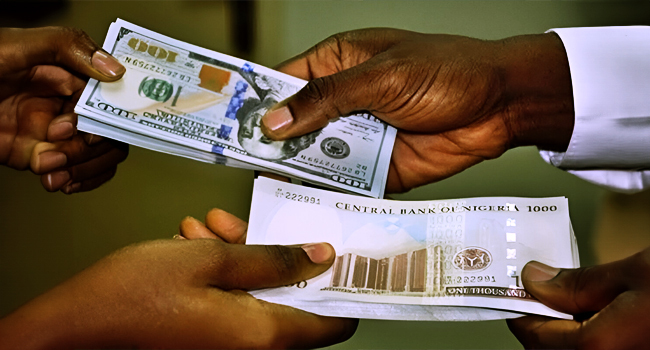
BLACK/ PARALLEL MARKET RATES
₦1370 DOLLAR (USD)
₦1800 POUND (GBP)
₦1510 EURO (EUR)
₦970 CANADIAN DOLLAR (CAD)
₦65 SOUTH AFRICAN RAND (ZAR)
₦350 UAE DIRHAM (AED)
₦190 CHINESE YUAN (CNY)
₦100 GHANAIAN CEDI (GHS)
₦2300 WEST AFRICAN CFA F.(XOF)
₦2200 CENTRAL AFRICAN CFA F.(XAF)
₦850 AUSTRALIAN DOLLAR AUSSIE (AUD)
CBN OFFICIAL RATES
DOLLAR (USD)₦1331.61
POUND (GBP)₦1764.26
EURO (EUR)₦1490.48
SWISS FRANC (CHF)₦1608.23
JAPANESE YEN (JPN)₦8.4
CFA FRANC (XOF)₦2.27
WEST AFRICAN UNIT OF ACCOUNT (WAUA)₦1802.33
CHINESE YUAN (CNY)₦199.01
SAUDI RIYAL (SAR)₦354.83
SOUTH AFRICAN RAND (ZAR)₦80.49
Business
WEF could appoint Lagarde as its next chair, sources say
The WEF’s Board of Trustees, which includes Lagarde herself, was due to meet on November 2 and could elect her as its next chair, said the people close to the organisation, who spoke on condition of anonymity due to the sensitivity of the matter.

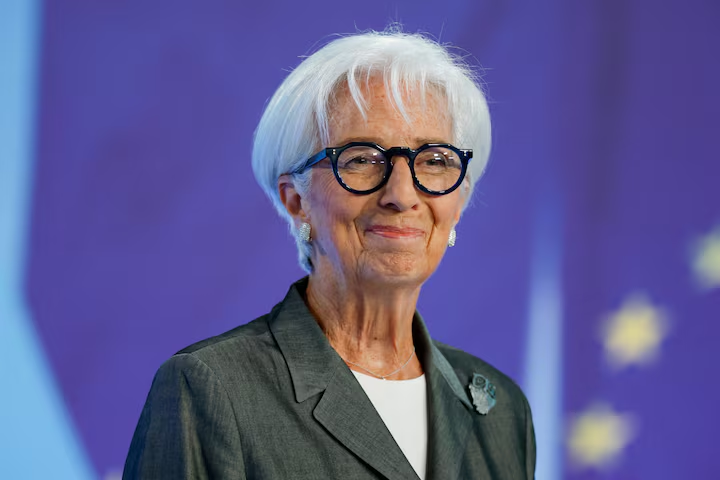
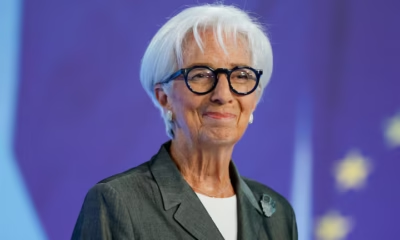
•European Central Bank President Christine Lagarde
The World Economic Forum could appoint Christine Lagarde as its next chair as soon as next month, four people close to the organisation told Reuters, meaning she would step down early as European Central Bank chief and trigger a wider reshuffle at the top of the ECB.Lagarde’s ECB term is scheduled to end in October 2027.
Leaving early would give European Union leaders a chance to pick a new ECB President before France’s spring presidential election, which opinion polls suggest the far-right could win, and could pave the way for a deal involving two other senior ECB roles.
The WEF’s Board of Trustees, which includes Lagarde herself, was due to meet on November 2 and could elect her as its next chair, said the people close to the organisation, who spoke on condition of anonymity due to the sensitivity of the matter.
No final decision has been taken yet, they said.
A spokesperson for the WEF said the forum could not confirm when the next full Board of Trustees meeting would take place, but that the aim was to hold one before the end of the year.
Business
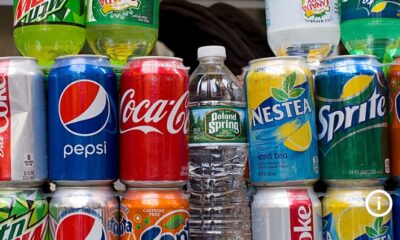
Germany plans tax on sugary drinks
The tax is expected to generate additional revenue for the federal government of €690 million in 2027 and €925 million in 2028.
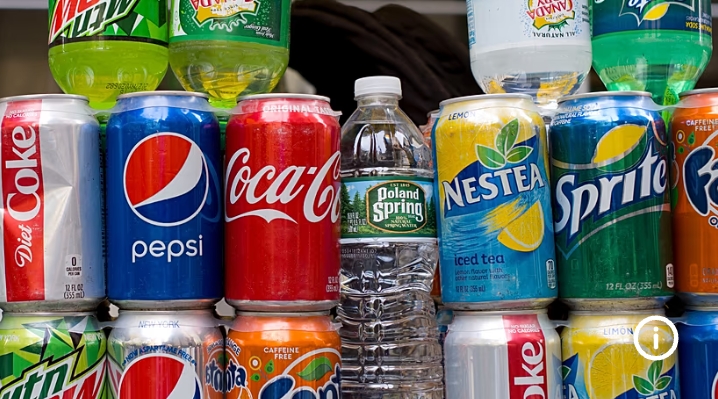
The German cabinet has approved draft legislation to tax sugary drinks in Europe’s biggest economy.
If passed by the German Bundestag, the tax will take effect on 1 July 2027.
The coalition aims to raise revenue for the federal budget while encouraging manufacturers to reduce sugar content and offer healthier products.
The levy is intended to ease pressure on the healthcare system, which faces costs of more than €2 billion every year linked to the high consumption of sugary drinks, which contributes to obesity, diabetes and tooth decay.
According to the federal government, Berlin is using the tax to implement “what associations from the fields of health, science, child protection, and consumer protection have long been demanding.”
The tax is expected to generate additional revenue for the federal government of €690 million in 2027 and €925 million in 2028.


JUST IN: Mob Sets BRT Bus Ablaze After Motorcyclist’s Death in Lagos

BREAKING: DSS Arrests Fugitive Maina Son, Hands Him to EFCC

BREAKING: 5 Arrested Over Imo NYSC Abduction

BREAKING: Lagos Govt Declares Today, Thursday Work-Free to Mark 2026 Ìṣẹ̀ṣe Day

Tech Expert, Zuckerberg trains with UFC champions, Adesanya, Alexander

Organ Trafficking: Ekweremadu bags 10 years in UK prison
-
 Business3 days ago
Naira Exchange Rates For Thursday, October 15
-
 Sports3 days ago
CAF Increases Annual Funding for Member Federations to $700,000
-

 News2 days ago
ASCON To Be Rebranded “National School Of Government”
-
 Business2 days ago
Germany plans tax on sugary drinks
-
 Business2 days ago
WEF could appoint Lagarde as its next chair, sources say
-

 International2 days ago
“Mother of all bombs,” Trump Plans To Hit Iran
-
 Business2 days ago
Naira Exchange Rates Friday, October 16
-
 Crime1 day ago
BREAKING: 5 Arrested Over Imo NYSC Abduction