Connect with us

Business

Dangote to flood Nigerian markets with 1 million metric tons of paddy rice

Construction of the 32 metric tonnes per hour Dangote Rice Mill, being developed on a 30-hectare site in Wushishi, is progressing steadily and is on track for completion.

Published

on

21 Views

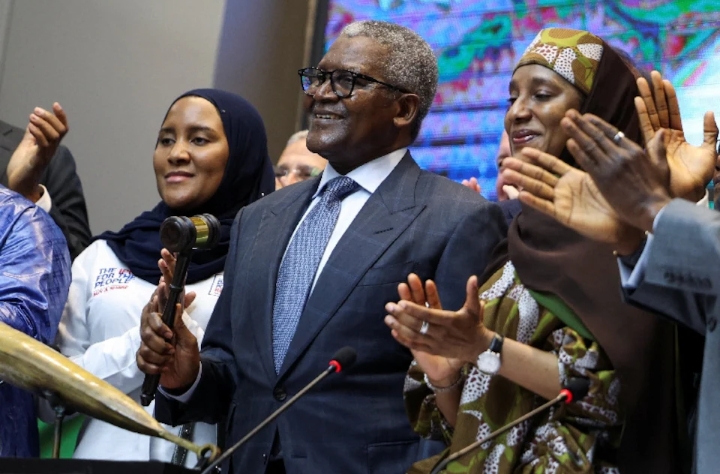
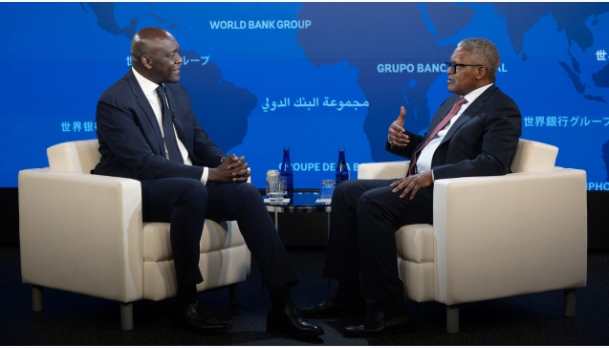
Aliko Dangote in a conversation with IFC MD/CEO, Maktar Diop

Dangote Rice Limited had signed a Memorandum of Understanding with the Niger State government for the production and supply of 1 million metric tons of paddy rice over the next 10 years.

This was disclosed in a statement by the Dangote Industries Limited’s Group Chief Branding and Communication Officer, Anthony Chiejina, stating that the company is collaborating with the Niger State government on several economic initiatives to boost food sufficiency in Nigeria.

The statement quoted the Regional Director and Senior Adviser to the President and Chief Executive of the Dangote Group, Fatima Wali-Abdurrahman, as saying that construction of the company’s rice mill in Niger State was progressing.

“Construction of the 32 metric tonnes per hour Dangote Rice Mill, being developed on a 30-hectare site in Wushishi, is progressing steadily and is on track for completion.

This landmark project represents a significant step forward in bolstering the food security initiatives of the state,” she said.

Wali-Abdurrahman emphasised that upon its delivery, the mill is expected to enhance local rice production, create employment opportunities, and contribute to the agricultural development of Nigeria.

Earlier, Africa’s billionaire industrialist, Aliko Dangote, the President of Dangote Group, told Makar Diop IFC MD/CEO, that to create more jobs and prosperity is to do agriculture. With agriculture, we’ll get to maybe 200,000 jobs. And that’s what will really give me self-satisfaction.

Continue Reading
Click to comment

Leave a Reply

Your email address will not be published. Required fields are marked *

Business

What President Tinubu Tells World Leaders At Nairobi’s Summit

“Every single dollar that leaves our treasury to pay punitive interest rates is a dollar that did not go into our steel sector, textile mills, agro-processing plants or digital industries,” the President stated.

Published

on

By

10 Views

President Bola Tinubu has called for a major shift in Africa’s economic structure, insisting that the continent must stop exporting raw materials and start building industries capable of competing globally.

Tinubu spoke on Tuesday at the Africa Forward Summit in Nairobi, Kenya, where he led Nigeria’s delegation of top government officials and private sector leaders to discussions on industrialisation, trade and economic development across Africa.

The President said Africa’s continued dependence on exporting crude oil, minerals and agricultural commodities while importing finished products was damaging local industries and slowing economic growth.

“We export raw minerals, crude oil and agricultural commodities, and we import processed goods at a premium.

This pattern is not an accident. It is the product of a global financial architecture that starves our industries of affordable capital,” Tinubu said.

He argued that African countries still face unfair borrowing conditions despite implementing difficult economic reforms aimed at stabilising their economies and attracting investment.

According to him, Nigeria’s recent reforms, including fuel subsidy removal, exchange rate unification and banking recapitalisation, were necessary steps taken to reposition the economy for long-term growth.

“Every single dollar that leaves our treasury to pay punitive interest rates is a dollar that did not go into our steel sector, textile mills, agro-processing plants or digital industries,” the President stated.

Tinubu also used the summit to promote Nigeria’s maritime and blue economy potential, pledging stronger regional cooperation through the country’s Deep Blue Project to improve security in the Gulf of Guinea.

“Secure sea lanes, predictable regulation and functional courts are the preconditions that unlock private capital.

Nigeria is ready to work with other Gulf of Guinea states through shared maritime intelligence and coordinated enforcement,” he said.

Continue Reading

Business

France Mobilises €23bn Private Capital For Investments In Africa

Nigeria’s President Bola Tinubu participated in the gathering, which observers described as a major diplomatic and economic engagement aimed at deepening Africa-France cooperation.

Published

on

By

9 Views

•Photo: French President Emmanuel Macron attends the Africa Forward Summit 2026 at the Kenyatta International Convention Centre (KICC), in Nairobi, Kenya, May 12, 2026. REUTERS/Monicah Mwangi.

French President Emmanuel Macron said yesterday France had ‌mobilised €23 billion ($27.01 billion) during the African Forward Summit in Nairobi for investments in Africa, to develop new partnerships in Africa after seeing its influence fade in former colonies in West Africa.

More than 30 African leaders, as well as heads of multilateral financial institutions and business executives from across Africa and France, are attending the Nairobi summit, the first France has held in an English-speaking country.

Macron said that rather than African leaders borrowing to fund infrastructure development, he supported creating a first-loss guarantee mechanism to de-risk investments on the continent and would lobby for the idea at the G7 summit next month.

The summit, co-hosted by France and Kenya, has brought together more than 30 African heads of state, global investors, financial institutions and development partners to discuss issues ranging from climate financing and energy transition to digital transformation and industrial growth.

Nigeria’s President Bola Tinubu participated in the gathering, which observers described as a major diplomatic and economic engagement aimed at deepening Africa-France cooperation.

U.N. Secretary-General Antonio Guterres noted that African countries face borrowing costs that are twice as high on average as advanced industrialized economies.”That is not a market verdict on Africa. It is a verdict ⁠on the injustices of the system,” he told the summit.

Decrying what they say are biases against them that overstate the continent’s risk, African governments have called for changes to the methodologies used by credit ratings agencies.

Major agencies including S&P Global Ratings, Moody’s and Fitch reject ⁠accusations of regional bias, saying their ratings are based on globally applied, publicly disclosed criteria.

Continue Reading

Business

“We Will Open Africa” — A Conversation with Aliko Dangote

We will open Africa by demonstrating that we believe in Africa, by investing our money in Africa. Because if I don’t invest my own money, I can never go to any conference and convince people that Africa is a good place to come and invest.

Published

on

By

38 Views

In this conversation with IFC Managing Director, Makhtar Diop, Aliko Dangote, Africa’s leading industrialist, lays out a vision rooted in African-led investment across cement, energy and fertilizer, logistics, agriculture and water.

Excerpt:

Makhtar Diop: Aliko, this is a huge pleasure to have you at IFC. I don’t need to introduce Aliko Dangote, who is the largest investor in the continent, but not only in the continent, but one of the largest investor in the world and has been a transformative industrialist in the continent. We have been working with Aliko Dangote Group. But I want just today to have a conversation about your vision of Africa. Last year, you set up a group called African Renaissance. Tell us, why did you put this group together?

Aliko Dangote: Well, thank you very much Makhtar, I must really thank you for doing a great job. My own vision of Africa – because I sat down one day and I said, okay, fine, everything is about potential, potential, potential.

How do we get this potential into reality? How do you really, you know, make sure we translate our potential to real economic growth. And I said, let me get all the big guys in Africa who really care much about Africa, like-minds, and see how do we really sit down together and craft a vision for Africa.

Because when you look at it, every single thing you know is like, people are just putting roadblock for Africa to not escape our own cage, where we are.

So we set up this group, which I’m very happy that you have accepted to be a member. You know, to say ok fine, you look at Africa today, um, you know, somebody like myself, I need 38 visas to move around. How do I now invest, if I’m not able to move around?

I mean 38 visas? It doesn’t make sense. Nobody has time to go and apply for a visa, take your passport and whatever. And most of them, they don’t do visa on arrival. So we look at that one: free movement of people, free movement of goods and services.

These are critical areas. Without this, there’s no way we are going to have a very prosperous Africa, you know. Because with this I cannot move my goods from Nigeria, from Lagos to Republic of Benin.

And when you try to cross the border, you can be there for a week if you are lucky. If you are not lucky, you don’t know anybody. You’re going to be there for two weeks. There’s no way you can do a trade with your neighbours like this.

Then we look at the sector of transportation. When you look at it, most of the people who own ships that move goods around, they are owned by other nationalities, not Africans. And it costs us, for example, to go from Lagos – I mean port – to Accra, more than coming from Spain to Lagos.

Then you talk about aviation. When you talk about aviation from Lomé to Accra, somebody will charge you $600. How do you move around? People cannot afford this kind of, you know, I mean, $600 is a lot of money.

Makhtar: Yeah but Aliko as usual, you are not taking a lot of credit for what you did. Let me push you a little bit on something. Yes, a lot of people have been talking about these ideas and there is a diagnostic. But the difference is that you’re making it happen.

Aliko: That’s true.

Makhtar: It’s a different story. We all, in our professional careers, have seen a lot of discussion, diagnostics about the problems. But when we come to crossing the line and making it a reality.

Aliko: Delivery is an issue.

Makhtar: You go and did something which is quite amazing. Say, Nigeria now they need to use more value addition on something that it has in abundance, which is oil. And you build a refinery, I understand more than $20 billion. So, how did this big idea came to you? And what were the steps? Because it was the first time you say that, people say, you know, Aliko is just dreaming, its not possible to do that. But you were persistent and did it. Why did you do it?

Aliko: Okay. You see, first of all, when you look at it, Nigeria, you’re right. We have a lot of oil. At one point, we were exporting 2.4 million barrels per day and not processing one barrel. Every single, you know product that we use, whether it’s gas, oil, gasoline, jet fuel, everything is imported.

You know, Makhtar, to tell you the truth, Dangote Refinery was always on the agenda of discussion. Always. And when you hear 650,000 barrels all the trading companies, all the big corporations, they always tell people openly ‘this refinery will never happen’. You know, at the end of the day, fast forward, Makhtar we as an African company, we’ve been able to deliver.

But let me tell you what will surprise you more, because, I mean, I must thank you for IFC taking also a risk on us because you are part of our pool of funding.

And to tell you the truth, at the time when I started this refinery, I have never, ever seen crude oil in my life. Never. Yes, never. I always avoid crude oil because for us in Nigeria, once you say that you are in oil, it’s a dirty business.

And I wanted to do a clean business, so I left the oil. It is just because I’ve seen my country suffering.

I’ve seen that when I look at it, all African countries apart from Algeria and Libya, at that time, when we started – everybody was importing.

Nobody had sufficiency in petroleum products. And I said, no, no, this cannot continue.

You know, we had to establish a company where we did the EPC, which is engineering, procurement and construction.

Every single nut and bolts we bought – we shipped. Ordering of the equipments – we did. We put every single thing together to now achieve that.

And now people have seen the benefit of it. Today the refinery, we have tested the refinery up to 661,000 barrels per day. But we have been now stable for the last two months at 650,000 barrels per day, and every single department is working. So you can see that’s what we have actually done.

And when we look at it, Makhtar we say that okay, fine.

You know, this thing now has removed fears in us. And we’re saying that, you know, for Africa to develop, some of us, we must take that risk in terms of opening up Africa.

How do we open up Africa? We will open Africa by demonstrating that we believe in Africa, by investing our money in Africa. Because if I don’t invest my own money, I can never go to any conference and convince people that Africa is a good place to come and invest.

But right now, I have a voice. Right now I have a mouth to say, hey, come and invest in Africa because I have demonstrated that, look, these things are possible.

“Our own mission in Dangote is to look at critical needs of Africa and make sure that, yes, we make those critical areas a reality. “

Makhtar: I see that you have been very deliberate in supporting African countries.

Aliko: You know, I feel much more satisfied as a human being to now take my continent out of trouble. How do I take my content out of trouble? Because we cannot continue. Every day we import food, we import whatever that we consume.

Okay, so we decided that, look, the best thing that for us to do is to look at what are the needs of Africa. And the needs of Africa is petroleum products, fertilizers. You know, today we are going to be – in about two and a half years – the largest fertilizer company in the world.

We are putting up 12 million tons of urea. We are opening up a mines of potash and phosphate in Congo-Brazzaville. We are now going into power – 20,000MW. We are building the biggest deep sea port of 80m draft.

Okay. We are doing LNG. So why? Because we have now actually freed up our assets and we can actually raise more money.

Our cash flow now is very, very strong. But what do you want to do with all this money. What we are trying to do is to now say, okay, fine. How can African countries and Africans most especially benefit from this?

Our own mission in Dangote is to look at critical needs of Africa and make sure that, yes, we make those critical areas a reality.

Because if you don’t do that, it’s just like now you look at it, how can we in Africa be exporting 80% of the cocoa of the world? Every single cocoa is being shipped in beans. Simple. You process it.

How much would it cost? And if you keep waiting for foreign investors; foreign investors are very smart.

They are not going to come. They will only come when they see our own commitment.

So that’s why for us now. We have also changed because if you look at it, most of our companies we own super majority 89%, 90%, 92%, some 100%.

And we are saying that no, for us to grow up at scale, we need to make sure that we have partnership.

We should also collectively get Africans to buy shares. Like now the refinery we are going to list.

When we list, we are going to ask Africans to do… and we want to de-risk also their own capital. So when we are paying dividend, all our dividends will be in dollars.

And you can choose either you want naira or you want dollars or you want, uh, South African rand, whatever that you need, we will pay. But it is going to be calculated and paid for in dollars.

Credit: IFC

Continue Reading

Trending