
Business
Nigeria, Brazil rejig strategic alliance to boost trade, clean energy, agric, others at business forum


VP Shettima: We’re Undergoing Quiet But Bold Transformation Under President Tinubu
The Vice President, Senator Kashim Shettima, has said Nigeria is currently witnessing a silent but resolute transformation under the administration of President Bola Ahmed Tinubu.
This is coming just as Nigeria and the Federative Republic of Brazil have tweaked their strategic alliance to advance economic development in key sectors, including agriculture, food security infrastructure, clean energy, trade and industry, among others.
In a press release signed by Stanley Nkwocha, Senior Special Assistant to The President on Media & Communications, (Office of The Vice President), Senator Shettima spoke on Wednesday during the Nigeria–Brazil Business Forum tagged, “Roots to Revenue: The Nigeria–Brazil Corridor”, on day three of the Nigeria–Brazil Strategic Dialogue Mechanism (SDM), in Abuja.
He said: “the renewed strategic alliance with Brazil is grounded in intent, and rich in the potential for mutual growth”.
According to him, Brazil’s journey, especially the strides in agriculture, energy, infrastructure and industrial development, speaks to ongoing transformation in Nigeria, and reflects “what is possible when technical capacity is matched with national determination.
“These are the same areas where Nigeria is making bold moves. Under the leadership of His Excellency, President Bola Ahmed Tinubu, GCFR, Nigeria is undergoing a quiet but resolute transformation.
Markets are being opened. Institutions are being rebuilt. Policies are being refocused.
“And what drives these changes is a seriousness of purpose that goes beyond reform for reform’s sake. What we seek are partners who see our direction, who respect our ambition, and who are prepared to walk the path with us,” he stated.
Underscoring the need for the strategic alliance with Brazil, VP Shettima noted that Nigeria is embarking on a journey similar to that of the South American country, particularly in agriculture, as well as the transformation through sustained investment in research, modernisation and support for farmers.
His words: “Our Special Agro-Industrial Processing Zones are taking form. Our farmers are ready to operate at scale. But we know the difference between going alone and going far. Brazil can stand with us in this effort, not as a donor, but as a partner in innovation, in training and in investment.
“We are equally attentive to your leadership in clean energy. Nigeria’s energy transition is rooted in what we can control. We are harnessing our gas reserves to power our industries and transportation, while also advancing our renewable energy ambitions.
Brazil’s example provides guidance that is real and tested.
“We are eager to learn from your experience in building an energy economy that creates jobs, supports industries and expands access to rural communities.
Our teams are ready to engage on how to move from policy to practice, from ideas to infrastructure.
“The Nigerian Vice President further disclosed that Nigeria is encouraged by Brazil’s interest in skills development and human capital, saying it aligns perfectly with one of the most pressing national goals, which is to ensure that the youthful country is prepared for future demands.
“We welcome the opportunity for institutional partnerships that promote training, research and the exchange of knowledge in sectors where Brazil has built strength, and in areas where Nigeria is gaining ground,” he added.
Earlier, the Vice President of Brazil, H.E. Geraldo Alckmin, reaffirmed Brazil’s commitment to strengthening bilateral relations with Nigeria through long-term cooperation, shared innovation, and mutual economic growth.VP Alckmin described the moment as “one of the most promising” in the history of Nigeria-Brazil diplomatic and commercial relations.
“This is a necessary complement to deepen our relationship. We want this moment to correspond to the production of sustainable partnerships for our people,” he declared.
Highlighting the potential in key sectors such as agriculture, defence, innovation, and energy, Alckmin acknowledged that despite the strong historic and cultural ties, trade volumes between both countries are still much lower than the potential.
“Our trade is growing, but it can increase tremendously. Brazil is ready to work with Nigeria to build a commercially successful South-South corridor,” he stated.
He also spoke on the Green Imperative Initiative (GPI), a $1.1 billion programme to transfer Brazilian agricultural technology to Nigeria, as a model of transformative South-South cooperation.
“Brazil does not just export products, but solutions and ideas,” Alckmin said, adding that under President Lula’s administration, Brazil has simplified its tax regime and is exploring a direct flight route to Nigeria to ease business travel and trade.
On Nigeria’s side, the Minister of Industry, Trade and Investment, Dr Jumoke Oduwole, called for a reset in the bilateral trade dynamic, lamenting the current $2 billion trade volume, down from $9 billion a decade ago.
“The Nigeria-Brazil corridor is not a nostalgic idea; it is realistic and achievable. Let us walk the talk and ensure our deliberations yield results,” she urged.
Dr Oduwole outlined Nigeria’s priority sectors for investment, including agro-industrial value chains, digital trade, the creative economy, and pharmaceuticals.
She also revealed efforts by the Nigerian government to streamline investor engagement through a digital portal tracking live project pipelines.
“We are serious about institutional delivery. Our agencies—NEPC, NIPC, PEBEC, NASENI—are working as one team,” she noted.
Also speaking, Director General of the Presidential Enabling Business Environment Council (PEBEC), Princess Zarah Mustapha, emphasised state-level reforms as critical to unlocking sub-national investments.
At the same time, NIPC’s representative, Mrs Victoria Aigbedion, reiterated Nigeria’s commitment to creating a regulatory climate attractive to investors, especially in mining, infrastructure, creative industries, and logistics.
Members of the Brazilian business delegation who spoke at the forum expressed enthusiasm about Nigeria’s investment landscape and long-term investment possibilities.



Business
Dangote Refinery’s IPO Ends Tomorrow
“The level of investor interest reflects growing confidence in our business and in the strong financial results we have delivered,” the company said.

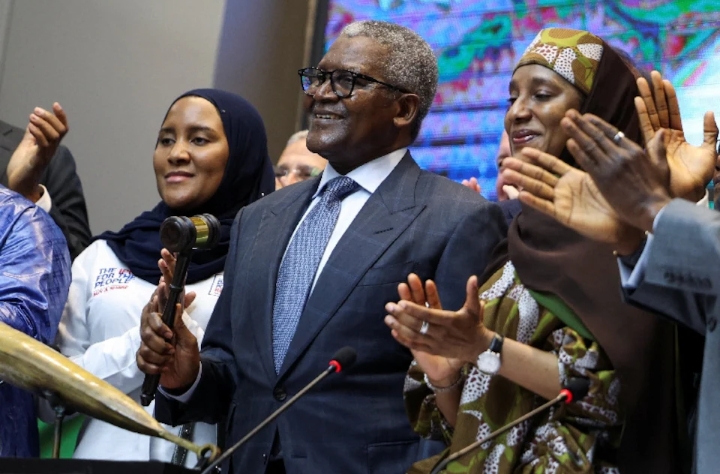
[File photo] Opening ceremony of Dangote Refinery’s IPO on the NGX, September 14,2026
Dangote Petroleum Refinery & Petrochemicals has confirmed that its Initial Public Offering (IPO) will close on Tuesday, 27 October 2026 as scheduled, with no extension.
In a statement, the management said that the IPO has become a historic ownership moment, an opportunity for Africans at home and abroad to own a stake in one of the continent’s most strategic industrial assets.
“Investors recognise that this refinery is not merely an energy asset. It is a platform for industrial growth, foreign-exchange generation, regional trade, energy security and economic development across Africa,” management said.
The offer was structured to ensure ordinary investors participate alongside institutions, broadening ownership of the world-class asset.
“The level of investor interest reflects growing confidence in our business and in the strong financial results we have delivered,” the company said.
Business
Dangote Visit London Stock Exchange Ahead of November Cement Listing
Unlike an initial public offering, a secondary listing would let Dangote Cement, already listed on the Nigerian Exchange, set up an additional presence in London.
Aliko Dangote visited the London Stock Exchange on Friday, October 23, 2026, as Dangote Cement Plc prepares a proposed $1 billion share sale and a secondary listing in the United Kingdom.
The company is reportedly targeting November 2026 for the listing, subject to market conditions and regulatory approval.
A video circulating on social media captured the visit, with exchange officials and attendees welcoming Africa’s richest man.
The trip is part of efforts to pull international investment into his business empire.
The proposed deal could see Dangote Cement offer about 10% of its equity to international investors, potentially raising roughly $1 billion.
The final timetable is not fixed and remains subject to market conditions and regulatory requirements.
Unlike an initial public offering, a secondary listing would let Dangote Cement, already listed on the Nigerian Exchange, set up an additional presence in London.
That could raise the company’s visibility with international institutional investors, including pension funds, asset managers and other investment firms.
The share sale has not been completed. Its final structure, valuation and pricing are still subject to confirmation.
Business
Olagunju to head JPMorgan’s Proposed Nigerian Merchant Bank
The proposed bank would expand JPMorgan’s presence beyond its representative office in Lagos. It could undertake a broader range of regulated banking activities after securing a final licence.

The Central Bank of Nigeria has granted JPMorgan approval-in-principle to establish a merchant bank in Nigeria.
The regulator also approved Adedapo Adedayo Olagunju as Managing Director of the proposed JPMorgan Merchant Bank Nigeria Limited.
The approval came on Friday, October 23, 2026. The bank has not received its final operating licence.
Olagunju has led JPMorgan’s West African operations since 2018.
He is an Oxford-trained banker with more than two decades of experience in treasury management, financial markets, institutional banking and structured finance.
His appointment puts him in line to head the American bank’s proposed Nigerian merchant bank once final licensing is completed.
The CBN also approved four non-executive directors and three independent non-executive directors for the proposed institution.
The proposed bank would expand JPMorgan’s presence beyond its representative office in Lagos. It could undertake a broader range of regulated banking activities after securing a final licence.


Suffocation, Overcrowding Kill 37 Niger Miners – Panel

Nigeria’s First Imported Ebola Patient Moved to Switzerland

Dangote Refinery’s IPO Ends Tomorrow

BREAKING: Lagos Govt Declares Today, Thursday Work-Free to Mark 2026 Ìṣẹ̀ṣe Day

Tech Expert, Zuckerberg trains with UFC champions, Adesanya, Alexander

Organ Trafficking: Ekweremadu bags 10 years in UK prison
-

 News1 day ago
BREAKING: Former Arise News Anchor, Constance Ikokwu Appointed NDC National Campaign Council Spokesperson
-
 Business1 day ago
Dangote Visit London Stock Exchange Ahead of November Cement Listing
-
 Health2 days ago
EBOLA: Lagos Heightens Watch at Airports After Abuja Case
-
 Business1 day ago
Naira To Dollar, Pound, Euro…Rate Monday, October 26
-

 International1 day ago
Brazil’s Lula Wins Fourth Term In Presidential Runoff
-
 Business2 days ago
History of Naira Revaluation and Devaluation (1973–2026) (Part 2)
-
News1 day ago
Sanwo-Olu: Opebi-Ojota Link Bridge Will Open Before Christmas
-

 Health1 day ago
Ebola: Nigeria Sends Back Swiss Woman Via Medivac Plane