
News
Killings: Shettima visits Plateau today, Danjuma calls for self-defence


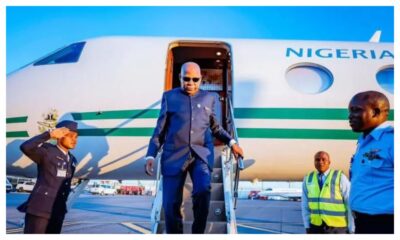
Amid renewed violence in Plateau and Benue states that has claimed over 100 lives in recent weeks, Vice President Kashim Shettima is expected to visit Plateau State today (Monday) as part of federal efforts to stem the tide of attacks and foster lasting peace.
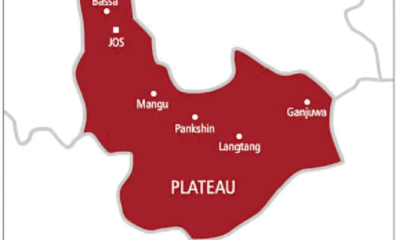
The visit comes days after gunmen launched deadly attacks on Bokkos and Bassa communities in Plateau, attracting public outrage and deepening calls for urgent government intervention.
Confirming the Vice President’s visit, the Minister of Humanitarian Affairs and Poverty Reduction, Dr. Nentawe Yilwatda, disclosed during a tour of affected communities in Bassa on Saturday that Shettima’s visit was directed by President Bola Tinubu himself.
“Mr. President is deeply concerned about these killings. That is why the National Security Adviser was here last week, and now the Vice President is coming to engage stakeholders directly,” Yilwatda stated.
During his visit, Shettima is expected to convene a high-level stakeholders’ meeting aimed at enhancing security coordination and strengthening local peace initiatives.
The Minister of Defence, Mohammed Badaru, who also visited the communities with top military commanders, including Maj. Gen. Folusho Oyinlola, assured residents of the Federal Government’s commitment to justice and security.
“We are investigating seriously. We are on the trail of the perpetrators and, by God’s grace, they will be brought to justice,” Badaru said.
“Support programmes for victims, especially widows, have also been launched, and more help will come to ease their pain,” he added.
Meanwhile, a former Minister of Defence, Lt. Gen. Theophilus Danjuma (retd.), has once again called on Nigerians to rise and defend themselves.
Speaking at a public function in his hometown, Takum, Taraba State, Danjuma reiterated a warning he gave five years ago, arguing that relying solely on government security forces is no longer realistic.
“The warning I gave years ago remains valid. Nigerians must rise and defend themselves before these bandits overrun the entire country,” he said.
Danjuma expressed sorrow over the ongoing killings in Benue and Plateau states, describing them as evidence of the government’s failure to secure the lives and property of its citizens.
“We must be proactive. We cannot continue to watch helplessly while our people are massacred. Enough is enough,” he stressed.
Also, the Plateau Youth Council, Northern Zone, condemned the attacks as deliberate and genocidal, rather than communal clashes as claimed by federal officials.
Addressing journalists in Jos, PYC Northern Coordinator, Samson Chiroma, said, “These are not random clashes. These are systematic attempts to displace our people, coinciding with the beginning of the wet farming season.
This is genocide, plain and simple.”Chiroma accused Fulani militias of carrying out the attacks and faulted the Federal Government’s response as inadequate and detached from reality.
“If the authorities are serious about stopping these killings, they must start by arresting those making inciting statements. Otherwise, it will appear that some people are above the law,” he said.
He called for urgent reinforcement of Operation Rainbow, the state’s local security outfit, through recruitment and retooling to better protect vulnerable communities.





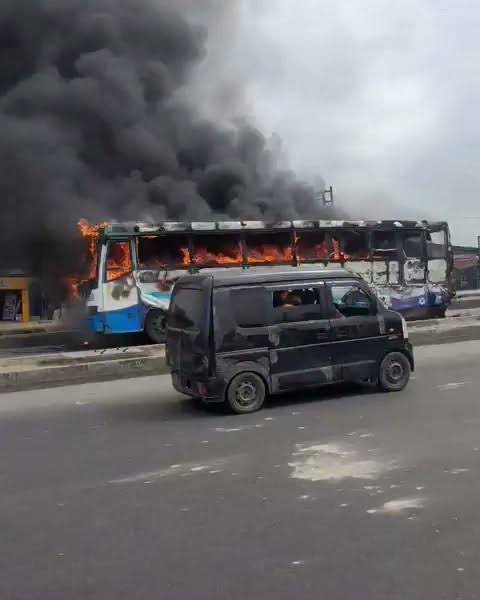
An angry mob has set a Bus Rapid Transit (BRT) bus on fire after it reportedly crushed a commercial motorcyclist to death at Ogolonto Bus Stop along Ikorodu Road in Lagos State.
The incident occurred on Friday, October 16, 2026. Eyewitness accounts and social media reports indicate that the motorcyclist was riding alone along the restricted BRT lane when the collision happened. He died at the scene.
Enraged residents and youths then attacked the bus driver and set the vehicle ablaze. Police officers and officials of the Lagos Neighbourhood Safety Corps (LNSC), who were nearby, intervened promptly and rescued the driver unharmed.
The identity of the deceased motorcyclist and the exact circumstances of the crash had not been officially confirmed at the time of filing this report. It was also unclear whether any arrests had been made in connection with the burning of the bus.
News
ARISE News Wins Seven Honours At Nigerian Broadcasters Merit Awards
The awards recognised the network’s achievements in television journalism and programming, with ARISE News winning the Best TV Channel (Viewer’s Choice) category.


• ARISE News Anchor and host of What’s Trending Ojy Okpe was named Best Newscaster (TV – Female)
ARISE News has emerged as one of the major winners at the just ended Nigerian Broadcasters Merit Awards (NBMA).
ARISE News won seven honours across television broadcasting, news reporting, presentation and production during the ceremony.
The awards recognised the network’s achievements in television journalism and programming, with ARISE News winning the Best TV Channel (Viewer’s Choice) category.
The network’s flagship breakfast programme, The Morning Show, also won the Best TV Talk Show award, further strengthening its recognition in television broadcasting.
ARISE News Anchor and host of What’s Trending Ojy Okpe was named Best Newscaster (TV – Female).
Rufai Oseni was named Nigerian Broadcaster of the Year (Male), while Vimbai Mutinhiri-Ekpeyong received the Nigerian Broadcaster of the Year (Female) award.
The recognition extended to the network’s newsroom, with Ovieteme George winning Best TV News Reporter (Male) for his contributions to television news reporting.
Behind the camera, Sam Adeyemi received the Best Camera Operator/Cinematographer award, recognising his work in television production and visual storytelling.
News
Meta removes 3.7 million accounts in West Africa scam crackdown
The joint operation led to 28 arrests, identified more than 30 suspected scam centres and rescued 117 people allegedly trafficked and forced to work in scam compounds in Ghana.

Meta, the parent company of Facebook and Instagram, has removed more than 3.7 million Facebook and Instagram accounts, pages and groups linked to suspected scam networks operating in West Africa.
The joint operation led to 28 arrests, identified more than 30 suspected scam centres and rescued 117 people allegedly trafficked and forced to work in scam compounds in Ghana.
The company announced the crackdown in a statement on Tuesday, October 13, 2026. It involved 14 technology companies and law enforcement agencies from 10 countries.
The United Kingdom’s National Crime Agency coordinated the operation with the US Department of Justice, the Federal Bureau of Investigation and other agencies. Nigerian authorities were involved.
Other countries included Ghana, Australia, Canada, New Zealand and India.Tech companies that took part included Google, Microsoft, OpenAI, Coinbase, Starlink and Adobe.
Meta said the partnership let participants share intelligence across digital platforms, countries and financial systems to identify criminal networks.


JUST IN: Mob Sets BRT Bus Ablaze After Motorcyclist’s Death in Lagos

BREAKING: DSS Arrests Fugitive Maina Son, Hands Him to EFCC

BREAKING: 5 Arrested Over Imo NYSC Abduction

BREAKING: Lagos Govt Declares Today, Thursday Work-Free to Mark 2026 Ìṣẹ̀ṣe Day

Tech Expert, Zuckerberg trains with UFC champions, Adesanya, Alexander

Organ Trafficking: Ekweremadu bags 10 years in UK prison
-

 Business3 days ago
Naira Exchange Rates Friday, October 16
-
 Crime2 days ago
BREAKING: 5 Arrested Over Imo NYSC Abduction
-

 News3 days ago
Meta removes 3.7 million accounts in West Africa scam crackdown
-

 News3 days ago
ARISE News Wins Seven Honours At Nigerian Broadcasters Merit Awards
-
 Crime2 days ago
BREAKING: DSS Arrests Fugitive Maina Son, Hands Him to EFCC
-
 News2 days ago
JUST IN: Mob Sets BRT Bus Ablaze After Motorcyclist’s Death in Lagos