
Health
BREAKING: Lassa fever: UK visitor tests positive as death toll hits 98 in 2 months

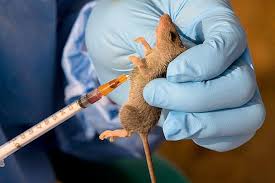
The Nigeria Centre for Disease Control and Prevention (NCDC) has confirmed a Lassa fever case with a travel history to the United Kingdom.
The Director General of the NCDC, Dr Jide Idris, in a public advisory on Monday, said the agency was notified on 5th of March of a confirmed case of Lassa fever by the Ondo State Ministry of Health, in a 31-year-old physician managed at a private health facility in Ondo State after returning from a trip abroad (UK).
Lassa fever is an acute viral haemorrhagic fever (VHF) caused by the Lassa virus. The natural reservoir for the virus is the multimammate rat (also known as the African rat). Other rodents can also act as carriers of the virus.
Dr Idris said the patient departed Nigeria on February 19 and returned February 27, adding that samples were taken late on Friday, February 28 on a suspicion of Lassa fever, but the patient unfortunately passed away in the early hours of Saturday, March 1.
He said the laboratory investigation returned a result that was Lassa Fever positive on PCR on Tuesday March 4, adding that “The patient was said to have visited his fiancée in Edo State, as well as family and friends before travelling. “
The NCDC DG said to enhance state and international level coordination of all control and management efforts, some steps had been taken.
“Ondo State Ministry of Health has bolstered control and management efforts through contact tracing and line listing of contacts of the confirmed case.
“All necessary in-country structures have been mobilized to ensure all possible contacts are traced and monitored. Communicated to the Port Health Services to support contact tracing and line listing of contacts and bolster surveillance efforts at the point of entries and exits (information include patient’s biodata, flight details etc. shared).
“Information shared with all relevant authorities in line with the International Health Regulations (2005), and contact tracing efforts also on-going in the UK,” he stated.
The NCDC boss explained that a total of 2728 Lassa fever suspected cases; 535 confirmed cases and 98 deaths have been recorded across 14 states in Nigeria (Case Fatality Rate 18.3%) since the beginning of this year.
He said five states account for 91% of confirmed cases: Ondo: 31%, Bauchi: 24%, Edo: 17%, Taraba: 16% and Ebonyi: 3%.
He said, “Ten (10) LGAs make up 68% of confirmed cases, namely Owo, Akure South, Etsako West, Kirfi, Akoko South West, Bali, Esan North East, Bauchi, Toro and Jalingo. “
He said while NCDC leads the prevention, preparedness, and response to public health emergencies, state governments are also critical in implementing their outbreak response plans tailored to their specific geographical needs.
“And we will continue to support them. However, this responsibility, being a collective one, members of the public also have a role to play,” he said.
He further advised members of the public to
always keep their environment clean, especially their homes, markets, dump sites to reduce breeding grounds for rats
He said, “Block all holes in your house to prevent the entry of rats and other rodents.
“Cover your dustbins and dispose of refuse or waste properly. Communities should set up dump sites far from their homes to reduce the chances of the entry of rodents into their homes.
“Safely store food items such as rice, garri, beans, corn/maize, etc., in tightly sealed or well-covered containers. And avoid open drying of food stuff. Properly process or prepare rats (bushmeat) before consumption. Avoid drying food stuff outside on the ground or roadside, where it is at risk of contamination.
“Discourage bush burning and Deforestation as these can destroy the homes and food sources of rodents, driving them to migrate from the bushes to human residences to find food.
“Eliminate rats in homes and communities by setting rat traps and other appropriate and safe means. Practice good personal and hand hygiene by frequently washing hands with soap under running water or using hand sanitizers when necessary.”
While advising people to avoid overcrowded living areas as overcrowding leads to poor sanitation, he said they should also avoid self-medication to ensure proper diagnosis and early treatment.
“Visit the nearest health facility if you notice any of the signs and symptoms associated with Lassa fever mentioned earlier or call the State Ministry of Health hotline and 6232 (NCDC),” he added.






Health
Millions of bedbugs crawl out of mattresses and walls in huge outbreak
Bedbugs can enter homes on clothes, luggage, or second hand furniture – and “hide” in mattresses or walls, according to the NHS.


Millions of bedbugs were crawling out of mattresses in what a pest controller said was the worst outbreak he had seen in 38 years.
They were even in the walls and under the wallpaper, with the mattresses and bed frames needing to be incinerated.
Cardiff pest controller Gareth Davies had to wear full protection as his team tackled the problem in the Canton area of the city, using a specialist vacuum cleaner to collect millions of the bugs.
It came after they had tackled a large cockroach outbreak last month in a scene he likened to a horror movie.
“This house was just horrific,” he told BBC Radio Wales Breakfast.
“Hundreds of thousands of them when you lifted the mattresses up.
“They were coming out of the wallpaper, it was horrendous.”
Bedbugs can enter homes on clothes, luggage, or second hand furniture – and “hide” in mattresses or walls, according to the NHS.
Credit: BBC
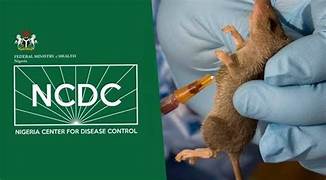
The Nigeria Centre for Disease Control and Prevention (NCDC) has confirmed that Lassa fever has claimed 259 lives and infected 1,086 people across 24 states and 118 local government areas so far in 2026.
In its latest Lassa Fever Situation Report for epidemiological week 36 (August 31 to September 6), the agency said the figures represent a case fatality rate of 23.9 percent — significantly higher than the 18.6 percent recorded during the same period in 2025.
Twelve new confirmed cases were recorded in week 36, a decline from the 18 cases reported the previous week. The fresh infections were detected in Ondo, Edo and Kogi states.
Five states continue to bear the heaviest burden, accounting for 87 percent of all confirmed cases this year: Bauchi, Ondo, Taraba, Benue and Edo. People aged 21 to 30 remain the most affected age group.
The NCDC noted that no new infections among healthcare workers were recorded during the latest reporting week. The agency continues to urge the public to maintain hygiene, avoid contact with rodents and their droppings, and seek early medical care if symptoms appear.
Health
Nigerian hospital successfully performs kidney cancer surgery via tele-robotic
The development could reduce the need for Nigerians to travel abroad for specialised medical treatment, thereby reducing expenditure on international travel, accommodation and medical services.
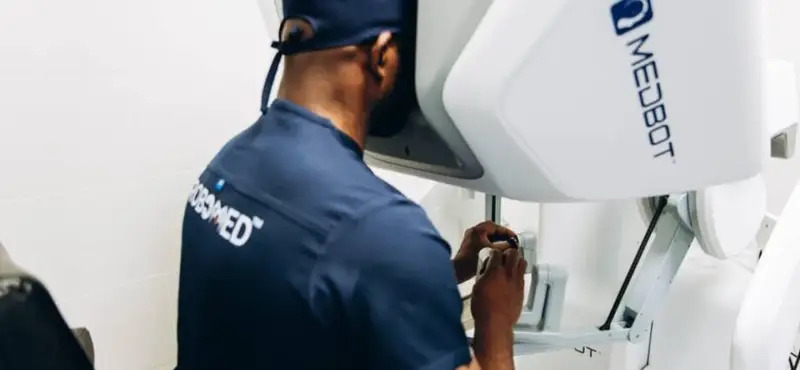
• A surgeon performing tele-robotic surgery.
Nisa Premier Hospital, Abuja, has partnered with RoboMed Global and The Redeemer’s Health Village (RHV) to successfully perform what the hospital described as the first tele-robotic surgery in Nigeria and West Africa.
The landmark kidney cancer surgery was performed on a patient at Nisa Premier Hospital, Abuja, while the surgeon, Professor Obi Ekwenna-Davis, remotely controlled the robotic surgical platform from Redeemer’s Health Village in Lagos.
The procedure, which lasted approximately three hours, was performed to remove a kidney affected by a cancerous tumour.
The hospital said the patient had been discharged following the successful procedure, although details about the patient’s identity and condition were withheld for privacy reasons.
Speaking during an event to mark the milestone, the Chief Executive Officer of Nisa Premier Hospital, Dr Ibrahim Wada, said the development demonstrated the potential of tele-robotic surgery to connect specialist surgical expertise with patients across Nigeria.
Wada said the procedure was carried out using the MicroPort robotic surgical platform installed at Nisa Premier Hospital, with the remote surgeon controlling the system from Lagos.
He said the development could reduce the need for Nigerians to travel abroad for specialised medical treatment, thereby reducing expenditure on international travel, accommodation and medical services.
According to him, the technology also creates an opportunity for Nigerians to access specialised expertise from doctors located in other parts of the world without requiring the doctors to travel physically to Nigeria.
Source: Daily Trust


AI to eliminate 40% of global jobs – IMF boss

JUST IN: Pope Leo XIV to Undergo Surgery for Early-Stage Lung Nodule

FG Withdraw Charges Against PFIPC DG Adeyemi

Tech Expert, Zuckerberg trains with UFC champions, Adesanya, Alexander

Organ Trafficking: Ekweremadu bags 10 years in UK prison

SAINT OBI: Between his marriage and his death
-

 Business20 hours ago
Nigeria’s ₦33bn Fruit Import Bill Exposes Missed Opportunities in Jos
-

 Business21 hours ago
Naira To Dollar, Pound ,Euro …Rates For Monday, October 12
-

 International1 day ago
‘Up to our people’ to pick leader, Zelenskyy responds to Trump’s pledge for new elections in Ukraine
-

 Opinions1 day ago
Human Capital Africa Statement For International Day of the Girl Child 2026
-

 Politics15 hours ago
BEWARE: Fake 2027 Gov’ Candidates List Circulating Online — INEC Raises Alarm
-

 International1 day ago
Time for Ukraine to get a new president’, says Trump
-

 News21 hours ago
Forbes Scores GTBank Best Employers 2026
-

 Politics19 hours ago
2027: 119 Women Jostle For State’s Governors