
Politics
Who Will Be The Next INEC Chairman, After Yakubu?
Moreover, some schools of thought said that President Tinubu’s political experience is enough to guide him in appointing a competent and unbiased Nigerian to head the commission.

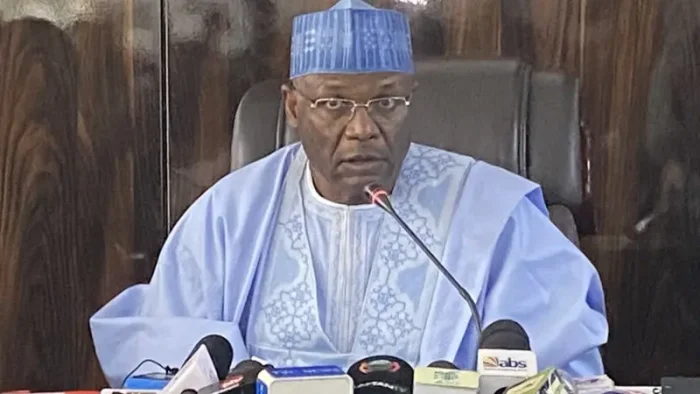
“In his first public appearance since the rumours emerged, Yakubu formally informed the ECOWAS Assembly that he was attending the ECONEC meeting for the final time as Chairman of INEC because his tenure ends later this year.”
Who Will Be The Next INEC Chairman, after Yakubu? And will he come from the North, South, West or the East region of the country?
Ohibaba.com reports that since Nigeria’s Independence in 1960, twelve people have served as the INEC Chairman which first existed as Federal Electoral Commission ( FEDECO) , and now INEC – Independent National Electoral Commission.
List of INEC Chairman 1960 to 2025
1. Eyo Esua (1964–1966),
2. Michael Ani (1976–1979),
3. Victor Ovie-Whiskey (1980–1983),
4. Eme Awa (1987–1989),
5. Humphrey Nwosu (1989–1993),
6. Okon Uya (1993, June-November)
7. Professor Okon, Sumner Dagogo-Jack (1994–1998),
8. Ephraim Akpata (1998–2000),
9. Abel Guobadia (2000–2005)
10., Maurice Iwu (2005–2010),
11.Attahiru Jega (2010–2015),
12. Mahmood Yakubu (2015-present).
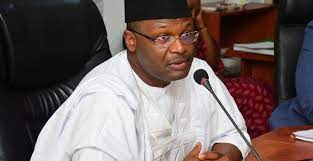
According to a report by the Guardian, the outgoing Chairman of INEC, Prof. Mahmood Yakubu, yesterday bade farewell to colleagues on the continent amid his call for a stronger regional collaboration among election management bodies in West Africa.
Yakubu, who had earlier been rumoured to have been removed from office by President Bola Tinubu, attended the extraordinary general assembly of the ECOWAS Network of Electoral Commissions (ECONEC) in Banjul, Gambia.
He had earlier dispelled claims of his removal when, on Tuesday, he presided over the commission’s weekly management meeting in Abuja.
The rumour mill on Wednesday went on overdrive when leaders of the opposition Labour Party (LP) led a delegation to the INEC office but were received by an acting chairman, Sam Olumekun.Yakubu’s absence had raised concerns, but Chief Press Secretary to the INEC chairman, Rotimi Oyekanmi, explained that National Commissioner Olumekun was the INEC acting chairman at the moment, as Yakubu had travelled to the Gambia to attend the ECONEC meeting.
In his first public appearance since the rumours emerged, Yakubu formally informed the ECOWAS Assembly that he was attending the ECONEC meeting for the final time as Chairman of INEC because his tenure ends later this year.
Yakubu told his fellow electoral commissioners, who previously served as president of the ECONEC Steering Committee, to strengthening democratic institutions in their home countries and across Africa.
Yakubu recalled how he had proudly announced that every country in the sub-region was under democratic rule in 2017. Sadly, he observed, that was no longer the case.
He regretted that today, four countries in the region are no longer practising democracy. Yakubu, however, was optimistic and expressed the hope that democracy would soon return to the affected nations.As his tenure nears its end, intrigues are playing out among political, regional and other stakeholders on how to prevail over President Tinubu to determine and influence whom and the region where the next INEC boss should come from.
While a section of the north is already agitating that President Tinubu should be fair and transparent enough to look elsewhere apart from the Southwest to pick Yakubu’s replacement
Others said the National Assembly should expedite that aspect of the constitutional amendment that deals with the appointment of INEC Chairman, with the view that the solely prerogative of appointing the commission’s chairman must be taken away from Mr President and becomes a democratic process.
Moreover, some schools of thought said that President Tinubu’s political experience is enough to guide him in appointing a competent and unbiased Nigerian to head the commission.
They said that as much as former President Muhammadu Buhari appointed Yakubu through his prerogative power, the incumbent President should not be blackmailed as to whom he wishes to appoint.


Politics
NBA Cautions Lawyers Against Involvement in Political Party Disputes
The association cited Section 83 of the Electoral Act, which it said restricts courts from entertaining suits relating to the internal affairs of political parties, warning that such actions could undermine Nigeria’s democratic process ahead of the 2027 general elections.
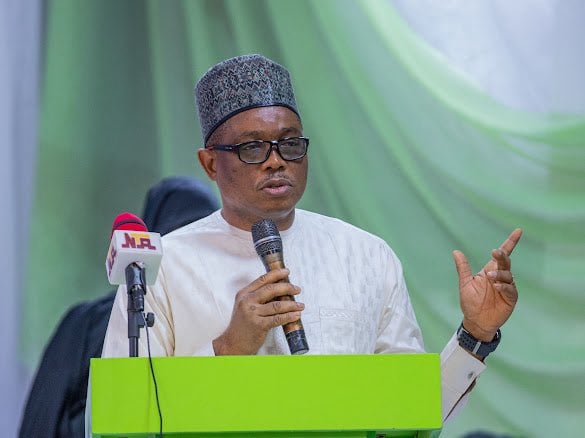
Photo: NBA President, Afam Osigwe (SAN) | Credit: NBA (X).
The President of Nigerian Bar Association (NBA), Afam Osigwe (SAN) on Friday cautioned lawyers and courts against involvement in the internal affairs of political parties.
The association cited Section 83 of the Electoral Act, which it said restricts courts from entertaining suits relating to the internal affairs of political parties, warning that such actions could undermine Nigeria’s democratic process ahead of the 2027 general elections.
Osigwe, in a statement said that the NBA had observed a growing trend of litigation aimed at drawing courts into intra-party disputes, despite clear statutory provisions limiting judicial intervention in such matters.
Osigwe emphasised that the recent political and legal developments arising from the interpretation of the Electoral Act 2022 raise serious constitutional and rule-of-law concerns.
Osigwe further noted that the law also prohibits courts from granting interim or interlocutory injunctions in such disputes.
The statement read in part, “Where any action is brought in negation of this provision, no interim or interlocutory injunction shall be entertained by the Court, but the Court shall suspend its ruling and deliver it at the stage of final judgment and shall give accelerated hearing to the matter.”
The NBA expressed concern that, contrary to these provisions, courts have continued to entertain such cases, sometimes issuing orders that affect party leadership contests and internal governance structures.
It also accused some lawyers of filing suits aimed at securing judicial intervention in political disputes through forum shopping and what it described as “mala fide applications” to obtain favourable orders.“
This emerging trend of subverting the clear letters of the Electoral Act and dragging courts into the internal affairs of political parties through disingenuous litigation, forum shopping, and mala fide applications designed to secure undemocratic political advantage does no good for our democracy,” the association said.
The NBA warned that continued judicial involvement in such matters could turn court processes into instruments of political manipulation.
It stressed that the relevant provisions of the Electoral Act were designed to prevent abuse of court processes and preserve the integrity of internal party democracy.
The association also reminded legal practitioners of their professional responsibilities, stating that lawyers must not act as political agents in pursuit of partisan outcomes.“The filing of actions intended to draw courts into internal political party disputes, particularly where jurisdiction is expressly excluded, constitutes an abuse of court process and a violation of professional responsibility,” it said.
The NBA warned that it would initiate disciplinary action against any lawyer found to have violated these provisions.
Politics
2027: Bode George warns INEC, Judiciary Drifting Nigeria Towards ” One Party Rule”
” They are ready to destroy all democratic fundamentals, tenets and ethos to have their way, ” said Chief George , urging all leaders and elders, regardless of party affiliations, to rise and condemn what is happening,
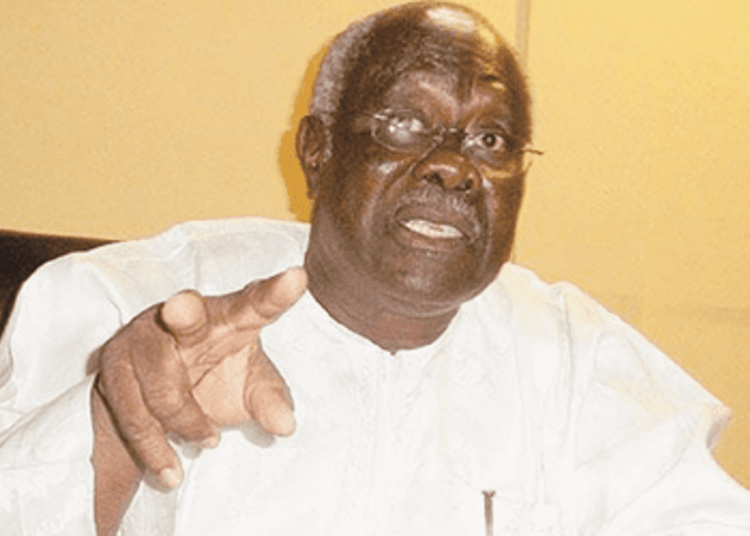
“You want to be the only presidential candidate in 2027, in a multi-cultural, multi-religious and multi-ethnic country like Nigeria in the 21st Century. How is that possible? We must encourage a multi-party democracy. That is the spinal cord of participatory democracy.’’
That’s Chief Olabode George, an elder statesman and the former Deputy National Chairman of the Peoples Democratic Party (PDP), while reflecting on the current happenings in the country ‘s government and politics space.
Chief George, who stated this in a statement issued by him on Thursday, said that actions and utterances coming from APC and INEC in recent weeks showed that they don’t want any other presidential candidate to emerge in 2027 aside from President Bola Tinubu of the APC
“They are ready to destroy all democratic fundamentals, tenets and ethos to have their way, ” said Chief George , urging all leaders and elders, regardless of party affiliations, to rise and condemn what is happening, emphasising, “You don’t appease evil. You deal with evil.”
The elder statesman said that the Chairman of INEC, Prof. Joash Amupitan, was a pitiable sight when he appeared on a television programme to defend the actions of the Electoral umpire in using technicalities to sack Excos of political parties.
“Enough is enough. This nation must not sink. At 80 years, what am I looking for? I was in Form 4 in secondary school when the Western Region crisis started in 1962. I don’t think some of those causing a crisis in the polity today were born then. Military or civilian, I have seen it all. We must not allow this country to go down,” he said.
We are firing the warning shot now. Nigeria is too big to be manipulated by a greedy and selfish few
Chief George said that he chose to sound a note of warning because Nigeria is too big to be manipulated.
“We are firing the warning shot now. Nigeria is too big to be manipulated by a greedy and selfish few. Look at insecurity. This country is gradually collapsing. I don’t want to hear anything like external factors or elements.
Those killing and kidnapping Nigerians all over the place are in this country. Instead of the president, as the Commander-in-Chief, to deal with these bloodthirsty maniacs, he is busy using INEC to destroy opposition parties.”
He appealed to Nigerians not to allow such a thing to happen, saying, “It is unfortunate that the electoral body has become an undertaker, mandated by the ruling party to destroy this democracy.
“Unfortunately, our judiciary is also drifting. I remember the glorious years of Justices Elias, Kayode Eso, Oputa, Belgore, Uwais, and others. Today, the rot in the judiciary is appalling.
“Any evil is a reflection of injustice. There is evil in the country today. Clearly, injustice can never overcome justice. When you deliver good judgments, justice is done. When you use technicalities to deliver wrong judgments, it is injustice,” he said.
Politics
Rep Dasuki Joins ADC, says INEC Chair Becoming Threat to Nigeria’s Multi-party Democracy
Rep Dasuki specifically cited the decision of INEC not to recognize the David Mark-led leadership of the African Democratic Congress (ADC) as a critical step in what he believes is a broader scheme to stifle opposition and dismantle democratic plurality.
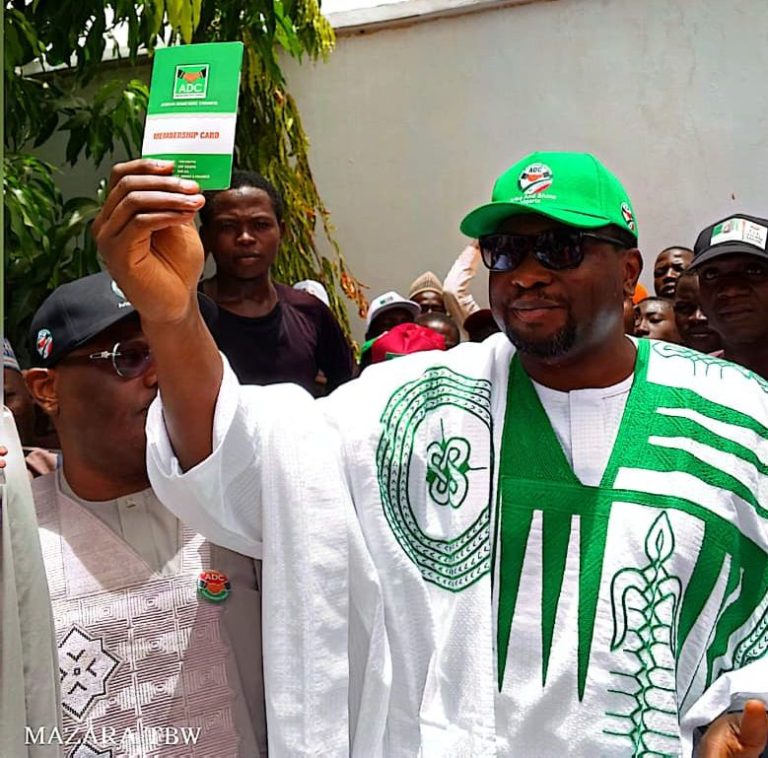
Abdussamad Dasuki, a House of Representative ‘s member representing Tambuwal/Kebbe Federal Constituency of Sokoto State, has observed that the Independent National Electoral Commission, under the leadership of Prof Joash Amupitan, is becoming an existential threat to Nigeria’s multiparty democracy.
Dasuki stated this on Wednesday when he picked up his membership card of the African Democratic Congress (ADC) at his Dogon Daji/Salah Ward, Tambuwal LGA of Sokoto, alleging that the commission was colluding with those plotting to stifle opposition party and turn Nigeria into one-party state.
The event witnessed a massive turnout of supporters, including hundreds of members of the Peoples Democratic Party (PDP), and other parties who formally defected to the ADC.
Addressing the enthusiastic crowd, Rep Dasuki warned that recent developments in the country’s political landscape point to a coordinated effort to weaken opposition voices and undermine democratic principles.
Rep Dasuki specifically cited the decision of INEC not to recognize the David Mark-led leadership of the African Democratic Congress (ADC) as a critical step in what he believes is a broader scheme to stifle opposition and dismantle democratic plurality.


NBA Cautions Lawyers Against Involvement in Political Party Disputes

2027: Bode George warns INEC, Judiciary Drifting Nigeria Towards ” One Party Rule”

DR Congo Central Bank Announces Ban on Foreign Currency Cash Transactions from 2027

Tech Expert, Zuckerberg trains with UFC champions, Adesanya, Alexander

Organ Trafficking: Ekweremadu bags 10 years in UK prison

SAINT OBI: Between his marriage and his death
-
 International3 days ago
Oil Prices Rise, Stocks Fall as Trump’s Iran Deadline Looms
-
 Politics2 days ago
Atiku, Obi, Kwankwaso, Aregbesola, Storm INEC Hqtrs in Protests
-
 Politics3 days ago
JUST IN: ADC Faces Fresh Crisis as New Faction Emerges, rejects David Mark-led coalition
-
Politics2 days ago
Coalition Leaders Rouse Nigerians to Reject ‘One Party ‘Rule’, Warning INEC “Don’t kill Democracy”
-

 Business2 days ago
Crude Oil Prices Drop Below $95 After US-Iran Ceasefire
-
 News3 days ago
Abiodun Presents Ceremonial Sword to Tinubu, Urges Sustained War on Crime
-
 News3 days ago
Lagos Announces Traffic Diversions for Wednesday and Thursday Project Commissionings
-
 International2 days ago
Iran reopens Strait of Hormuz following two-week cease-fire agreement with Trump