
Health
Two-Thirds Households In Nigeria Lack Money For Healthy Food — NBS Survey


A survey by the National Bureau of Statistics (NBS) has highlighted the harsh realities faced by Nigerian households, with two-thirds struggling to afford healthy and nutritious meals due to financial constraints. The report, titled Nigeria General Household Survey – Panel (GHS-Panel) Wave 5 (2023/2024), sheds light on the deepening multidimensional poverty and the impact of diminishing purchasing power caused by rising prices of goods and services.
Food Insecurity
The report reveals widespread food insecurity, with 66.7% of households unable to eat nutritious or preferred foods in the past month due to a lack of money. Other findings include:
- 63.8% of households consuming limited types of food.
- 62.4% expressing worry about insufficient food supplies.
- 60.5% eating less than they felt necessary.
The survey also notes a significant increase in food insecurity over time. Between Waves 4 and 5, the proportion of households worried about inadequate food rose from 36.9% to 62.4%.
Energy Access and Power Blackouts
Access to electricity varies significantly between urban and rural areas, with 82.2% of urban households connected to the power grid compared to just 40.4% in rural areas. However, households face an average of 6.7 power blackouts per week.
Traditional cooking methods dominate, with 65.0% of households using three-stone stoves and 70.2% relying on wood as fuel. Despite this, the use of liquefied petroleum gas (LPG) is steadily increasing.
Basic Infrastructure and Sanitation
The survey highlights significant gaps in basic infrastructure:
- Many households lack proper toilet facilities and rely on informal waste disposal methods, with 45.6% dumping waste in bushes or streets.
- Tube wells or boreholes are the primary sources of drinking water for many households.
Asset Ownership and Housing
Asset ownership has declined since 2018/19. Key findings include:
- 66.7% of households owning mobile phones, while 21.3% have internet access.
- 70.4% of households own their homes, with rural ownership higher at 80.1% compared to 49.1% in urban areas.
Implications
The survey underscores the urgent need for policy interventions to address poverty, food insecurity, and inadequate infrastructure in Nigeria. Rising inflation, coupled with inconsistent access to energy and basic amenities, continues to erode the quality of life for millions of Nigerians.



Health
Millions of bedbugs crawl out of mattresses and walls in huge outbreak
Bedbugs can enter homes on clothes, luggage, or second hand furniture – and “hide” in mattresses or walls, according to the NHS.


Millions of bedbugs were crawling out of mattresses in what a pest controller said was the worst outbreak he had seen in 38 years.
They were even in the walls and under the wallpaper, with the mattresses and bed frames needing to be incinerated.
Cardiff pest controller Gareth Davies had to wear full protection as his team tackled the problem in the Canton area of the city, using a specialist vacuum cleaner to collect millions of the bugs.
It came after they had tackled a large cockroach outbreak last month in a scene he likened to a horror movie.
“This house was just horrific,” he told BBC Radio Wales Breakfast.
“Hundreds of thousands of them when you lifted the mattresses up.
“They were coming out of the wallpaper, it was horrendous.”
Bedbugs can enter homes on clothes, luggage, or second hand furniture – and “hide” in mattresses or walls, according to the NHS.
Credit: BBC
The Nigeria Centre for Disease Control and Prevention (NCDC) has confirmed that Lassa fever has claimed 259 lives and infected 1,086 people across 24 states and 118 local government areas so far in 2026.
In its latest Lassa Fever Situation Report for epidemiological week 36 (August 31 to September 6), the agency said the figures represent a case fatality rate of 23.9 percent — significantly higher than the 18.6 percent recorded during the same period in 2025.
Twelve new confirmed cases were recorded in week 36, a decline from the 18 cases reported the previous week. The fresh infections were detected in Ondo, Edo and Kogi states.
Five states continue to bear the heaviest burden, accounting for 87 percent of all confirmed cases this year: Bauchi, Ondo, Taraba, Benue and Edo. People aged 21 to 30 remain the most affected age group.
The NCDC noted that no new infections among healthcare workers were recorded during the latest reporting week. The agency continues to urge the public to maintain hygiene, avoid contact with rodents and their droppings, and seek early medical care if symptoms appear.
Health
Nigerian hospital successfully performs kidney cancer surgery via tele-robotic
The development could reduce the need for Nigerians to travel abroad for specialised medical treatment, thereby reducing expenditure on international travel, accommodation and medical services.
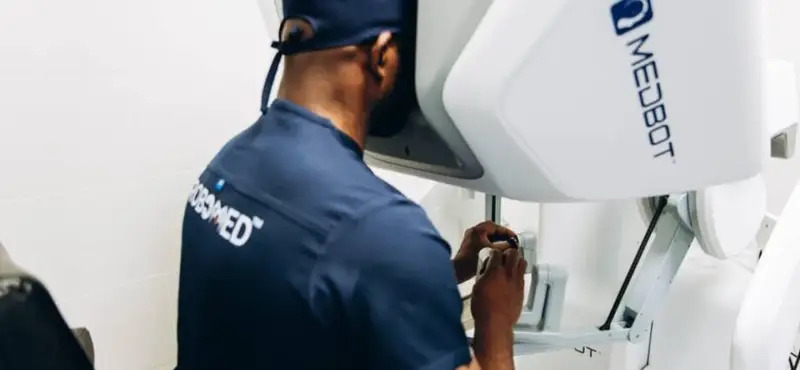
• A surgeon performing tele-robotic surgery.
Nisa Premier Hospital, Abuja, has partnered with RoboMed Global and The Redeemer’s Health Village (RHV) to successfully perform what the hospital described as the first tele-robotic surgery in Nigeria and West Africa.
The landmark kidney cancer surgery was performed on a patient at Nisa Premier Hospital, Abuja, while the surgeon, Professor Obi Ekwenna-Davis, remotely controlled the robotic surgical platform from Redeemer’s Health Village in Lagos.
The procedure, which lasted approximately three hours, was performed to remove a kidney affected by a cancerous tumour.
The hospital said the patient had been discharged following the successful procedure, although details about the patient’s identity and condition were withheld for privacy reasons.
Speaking during an event to mark the milestone, the Chief Executive Officer of Nisa Premier Hospital, Dr Ibrahim Wada, said the development demonstrated the potential of tele-robotic surgery to connect specialist surgical expertise with patients across Nigeria.
Wada said the procedure was carried out using the MicroPort robotic surgical platform installed at Nisa Premier Hospital, with the remote surgeon controlling the system from Lagos.
He said the development could reduce the need for Nigerians to travel abroad for specialised medical treatment, thereby reducing expenditure on international travel, accommodation and medical services.
According to him, the technology also creates an opportunity for Nigerians to access specialised expertise from doctors located in other parts of the world without requiring the doctors to travel physically to Nigeria.
Source: Daily Trust


JUST IN: Mob Sets BRT Bus Ablaze After Motorcyclist’s Death in Lagos

BREAKING: DSS Arrests Fugitive Maina Son, Hands Him to EFCC

BREAKING: 5 Arrested Over Imo NYSC Abduction

BREAKING: Lagos Govt Declares Today, Thursday Work-Free to Mark 2026 Ìṣẹ̀ṣe Day

Tech Expert, Zuckerberg trains with UFC champions, Adesanya, Alexander

Organ Trafficking: Ekweremadu bags 10 years in UK prison
-

 Business2 days ago
Naira Exchange Rates For Thursday, October 15
-
 Sports2 days ago
CAF Increases Annual Funding for Member Federations to $700,000
-
 News2 days ago
ASCON To Be Rebranded “National School Of Government”
-

 Business2 days ago
Germany plans tax on sugary drinks
-

 News3 days ago
Sanwo-Olu Appoints Olatunbosun Ogunbanwo, 5 Others as Perm Secs
-

 Business2 days ago
WEF could appoint Lagarde as its next chair, sources say
-

 International2 days ago
“Mother of all bombs,” Trump Plans To Hit Iran
-

 Business1 day ago
Naira Exchange Rates Friday, October 16