
Health
Lagos Launches Public Health Campaign on Mpox


The Lagos State Government has unveiled a series of comprehensive public health initiatives.
These are in response to the growing global concern over the Mpox virus, particularly the newly identified Clade 1B variant.
During a media briefing held at Protea Hotel, Alausa Ikeja, the State Commissioner for Health, Prof. Akin Abayomi, outlined the state’s multipronged strategy to shield Lagos from this emerging threat.
Prof. Abayomi announced three significant milestones as part of Lagos State’s public health strategy against Mpox.
The first is a robust stakeholder engagement involving experts from various sectors to discuss Mpox and its management, both locally and globally.
Although Lagos has no active cases at present, however, the risk posed by the more aggressive Clade 1B variant remains a significant concern due to Lagos’s extensive travel connections.
The second milestone is the activation of an Emergency Operations Centre (EOC) specifically dedicated to monitoring and addressing the Mpox outbreak, with a particular focus on the Clade 1B variant.
The third milestone is the launch of a statewide public health awareness campaign aimed at educating residents about the risks associated with Mpox and preventive measures they can take.
The Commissioner emphasized the current concern over the Clade 1B variant, which is rapidly spreading across Central Africa, particularly in the Democratic Republic of Congo (DRC), and has now reached neighboring countries like Cameroon, Rwanda, and Burundi.
“This variant is distinct from the indigenous Clade 2 variant, which has been detected sporadically in West Africa. Although Lagos has no active cases at present, however, the risk posed by the more aggressive Clade 1B variant remains a significant concern due to Lagos’s extensive travel connections.
The World Health Organization (WHO) has declared the outbreak in the DRC a Public Health Emergency of International Concern, highlighting the need for a coordinated global response”, he said.
Prof. Abayomi noted that Lagos State is taking proactive steps, drawing on its experience with past health crises like Ebola, COVID-19, cholera, and Lassa fever. According to him, these measures aim to prevent the introduction of the Clade 1B variant into Lagos, which could have severe health and economic implications.
The Commissioner explained that Mpox, like smallpox and cowpox, is a zoonotic disease that initially spreads from animals to humans, particularly through rodents and monkeys.
Human-to-human transmission occurs through close contact, with the Clade 1B variant showing a higher transmission rate, especially through sexual contact.
Prof. Abayomi warned that while there are currently no active Mpox cases in Lagos, the state must remain vigilant against the potential importation of this aggressive variant.
He disclosed that a mini-symposium on Mpox which was held before the media briefing, featured insights from global health experts, including representatives from WHO, UNICEF, the Nigeria Centre for Disease Control (NCDC), Nigeria Institute of Medical Research (NIMR), LUTH and LASUTH. “These experts discussed the risks posed by the Clade 1B variant to Lagos and the steps needed to create a biological shield against the virus.
The collective goal is to ensure that Lagos is fully prepared to manage any potential outbreak and minimize its impact”, Prof. Abayomi said.
While noting that Lagos State’s high population density and extensive travel links make it particularly vulnerable to the rapid spread of contagious diseases, the Commissioner urged the public and healthcare providers to be vigilant and prepared to recognize, diagnose, and manage Mpox cases effectively.
“The activation of the EOC and the launch of the public awareness campaign are critical components of this strategy.
As part of the proactive measures, a comprehensive public health awareness campaign has been rolled out across Lagos. This campaign seeks to inform the public about the symptoms of Mpox, such as fever, joint pain, body aches, and distinctive rashes.
Residents are urged to report any suspicious symptoms to the nearest health facility for prompt evaluation”, he stated.
Prof. Abayomi noted that Lagos State is also exploring vaccine options and has established local research teams to guide government policy on Mpox. These efforts aim to bolster the state’s preparedness for a possible outbreak and ensure a swift and effective response.
The Commissioner noted that despite the absence of active Mpox cases in Lagos, the state government is committed to maintaining a high level of preparedness. Prof. Abayomi expressed gratitude to all partners and collaborators for their continued support in these efforts, stressing the importance of collective action in safeguarding Lagos from the potential dangers of Mpox.
Speaking in the same vein, the Director of Epidemiology, Biosecurity, and Global Health in the Lagos State Ministry of Health, Dr. Ismail Abdus-Salam provided detailed information on the symptoms of the Clade 1B variant.
He highlighted the severity of the rashes caused by this variant, particularly those that appear in the genital area, which are more painful and pronounced than typical Mpox rashes.
Dr. Abdus-Salam emphasized the critical need for early identification and containment of Mpox cases to prevent the spread of the Clade 1B variant within Lagos. “The state’s public health systems are on high alert, ready to act swiftly to protect residents from this virulent strain”, he said.
Lagos State’s comprehensive and proactive approach to public health sets a precedent for other regions to follow.
The state’s ongoing efforts to prevent the importation and spread of Mpox, particularly the Clade 1B variant, demonstrate its commitment to protecting the health and well-being of its residents in the face of emerging global health threats.







Health
Millions of bedbugs crawl out of mattresses and walls in huge outbreak
Bedbugs can enter homes on clothes, luggage, or second hand furniture – and “hide” in mattresses or walls, according to the NHS.

Millions of bedbugs were crawling out of mattresses in what a pest controller said was the worst outbreak he had seen in 38 years.
They were even in the walls and under the wallpaper, with the mattresses and bed frames needing to be incinerated.
Cardiff pest controller Gareth Davies had to wear full protection as his team tackled the problem in the Canton area of the city, using a specialist vacuum cleaner to collect millions of the bugs.
It came after they had tackled a large cockroach outbreak last month in a scene he likened to a horror movie.
“This house was just horrific,” he told BBC Radio Wales Breakfast.
“Hundreds of thousands of them when you lifted the mattresses up.
“They were coming out of the wallpaper, it was horrendous.”
Bedbugs can enter homes on clothes, luggage, or second hand furniture – and “hide” in mattresses or walls, according to the NHS.
Credit: BBC

The Nigeria Centre for Disease Control and Prevention (NCDC) has confirmed that Lassa fever has claimed 259 lives and infected 1,086 people across 24 states and 118 local government areas so far in 2026.
In its latest Lassa Fever Situation Report for epidemiological week 36 (August 31 to September 6), the agency said the figures represent a case fatality rate of 23.9 percent — significantly higher than the 18.6 percent recorded during the same period in 2025.
Twelve new confirmed cases were recorded in week 36, a decline from the 18 cases reported the previous week. The fresh infections were detected in Ondo, Edo and Kogi states.
Five states continue to bear the heaviest burden, accounting for 87 percent of all confirmed cases this year: Bauchi, Ondo, Taraba, Benue and Edo. People aged 21 to 30 remain the most affected age group.
The NCDC noted that no new infections among healthcare workers were recorded during the latest reporting week. The agency continues to urge the public to maintain hygiene, avoid contact with rodents and their droppings, and seek early medical care if symptoms appear.
Health
Nigerian hospital successfully performs kidney cancer surgery via tele-robotic
The development could reduce the need for Nigerians to travel abroad for specialised medical treatment, thereby reducing expenditure on international travel, accommodation and medical services.
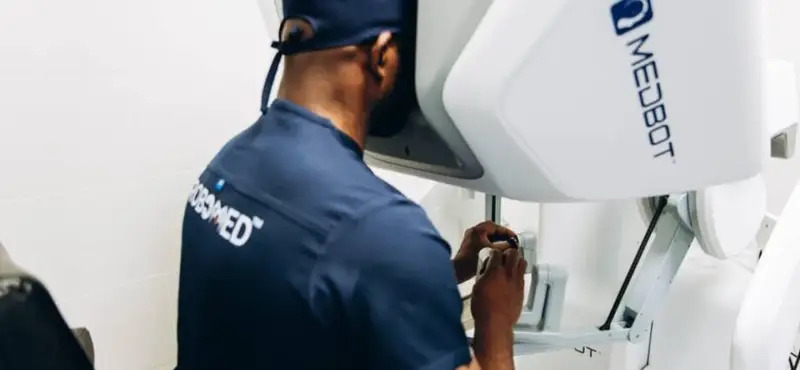
• A surgeon performing tele-robotic surgery.
Nisa Premier Hospital, Abuja, has partnered with RoboMed Global and The Redeemer’s Health Village (RHV) to successfully perform what the hospital described as the first tele-robotic surgery in Nigeria and West Africa.
The landmark kidney cancer surgery was performed on a patient at Nisa Premier Hospital, Abuja, while the surgeon, Professor Obi Ekwenna-Davis, remotely controlled the robotic surgical platform from Redeemer’s Health Village in Lagos.
The procedure, which lasted approximately three hours, was performed to remove a kidney affected by a cancerous tumour.
The hospital said the patient had been discharged following the successful procedure, although details about the patient’s identity and condition were withheld for privacy reasons.
Speaking during an event to mark the milestone, the Chief Executive Officer of Nisa Premier Hospital, Dr Ibrahim Wada, said the development demonstrated the potential of tele-robotic surgery to connect specialist surgical expertise with patients across Nigeria.
Wada said the procedure was carried out using the MicroPort robotic surgical platform installed at Nisa Premier Hospital, with the remote surgeon controlling the system from Lagos.
He said the development could reduce the need for Nigerians to travel abroad for specialised medical treatment, thereby reducing expenditure on international travel, accommodation and medical services.
According to him, the technology also creates an opportunity for Nigerians to access specialised expertise from doctors located in other parts of the world without requiring the doctors to travel physically to Nigeria.
Source: Daily Trust


JUST IN: Mob Sets BRT Bus Ablaze After Motorcyclist’s Death in Lagos

BREAKING: DSS Arrests Fugitive Maina Son, Hands Him to EFCC

BREAKING: 5 Arrested Over Imo NYSC Abduction

BREAKING: Lagos Govt Declares Today, Thursday Work-Free to Mark 2026 Ìṣẹ̀ṣe Day

Tech Expert, Zuckerberg trains with UFC champions, Adesanya, Alexander

Organ Trafficking: Ekweremadu bags 10 years in UK prison
-

 Business3 days ago
NAFDAC scolds fake manufacturers: “You are killing Nigerians in order to make money”
-

 Business2 days ago
Naira Exchange Rates For Thursday, October 15
-

 Business3 days ago
Oyedele Chairs G-24 Call for Fairer Global Financial System, Affordable Development Financing
-
 Sports2 days ago
CAF Increases Annual Funding for Member Federations to $700,000
-

 Politics3 days ago
Exclusion of candidates from INEC list: CD cautions INEC against manipulation by politicians
-
 News2 days ago
ASCON To Be Rebranded “National School Of Government”
-

 Business1 day ago
Germany plans tax on sugary drinks
-

 News2 days ago
Sanwo-Olu Appoints Olatunbosun Ogunbanwo, 5 Others as Perm Secs