
News
The Role of Certificate of Occupancy in Property Valuation Method in Nigeria by Dennis Isong


In Nigeria’s real estate landscape, property valuation serves as a crucial process that determines the worth of a property for various purposes, including buying, selling, and securing loans.
One significant document that plays a pivotal role in this process is the Certificate of Occupancy (C of O). This legal document, issued by the state government, confirms an individual’s right to use and occupy land for a specified period.
Understanding the interplay between the C of O and property valuation is essential for investors, developers, and homeowners alike, as it can significantly influence market perceptions and property prices.
Understanding the Certificate of Occupancy
The Certificate of Occupancy is a legal document that signifies ownership and the right to occupy land.
In Nigeria, land ownership is primarily governed by statutory laws, customary laws, and the Land Use Act of 1978, which mandates that all land in urban areas is owned by the government.
Thus, the issuance of a C of O is necessary to establish a legal claim over any parcel of land. Obtaining a C of O is a comprehensive process that involves several steps, including land survey, payment of necessary fees, and completion of relevant documentation.
Once issued, the C of O provides security to the landowner by guaranteeing their rights against unlawful eviction or encroachment.
This security is a significant factor in property valuation. Properties with a valid C of O are generally seen as more valuable and less risky compared to those without, as the certificate signifies legal recognition and ownership rights.
C of O and Market Perception
The presence of a C of O can significantly influence market perception and the demand for a property. Properties with a valid Certificate of Occupancy are typically viewed as more desirable by potential buyers and investors.
This perception stems from the legal security that a C of O provides. Buyers are more likely to invest in properties with a C of O because they have assurance that their rights are protected, and the likelihood of disputes regarding ownership is minimized.
Moreover, lenders and financial institutions often require a C of O before approving loans for property purchases or developments.
A valid C of O enhances the credibility of the property, making it easier for buyers to secure financing.
In Nigeria, a C of O is usually granted for 99 years, and this long tenure can positively influence a property’s valuation.
This accessibility to finance, in turn, can lead to increased property demand, thereby driving up its valuation.
Conversely, properties lacking a C of O may be perceived as risky investments, resulting in lower valuations and reduced buyer interest.
Thus, the C of O serves as a critical indicator of a property’s reliability and marketability.
C of O in the Property Valuation Process
In the property valuation process, a valuer considers various factors to determine the value of a property. These factors typically include location, size, condition, and comparable sales in the area. However, the existence of a C of O is often a prominent consideration.
During the valuation process, valuers will assess the C of O to ascertain the legal standing of the property.
A valid C of O not only confirms ownership but also indicates compliance with local land use regulations, zoning laws, and building codes. Valuers may also take into account the duration of the C of O.
In Nigeria, a C of O is usually granted for 99 years, and this long tenure can positively influence a property’s valuation.
The security provided by a long-term C of O assures potential buyers of their rights over the property for an extended period, making it a more attractive investment.
Conversely, properties without a C of O, or those with expired or disputed certificates, may be valued lower due to the inherent risks associated with such properties.
Furthermore, a C of O can impact future development potential, which is a crucial aspect of property valuation.
Properties with a valid C of O are more likely to receive the necessary approvals for development or alteration, while those without may face legal hurdles.
This potential for development can enhance the property’s value, as it indicates future income generation possibilities.
Consequently, valuers consider the C of O as a critical factor that influences the overall worth of the property in the market.
Challenges and Implications of C of O in Property Valuation
Despite its importance, the C of O is not without challenges. The process of obtaining a C of O can be lengthy and complex, leading to delays in property transactions.
In some cases, disputes over land ownership can arise, particularly in areas where customary land tenure systems are prevalent.
These disputes can complicate the valuation process, as properties with contentious C of Os may be difficult to sell and consequently valued lower.
Additionally, the presence of a C of O does not automatically guarantee a problem-free investment. Factors such as environmental issues, development restrictions, or changes in land use policies can affect property value.
Valuers must therefore conduct thorough due diligence, considering not only the existence of a C of O but also any associated risks or liabilities.
In conclusion, the Certificate of Occupancy plays a crucial role in property valuation methods in Nigeria.
As a legal document that signifies ownership and security, it significantly influences market perception and property demand.
Valuers must consider the C of O when assessing a property’s value, as it reflects the legal standing and development potential of the land.
However, challenges associated with the C of O, such as ownership disputes and regulatory complexities, must also be navigated to ensure accurate valuations.
For stakeholders in the Nigerian real estate market, understanding the importance of the C of O is vital for making informed investment decisions and maximizing property value.
▪︎ Dennis Isong is a TOP REALTOR IN LAGOS.He Helps Nigerians in Diaspora to Own Property In Lagos Nigeria STRESS-FREE. For Questions WhatsApp/Call 2348164741041


News
FG launches new digital postcodes
The code is designed to provide a precise, GIS-enabled reference for identifying locations.
• Image credit: NIPOST
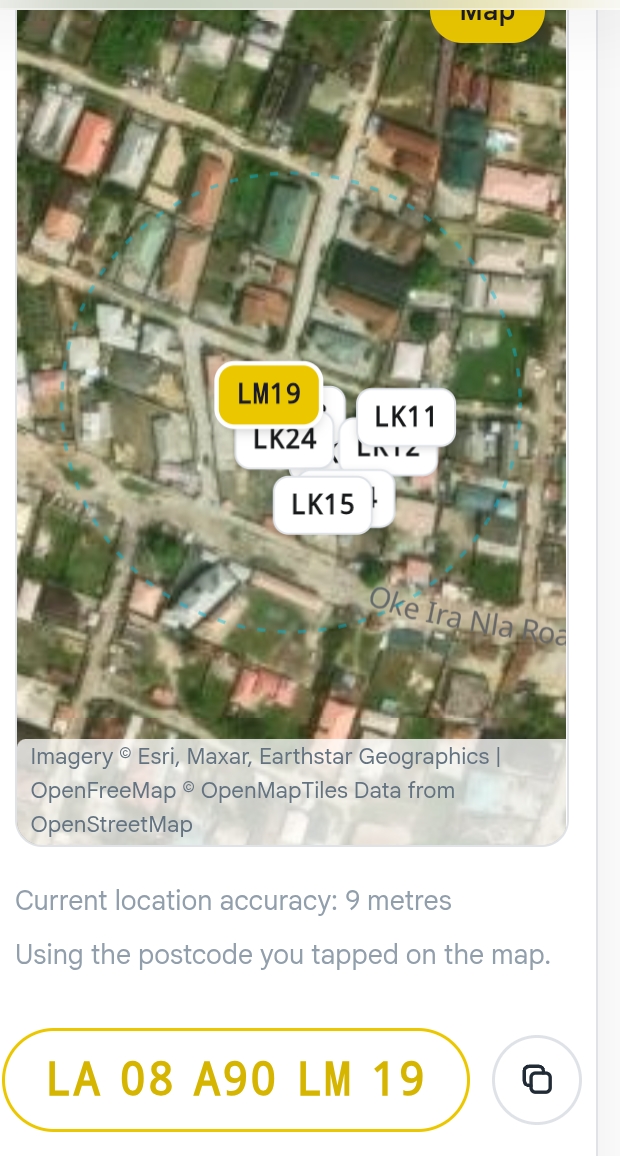
The Federal Government has launched the National Digital Alphanumeric Postcode System, urging Nigerians to find and begin using their postcodes.
The National Digital Alphanumeric Postcode, operated by the Nigerian Postal Service, gives every addressable building a unique 11-character code — the code is designed to provide a precise, GIS-enabled reference for identifying locations.system. Easier to find, share and use.
The Minister of Communications, Innovation and Digital Economy, Bosun Tijani announced the launch in a post on X on Thursday.
Tijani described the system as a step towards making locations across the country easier to identify and connecting people and businesses to services and opportunities.
Tijani said the system could help businesses reach customers beyond their immediate neighbourhoods, enable families to provide accurate locations during emergencies and help government agencies reach communities with essential services.
The minister encouraged Nigerians to search for their postcodes through the official Digital Postcode website, postcode.gov.ng, and share them with family members, friends and businesses.
News
Nigeria @ 66: President Tinubu says next phase of reforms’ll cut cost of living
“Our reforms did not create the weaknesses in our economy. They confronted them,” he said, while warning against attempts to reverse the policies and return to what he described as the “abuse of addictive subsidies”.

President Bola Tinubu has declared that the next phase of his administration’s reform will be focused on reducing the cost of living, creating jobs and ensuring that the benefits of economic growth were widely shared.
President Tinubu gave the assurance in his Independence Day address to mark Nigeria’s 66th anniversary, titled “From Reform to Prosperity”, in which he defended the economic policies of his administration and urged Nigerians to stay the course.
Tinubu said the reforms undertaken since his assumption of office had corrected the country’s economic direction, describing them as painful but necessary treatment for longstanding structural problems.
Using a cancer patient as an analogy, the President said Nigeria had for too long treated the symptoms of its economic problems rather than confronting their underlying causes.
“By 2023, poverty was rising, and hope was nearly gone. The country’s situation was darker than ever. We had no choice but to act,” he said.
Tinubu said previous administrations had chosen “morphine” by sustaining inefficient arrangements and postponing difficult decisions, while his administration chose to “excise the cancer”.
He acknowledged that the reforms had produced painful “side effects”, but argued that the hardship should not be confused with the underlying economic problems they were designed to address.
“Our reforms did not create the weaknesses in our economy. They confronted them,” he said, while warning against attempts to reverse the policies and return to what he described as the “abuse of addictive subsidies”.
The President’s speech came as some stakeholders and analysts regretted that, despite various reforms embarked upon by successive Federal Governments, the country was yet to come out of the woods economically and socially.


Former Vice President Atiku Abubakar has demanded the immediate release of five men arrested in Borno State for wearing T-shirts bearing the slogan “Tinubu Must Go.”
In a statement issued on Wednesday, the African Democratic Congress (ADC) presidential candidate condemned the arrests, describing the slogan as a legitimate political expression rather than a crime. He argued that wearing a T-shirt with a political message should not lead to detention in a democracy.
The five men — identified as Baba Aji Gremami, Mustapha Abba Yemen, Abacha Mohammed Ali, Adam Umar Gubio and Abdulhamid Mohammed — were reportedly arrested by the Borno State Police Command in Maiduguri and charged with offences including criminal conspiracy and inciting disturbance.
Atiku recalled that President Bola Tinubu had previously protested against the fuel pricing policies of the Goodluck Jonathan administration. He insisted that Nigerians must equally be free to express dissatisfaction with current government policies.
“‘Tinubu Must Go’ is a demand for political change. It is not a weapon, a threat or a crime,” Atiku said. “Tinubu was free to tell Jonathan that his policies were hurting Nigerians. Nigerians must be free to tell Tinubu that his policies are hurting them. Release these five citizens now.”
He called on the authorities to disclose the detainees’ whereabouts, grant them access to their families and lawyers, and free them if the political slogan was the sole basis for their arrest.


Naira Rates To Dollar, Pound ,Euro… Friday, October 2

Obafemi Hamzat promises to end ‘unauthorised levies’ in Lagos if he is elected

President Tinubu, Other Political Leaders Watch MKO Documentary

Tech Expert, Zuckerberg trains with UFC champions, Adesanya, Alexander

Organ Trafficking: Ekweremadu bags 10 years in UK prison

SAINT OBI: Between his marriage and his death
-

 Business2 days ago
Naira To Dollar, Pound, Euro… Rates Friday, October 1
-

 News2 days ago
Nigeria @ 66: President Tinubu says next phase of reforms’ll cut cost of living
-

 News3 days ago
Atiku Demands Release of 5 Arrested Over ‘Tinubu Must Go’ T-Shirts
-

 News3 days ago
FG Declares October 1 Public Holiday to Mark Independence Day Anniversary
-

 Business2 days ago
Court orders NMDPRA to continue issuing fuel import licences to Matrix Energy, AA Rano, AYM Shafa
-

 International3 days ago
Plane Makes Emergency Landing After Pilots Fight in Cockpit
-

 News2 days ago
FG launches new digital postcodes
-

 Business3 days ago
ON-GOING: Dangote $16 billion refinery groundbreaking holds in Kenya (Images)