
Business
Supreme Court Overturns Appellate’s Ruling on $2bn Debt Recovery Battles Nestoil /Neconde Energy vs FBNQuest Merchant Bank
In the lead judgment read by Justice Mohammed Baba Idris, the five-member apex court panel held it was a “legal anomaly” to allow lawyers appointed by the Receiver/Manager to also represent the companies, citing a conflict of interest.


The Supreme Court of Nigeria on Friday ruled in favor of Nestoil and Neconde Energy, overturning a previous appellate court decision that disqualified their legal counsel, including Wole Olanipekun (SAN) and Muiz Banire (SAN).
The court upheld the companies’ right to appoint their own lawyers to challenge the ongoing receivership.
The apex court ruled that despite the receivership initiated by a consortium of banks, Nestoil and Neconde retain the right to appoint their own legal counsel to challenge that very receivership.
Nestoil Limited (an oil services firm) and its affiliate Neconde Energy Limited (which holds interests in Oil Mining Lease 42) are embroiled in a multi billion-dollar debt recovery suit filed by lenders, primarily FBNQuest Merchant Bank Limited and First Trustees Limited.
The lenders allege that Nestoil, Neconde, and their promoters (Ernest Azudialu-Obiejesi and Nnenna Azudialu-Obiejesi) owe over $2 billion (plus N430 billion in related liabilities) under financing arrangements, including a Common Terms Agreement.
In the lead judgment read by Justice Mohammed Baba Idris, the five-member apex court panel held it was a “legal anomaly” to allow lawyers appointed by the Receiver/Manager to also represent the companies, citing a conflict of interest.
The judgment affirms that the boards of the companies retain the authority to act in defense of the companies’ interests.
A receiver/manager was appointed over the companies’ assets and interests, leading to disputes over who controls the companies and who can represent them in court.
In January 2026, the Supreme Court sent related appeals back to the Court of Appeal to resolve the preliminary issue of legal representation before proceeding on the merits.
On January 23, 2026, the Court of Appeal disqualified senior advocates Wole Olanipekun (SAN) (for Neconde) and Muiz Banire (SAN) (for Nestoil), ruling that the Ernest Azudialu-Obiejesi-led boards lacked authority to appoint counsel once the receiver/manager was in place. It allowed counsel appointed by the receiver to represent the companies instead.
Nestoil/Neconde and their promoters appealed this disqualification to the Supreme Court (one key appeal being SC/CV/48B/2026 by Neconde).
The apex court had reserved judgment after hearing arguments from a five-member panel.
In Friday’s ruling, the Supreme Court upheld the appeal by Nestoil and Neconde (and their promoters).
It set aside the Court of Appeal’s judgment disqualifying the companies’ chosen counsel.
Their boards (led by Ernest Azudialu-Obiejesi) retain the authority to appoint counsel of their choice to defend their interests, particularly since the validity of the receivership itself is being challenged.
Allowing the receiver/manager’s counsel (appointed by the lenders) to represent the companies would create a serious conflict of interest and undermine fairness and independence in legal representation.
The arrangement involving the lenders (FBNQuest and First Trustees) as appointors of the receiver was deemed fundamentally flawed.
The appointments of Wole Olanipekun (SAN) and Dr. Muiz Banire (SAN) (along with their teams) as counsel for Neconde and Nestoil are restored.
The companies are now free to proceed with their preferred lawyers in the ongoing debt recovery proceedings.
The ruling is procedural (focused solely on representation) and does not decide the merits of the underlying debt claims or receivership.
Those substantive issues will now continue in the lower courts with the restored counsel.









BLACK MARKET RATES
US DOLLAR (USD) Buy ₦1,416 Sell ₦1,423
GREAT BRITISH POUND (GBP) Buy ₦1,890 Sell: ₦1,910
EURO (EUR) Buy ₦1,590 Sell ₦1,610
CANADIAN DOLLAR (CAD) Buy ₦1,020 Sell ₦1,080
SOUTH AFRICAN RAND (ZAR) Buy ₦75 Sell ₦90
UAE DIRHAM Buy ₦350 Sell ₦370 CHINESE YUAN Buy ₦190 Sell ₦205
GHANA CEDI (GHS) Buy ₦95 Sell ₦110
WEST AFRICAN CFA Buy ₦2, 300 Sell ₦2, 400
CENTRAL AFRICAN CFA Buy ₦2,150 Sell 2,250
AUSTRALIAN DOLLAR Buy ₦800 Sell ₦900
CBN Exchange Rates
US DOLLAR (USD) ₦1,357. 65
GREAT BRITISH POUND (GBP) ₦1,834.04
EURO (EUR) ₦1,567.00
SWISS FRANC (CHF) ₦1,671. 98
JAPANESE YEN (JPN) ₦8.53
CHINESE YUAN (CNY) ₦201. 34
WEST AFRICAN CFA (XOF) ₦2. 39
WEST AFRICAN UNIT ACCOUNT (WAUA) ₦1,858.02
SAUDI RIYAL (SAR) ₦361.62
SOUTH AFRICAN RAND (ZAR) ₦84.23
Business
Traders shut down Enugu ‘s Obollo-Afor market over N25,000 haulage levy
However, Chairman of ESIRS, Emmanuel Nnamani, in a letter to the traders, said the haulage levy was not paid by traders buying or selling goods in the markets, but was applicable strictly to truck drivers plying interstate routes.

All shops and markets at Obollo-Afor, Udenu Local Government Area of Enugu State were shut yesterday, as traders staged a peaceful protest against alleged selective collection of a N25,000 haulage levy in the market.
The traders, who locked their shops and took to the streets in large numbers, carried placards with various inscriptions, alleging that the Enugu State Internal Revenue Service (ESIRS) had singled out Obollo-Afor Market for the collection of N25,000 haulage fee on every truckload of goods loaded or offloaded in the market.
However, Chairman of ESIRS, Emmanuel Nnamani, in a letter to the traders, said the haulage levy was not paid by traders buying or selling goods in the markets, but was applicable strictly to truck drivers plying interstate routes.
Addressing officials of the Udenu Local Government Council at the council secretariat, where the protesters marched to present their grievances, Chairman, Obollo-Afor Market Traders Association, Charles Eze, lamented that truck operators bringing foodstuffs, building materials, and other commodities to the market had stopped coming because of the levy.
Business
Nigeria’s oil production dropped by 4% in July – NUPRC
“In the month under review, the daily peak production of crude oil and condensate was 1.78mbpd, while the lowest daily production was 1.57mbpd.”

The Nigerian Upstream Regulatory Commission (NUPRC) data has shown Nigeria’s average daily oil production fell by four percent in July, 2026.
According to the NUPRC, Nigeria produced 1.505 million barrels per day (bpd) of crude oil and 0.17 million bpd of condensate, bringing the combined daily production to 1.67 million bpd.
The commission said the country met and exceeded its Organisation of the Petroleum Exporting Countries (OPEC) quota of 1.5 million bpd for the third consecutive month.
“In the month under review, the daily peak production of crude oil and condensate was 1.78mbpd, while the lowest daily production was 1.57mbpd.”


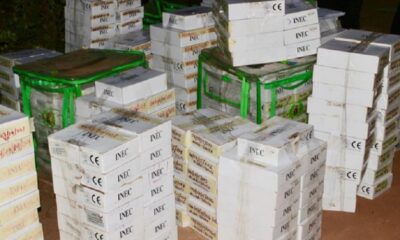
HAPPENING NOW: Security Beefed up at INEC Office in Osun Ahead of Saturday’s Governorship Election

Gov Mbah Invest in world-class Enugu International Hospital

Committees hit the ground running for 8th Kwara State Sports Festival

Tech Expert, Zuckerberg trains with UFC champions, Adesanya, Alexander

Organ Trafficking: Ekweremadu bags 10 years in UK prison

SAINT OBI: Between his marriage and his death
-

 Business2 days ago
FG approves tax waivers for 4,000 electric vehicles
-

 Business2 days ago
Naira Exchange Rates Thursday, August 13
-

 Business2 days ago
Azikel Refinery in Bayelsa Set To Add 25,000 bpd To National Capacity
-

 Business2 days ago
Guaranty Trust Bank doubles naira card international spending limit to $40,000
-

 Business2 days ago
Nigeria’s oil production dropped by 4% in July – NUPRC
-

 Sports2 days ago
Katsina United player declared dead found alive in mortuary
-

 Business3 days ago
Naira Exchange Rates Wednesday, August 12
-

 Politics2 days ago
Osun Polls: INEC Includes SDP Candidate, Deputy On Ballot Papers