
International
Afghan fathers forced to selling children to survive
Abdul tells us he is willing to sell his girls for marriage, or for domestic work. “If I sell one daughter, I could feed the rest of my children for at least four years,” he says.

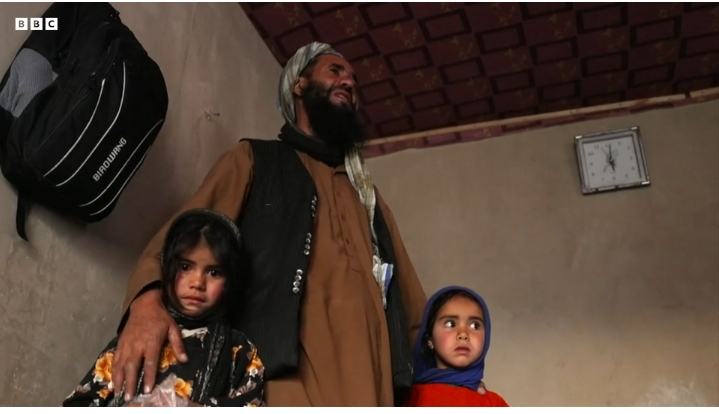
Image credit : BBC
This article contains distressing details . In Afghanistan today, a staggering three in four people cannot meet their basic needs, according to the UN. Unemployment is rife, healthcare struggling and the aid that once provided the basics for millions has dwindled to a fraction of what it once was.
The country is now facing record levels of hunger, with 4.7 million – more than a tenth of Afghanistan’s population – estimated to be one step away from famine.
BBC reported that as dawn breaks, hundreds of men gather at a dusty square in Chaghcharan, the capital of Ghor province in Afghanistan.
They line the roadside hoping someone will come along offering any work. It will determine whether their families eat that day.
The likelihood of success, however, is low.Juma Khan, 45, has found just three days of work in the past six weeks that paid between 150 to 200 Afghani ($2.35-$3.13; £1.76-£2.34) per day.
“My children went to bed hungry three nights in a row. My wife was crying, so were my children. So I begged a neighbour for some money to buy flour,” he says.
“I live in fear that my children will die of hunger.”
His story is in no way unique.
Ghor is one of the worst-affected provinces.
The men here are desperate.
“I got a call saying my children hadn’t eaten for two days,” says Rabani, his voice choking up.
“I felt like I should kill myself. But then I thought how will that help my family? So here I am looking for work.”
Khwaja Ahmad barely gets out a few words before he starts sobbing.
“We are starving. My older children died, so I need to work to feed my family. But I’m old, so no one wants to give me work,” he says.
When a local bakery near the square opens up, the owner distributes stale bread among the crowd.
Within seconds, the loaves have been pulled apart, half a dozen men clutching onto precious pieces.
Suddenly another scrum occurs.
A man on a motorcycle comes by wanting to hire one labourer to carry bricks. Dozens of men throw themselves at him.
In the two hours we were there, only three men got hired.
In the communities nearby – bare homes scattered over barren, brown hills, set against the snowy peaks of the Siah Koh mountain range – the devastating impact of unemployment is clear.
Abdul Rashid Azimi takes us into his home and brings out two of his children – seven-year-old twins Roqia and Rohila.
He holds them close, eager to explain why he’s making unbearable choices.
“I’m willing to sell my daughters,” he weeps. “I’m poor, in debt and helpless.
“I come home from work with parched lips, hungry, thirsty, distressed and confused. My children come to me saying ‘Baba, give us some bread’. But what can I give? Where is the work?”
Abdul tells us he is willing to sell his girls for marriage, or for domestic work. “If I sell one daughter, I could feed the rest of my children for at least four years,” he says.
He hugs Rohila, kissing her as he cries. “It breaks my heart, but it’s the only way.”
“All we have to eat is bread and hot water, not even tea,” says their mother, Kayhan.
Two of her teenage sons work polishing shoes in the town centre. Another collects rubbish, which Kayhan uses as fuel for cooking.
Saeed Ahmad tells us he has already been forced to sell his five-year-old daughter, Shaiqa, after she got appendicitis and a cyst in her liver.
“I had no money to pay the medical expenses. So I sold my daughter to a relative,” he says.
Shaiqa’s surgery was successful. The money for it came from the 200,000 Afghani ($3,200/£2,400) she has been sold for.
“If I had taken the whole sum at that time, he would have taken her away.
So I told him just give me enough for her treatment now, and in the next five years you can give me the rest after which you can take her,” explains Saeed.
She puts her tiny arms around his neck. Their close bond is evident, but in five years, she will have to leave and go to the relative’s home.
“If I had money, I would never have taken this decision,” Saeed says.
“But then I thought, what if she dies without the surgery? This way at least she will be alive.”
…
(Source: BBC)
International
“Mother of all bombs,” Trump Plans To Hit Iran
The 21,600-pound airburst weapon is designed to affect surface targets over a wide area and has so far not been deployed by the U.S. in previous strikes on targets inside Iran. It was used in Afghanistan in 2017 during the previous Trump administration.

The U.S. military is considering use of the GBU-43/B Massive Ordnance Air Blast (MOAB) bomb if it resumes strikes inside Iran, CNN reported Thursday, citing U.S. officials.
The 21,600-pound airburst weapon is designed to affect surface targets over a wide area and has so far not been deployed by the U.S. in previous strikes on targets inside Iran. It was used in Afghanistan in 2017 during the previous Trump administration.
Trump said Oct. 8 that he would not resume U.S. strikes on Iran before the Nov. 3 midterm elections, while attacks on shipping near the Strait of Hormuz and deadly Houthi strikes in Saudi Arabia have raised regional tensions.
Iranian Parliament Speaker Mohammad Bagher Ghalibaf said Tehran will combine military capabilities and negotiations to press its demands.
International
Child marriage in southern Germany: Over 350 cases recorded, some brides as young as 11
The most recent entries in the overview relate to 2026. They include, among other things, marriages of 16- and 17-year-old girls to adult men.

• Child marriage / UNICEF
In the southwestern German state of Baden-Württemberg, a total of 358 so-called child marriages have been officially recorded since 2012.
Euro News reported that only eight of these forced marriages have so far been legally annulled.
According to authorities, the other 350 cases were brought to an end in other ways.
This alarming finding comes from a response by the Baden-Württemberg state government to a minor inquiry submitted by AfD state parliament members Nikolaos Boutakoglou and Emely Knorr.
The Tübingen regional authority is responsible for recording the data, the answer came from the Ministry of the Interior.
The eight final annulments took place between 2018 and 2024. Among the documented cases was the marriage of an 11-year-old girl from Iraq to a 17-year-old Iraqi, which was annulled in 2020.
As early as 2018, the marriage of a 14-year-old Afghan girl to a 30-year-old man had been ended.
In 2024 two further annulments were added: they concerned a 16-year-old German girl and a 25-year-old Pakistani man and a 16-year-old Syrian girl and a 27-year-old man from the same country.State parliament member Nikolaos Boutakoglou wrote on Facebook that the issue was “really awful” but was being treated as a taboo.
According to its own account, the ministry deals exclusively with such marriages entered into abroad.
Since summer 2017, the Act to Combat Child Marriages has been in force in Germany.
In 2024, the Bundestag adopted new rules to protect minors in marriages concluded abroad.
Hundreds of cases without state intervention
The significantly higher number of cases concluded in other ways raises questions about how these marriages continued.
For the period from 2015 to 2026, the regional authority lists a total of 350 proceedings under the heading “other disposals.”But what became of the other child marriages?
The state government cites, among other things, the death of a spouse, reaching adulthood, a decision not to seek annulment or a new marriage concluded abroad.
In these cases, there was therefore no legally binding annulment.
For 2023, the records include the case of a 12-year-old Afghan girl who was married to a 21-year-old Afghan man. Girls aged 13 and 14 also appear several times in the statistics.
The most recent entries in the overview relate to 2026. They include, among other things, marriages of 16- and 17-year-old girls to adult men.
The statistics record the age of the spouses at the time of marriage and their respective nationalities.


Pope Leo XIV has announced that he will undergo surgery in the coming days to remove a small, localized nodule found on his lung during a recent routine medical checkup.
The 71-year-old pontiff made the disclosure himself during his weekly Angelus prayer in St. Peter’s Square. “Doctors found a localized nodule in my lung,” he said. “It was detected at a very early stage and is well-contained.
The doctors believe it is advisable to intervene, so, following their advice, I have decided to undergo surgery to remove it.”
The Vatican confirmed the operation is scheduled for the first days of this week at Rome’s Gemelli Hospital, which has a dedicated papal suite. Holy See spokesman Matteo Bruni said the Pope is expected to need about a week to recover. On Monday, the Vatican added that Leo will be admitted Tuesday morning.
The nodule’s nature—whether benign or malignant—has not been specified. Medical experts note that most lung nodules are non-cancerous, and early detection generally carries a favorable outlook.
This marks the first significant health issue of Leo’s papacy since his election in May 2025. The American-born pope, known for remaining physically active, has continued his full schedule of audiences and is still expected to proceed with a planned trip to Latin America next month.


JUST IN: Mob Sets BRT Bus Ablaze After Motorcyclist’s Death in Lagos

BREAKING: DSS Arrests Fugitive Maina Son, Hands Him to EFCC

BREAKING: 5 Arrested Over Imo NYSC Abduction

BREAKING: Lagos Govt Declares Today, Thursday Work-Free to Mark 2026 Ìṣẹ̀ṣe Day

Tech Expert, Zuckerberg trains with UFC champions, Adesanya, Alexander

Organ Trafficking: Ekweremadu bags 10 years in UK prison
-

 Business2 days ago
Naira Exchange Rates For Thursday, October 15
-
 Sports2 days ago
CAF Increases Annual Funding for Member Federations to $700,000
-

 News2 days ago
ASCON To Be Rebranded “National School Of Government”
-

 Business2 days ago
Germany plans tax on sugary drinks
-

 Business2 days ago
WEF could appoint Lagarde as its next chair, sources say
-

 International2 days ago
“Mother of all bombs,” Trump Plans To Hit Iran
-

 News3 days ago
Sanwo-Olu Appoints Olatunbosun Ogunbanwo, 5 Others as Perm Secs
-

 Business1 day ago
Naira Exchange Rates Friday, October 16