
News
Rising insecurity: NASS, ex-generals demand urgent military re-armament


Retired military generals have again called on the Federal Government to urgently equip the Nigerian Armed Forces, amid growing concerns over the resurgence of terrorists’ attacks and killings in the North-East.
This comes as the House of Representatives on Tuesday expressed deep concern over a recent deadly attack on a military facility in Giwa, Borno State, describing the incident as a glaring indicator that Boko Haram insurgents are better armed than the military.
During Tuesday’s plenary, the lawmakers lamented the gradual return of the terrorist group and the loss of lives in recent times in Borno and neighbouring Yobe States.
Though budgetary allocations to the defence and security sectors have steadily increased, there have been complaints and questions about the quality and volume of arms available to the troops.
In 2023, the Federal Government earmarked N2.98 trillion for defence and security. This rose to N3.25 trillion in the 2024 budget, and for 2025, President Bola Tinubu proposed a record N4.91tn out of the N49.7tn national budget, aimed at enhancing the operational effectiveness of security agencies.
Despite these substantial investments, Nigeria continues to grapple with deep-rooted security challenges, including insurgency and banditry.
The Defence Headquarters did not respond to the assertion by the House that the troops are ill-equipped when contacted on Tuesday.
The Director, Defence Information, Brig. Gen. Tukur Gusau, referred inquiries to the Director, Defence Media Operations, Maj. Gen. Markus Kangye. But Kangye did not respond to phone calls or a text message sent to him on the issue.
However, retired senior military officers urged the Federal Government to prioritise the procurement of modern combat equipment and improved intelligence support to the frontline troops.
They warned that without immediate intervention, the hard-won gains in the war against insurgency could be reversed.
Brigadier General Peter Aro (retd.) said the question of whether terrorists are better armed than the Nigerian military “is no longer rhetorical.
”Describing it as a red flag that demanded urgent intervention, Aro warned that the insurgent groups have evolved from ragtag militias to highly equipped forces with access to encrypted communications, drone surveillance, night-vision devices, GPS-guided explosives, and coordinated strike systems.
He stated, “While our troops remain committed and valiant, the battlefield has shifted from muscle to machine. Without matching this evolution, we risk sending brave soldiers into asymmetric warfare ill-equipped for modern threats. This isn’t about panic, it’s about parity.
“To stay ahead, Nigeria must make an urgent, strategic shift: fund intelligence, equip the army, and fast-track tech superiority. Gadgets that drive modern warfare, from satellite-linked sensors to AI-based surveillance tools, are prohibitively expensive, yet necessary.
“The army, under the leadership of one of the most competent, tested, and forward-thinking Chiefs of Army Staff in recent times, cannot afford to be left behind.
He has the vision, the field experience, and the strategic acumen; what he needs now is full backing. Not just in words, but in robust budgetary commitments that reflect the true cost of winning an intelligence-driven war.
The political leaders must show they have the willpower to take crucial decisions.
”Similarly, retired Brigadier General Bashir Adewinbi called for the military to be empowered with advanced intelligence-gathering tools such as surveillance drones and surveillance technologies that could aid in planning and executing strategic counterterrorism operations.
“You see what they (the terrorists) carry—it is above what our military is carrying,” Adewinbi affirmed. “We need equipment that can gather intelligence, monitor insurgents’ activities so the military knows what action to take,” he added.
Beyond a military solution, Adewinbi advocated for strong political will to address the root causes of insecurity, warning that some political actors may be exploiting the crisis for personal or partisan gain.
“They should be more stringent with whoever is involved in banditry or terrorist activities, regardless of who they are. Nigeria is our country, you don’t invite an enemy from outside just to discredit your political opponent, “ he said.
He also decried Nigeria’s porous borders, which he described as an open gateway for individuals with dangerous intentions.
“Anybody can go and come, anyhow, anytime, without being monitored,” he noted.
A former spokesman for the Nigerian Air Force, Group Captain Sadique Shehu (retd.), demanded strict accountability, pointing out that without proper monitoring, funds allocated to the armed forces may be misused.
Speaking in an interview, Shehu said, “If you allow the military on their own to decide how to do their work and how to spend their money, the funds won’t get anywhere.
In a democracy, either the executive branch or the legislature is supposed to be in a position to check these people. The system is awash with money, but there must be accountability.
’’According to him, the Nigerian public did not elect the service chiefs, and as such, the responsibility for ensuring that defence funds are well spent lies squarely with the elected officials.
“People do not elect the Chief of Army Staff or the Chief of Air Staff. They elected the president and lawmakers. They are the ones responsible. Yes, you are giving the military money, but did you follow the money and see where it was put?” he queried.
He likened the situation to household spending, saying, “Even if you give your wife a million naira and you don’t check how the children are feeding, she might be the kind of woman that likes buying gold or spending at ceremonies.
Certainly, you gave her one million – there’s no doubt about that – but what is being done with that money? There is no oversight.
There’s no oversight by the executive, there’s no oversight by the legislature.
”During the resumption of plenary on Tuesday, the member representing Jere Federal Constituency, Borno State, Ahmed Satomi, presented a motion of urgent public importance on the renewed attacks by terrorists in his state.
Rallying support for the motion, Satomi, a member of the All Progressives Congress, lamented the recent fire incident in Giwa Barracks and the attacks on military formations in Borno and Yobe States.
News
Breaking: Military rescue 20 corps members, civilian in Imo
The victims were reportedly abducted while travelling through the state, prompting security agencies to launch an operation to locate and rescue them.

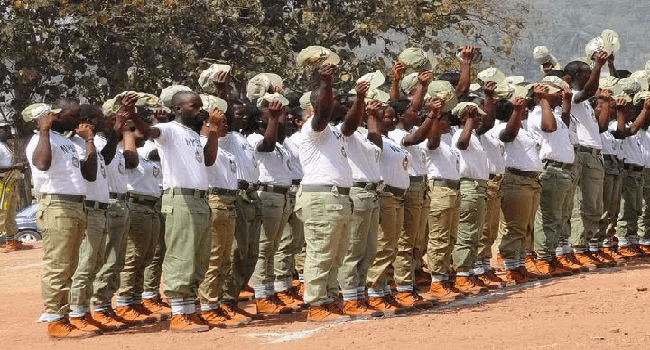
The military, Department of State Services, DSS, police and other security agencies have rescued twenty prospective National Youth Service Corps, NYSC, members and one civilian abducted in Imo State.
The victims were reportedly abducted while travelling through the state, prompting security agencies to launch an operation to locate and rescue them.
The rescued victims are currently receiving medical attention at a DSS facility, according to security sources, while efforts are ongoing to establish the circumstances surrounding the abduction and apprehend any remaining suspects.
News
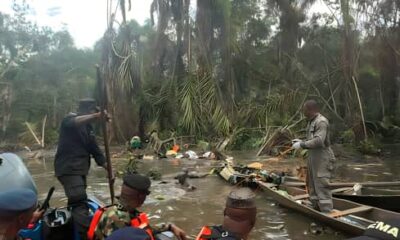
Military Chiefs Visit Ondo Crash Site As Underwater Search Intensifies
The Nigerian Navy has also brought in specialized hydrographic divers to map the murky waters while plans are underway to use swamp buggies for excavation.
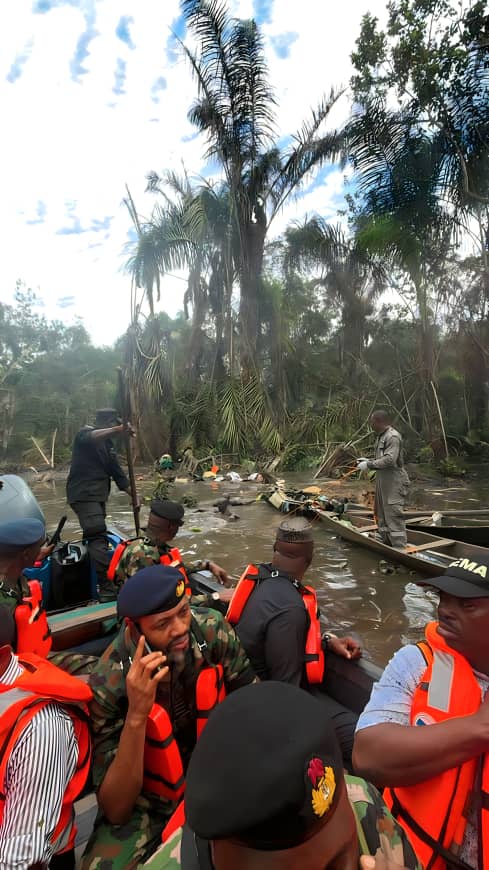
Top military chiefs have visited the crash site of the Nigerian Air Force ATR-42 aircraft in Igbokoda, Ondo State.
The Western Naval Command FOC, Rear Admiral Abubakar Mustapha and Logistics Command AOC, Air Vice Marshal Abubakar Abdul Suleh led the visit to inspect ongoing recovery efforts.
To locate the submerged aircraft, teams have deployed advanced underwater sonar equipment and drones across the difficult mangrove terrain.
The Nigerian Navy has also brought in specialized hydrographic divers to map the murky waters while plans are underway to use swamp buggies for excavation.
Rear Admiral Mustapha thanked the Ondo State Government, local communities and emergency agencies for their support while appealing to the public to remain calm as the operation continues.
The Nigerian Air Force (NAF) has released the identities of the people who died in the crash involving an NAF ATR 42 aircraft in the Igbokoda area of Ondo State, on Monday.
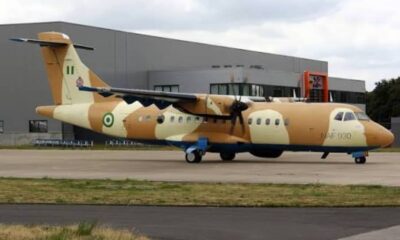
The aircraft, NAF 931, was carrying five crew members and 20 passengers when it crashed during a routine mission from Benin to Lagos.
In a statement, Air Commodore Ehimen Ejodame, NAF spokesperson, said no survivor had been found following the accident, which prompted the immediate activation of search-and-rescue operations in coordination with relevant authorities.
Those killed include five crew members: Squadron Leader MI Aburime, the flight captain; Squadron Leader AP Man-Ugwueje, co-pilot; Flight Lieutenant IS Bako, co-pilot; Warrant Officer Abubakar A, aircraft technician; and Corporal Uguru HC, aircraft technician.
The 20 passengers were identified as Flight Lieutenant TL Lazarus; Flight Lieutenant M Akinloye; Flying Officer IM Adeshina; Master Warrant Officer Onwuka F; Master Warrant Officer Matini BA; Warrant Officer Nuhu FS; Flight Sergeant James RB; Flight Sergeant Mohammed AI; Sergeant Ani AE; Sergeant Izibenikien SI; Sergeant Alafuka C; Sergeant Mbadugha AN; Lance Corporal Ugwuba FC; Lance Corporal Eledan GE; Mrs Ezeh Nneka; Godstmine Tarabina; Joy Micheal; Sunday Micheal; Ukeme David; and Gideon Omotola.
The Chief of the Air Staff, Air Marshal Sunday Kelvin Aneke, expressed profound condolences to the families, loved ones and colleagues of those who lost their lives in the crash.
Aneke described the incident as a deeply painful moment for the Nigerian Air Force and the country, while assuring the bereaved families of the Service’s full support during the difficult period.


Breaking: Military rescue 20 corps members, civilian in Imo

African Union launch continent’s first credit rating agency

Military Chiefs Visit Ondo Crash Site As Underwater Search Intensifies

Tech Expert, Zuckerberg trains with UFC champions, Adesanya, Alexander

Organ Trafficking: Ekweremadu bags 10 years in UK prison

SAINT OBI: Between his marriage and his death
-

 Sports3 days ago
FIFA to decide 2030 World Cup final venue in 2028 as Morocco, Spain wait
-

 News3 days ago
NGE Tasks Newsrooms, INEC on Must-Do Measures for Credible 2027 Polls
-

 Entertainment3 days ago
BBNaija season 11: “And The Winner is Temi Nkem”
-
 Business3 days ago
Naira Rates To Dollar , Pound, EURO… Monday, October 5
-
 News14 hours ago
Military Chiefs Visit Ondo Crash Site As Underwater Search Intensifies
-
 News3 days ago
Military Aircraft Crashes Near Ondo Naval Base; 32 On Board
-

 Politics2 days ago
I sleep And Eat Thinking About Tinubu’s Re-Election – Wike
-

 Politics1 day ago
BREAKING: APC Chairmen Accused of Leading Armed Attacks on ADC Members in Igueben