
Health
MPOX: Nigeria, Others To Benefit As WHO Plans $135m Fund


Nigeria and several other countries that have been recently hit by the Monkey Pox (MPOX) outbreak, stand to benefit from a $135m funding plan by the World Health Organization (WHO).
A statement by the organisation on Monday said the fund was necessary as it has launched a global Strategic Preparedness and Response Plan to stop outbreaks of human-to-human transmission of mpox through coordinated global, regional, and national efforts.
This follows the declaration of a public health emergency of international concern by the WHO Director-General on 14 August.
Although the current plan is subject to inputs by WHO’s member states, who were briefed on the plan on 23 August, the plan covers the six-month period of September 2024-February 2025.
During the period, a $135m funding need is envisioned for the response by WHO, member states, and partners, including the Africa Centres for Disease Control and Prevention (Africa CDC) which Nigeria is a member, communities, and researchers, among others.
The plan, which builds on the temporary recommendations and standing recommendations issued by the WHO Director-General, Dr Tedros Ghebreyesus focuses on implementing comprehensive surveillance, prevention, readiness and response strategies; advancing research and equitable access to medical countermeasures like diagnostic tests and vaccines; minimising animal-to-human transmission; and empowering communities to actively participate in outbreak prevention and control.
Strategic vaccination efforts will focus on individuals at the highest risk, including close contacts of recent cases and healthcare workers, to interrupt transmission chains.At the global level, the emphasis will be on strategic leadership, timely evidence-based guidance, and access to medical countermeasures for the most at-risk groups in affected countries.
WHO said it is working with a broad range of international, regional, national and local partners and networks to enhance coordination across key areas of preparedness, readiness and response.
This includes engagement with the ACT-Accelerator Principals group; the Standing Committee on Health Emergency Prevention, Preparedness and Response; the R&D Blueprint for Epidemics; and the interim Medical Counter Measures Network (i-MCM Net).
“The mpox outbreaks in the Democratic Republic of the Congo and neighbouring countries can be controlled and can be stopped.
“Doing so requires a comprehensive and coordinated plan of action between international agencies and national and local partners, civil society, researchers and manufacturers, and our Member States.
This SPRP provides that plan, based on the principles of equity, global solidarity, community empowerment, human rights, and coordination across sectors,” said Dr Ghebreyesus.
Nigeria Intensifies Surveillance As Mpox Cases Hit 39The Nigeria Centre for Disease Control (NCDC) said a total of 39 confirmed cases and zero deaths from mpox have been recorded across 33 states and the Federal Capital Territory.
Director General of the NCDC, Jide Idris, made the revelation at a press briefing on the declaration of mpox as a public health emergency of international concern earlier in the month.
He said the NCDC is intensifying surveillance across Nigeria to swiftly detect and respond to new cases.
According to Idris, the NCDC all port health services across all five international airports, 10 seaports, and 51 land/foot crossing borders are on high alert.
He added that some states have also been put on high alert including Lagos, Enugu, Kano, Rivers, Cross-River, Akwa-Ibom, Adamawa, Taraba, and the Federal Capital Territory, Abuja.
WHO recently declared the mpox surge in Africa a global public health emergency, worried by the rise in cases in DRC and the spread to nearby countries.
The WHO called a meeting of experts to study the outbreak and make a recommendation to Dr Ghebreyesus.
“Today, the emergency committee met and advised me that in its view, the situation constitutes a public health emergency of international concern. I have accepted that advice,” Tedros told a press conference.
“This is something that should concern us all. WHO is committed in the days and weeks ahead to coordinate the global response, working closely with each of the affected countries, and leveraging our on-the-ground presence, to prevent transmission, treat those infected, and save lives.
”The decision comes after the African Union’s health watchdog declared its public health emergency over the growing outbreak.
Mpox has swept through the Democratic Republic of Congo, where the virus formerly called monkeypox was first discovered in humans in 1970, and spread to other countries.
Tedros said the more than 14,000 cases and 524 deaths reported so far this year in DR Congo have already exceeded last year’s total.

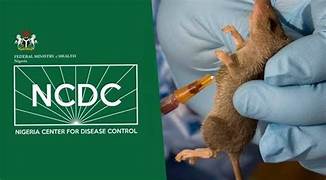
The Nigeria Centre for Disease Control and Prevention (NCDC) has confirmed that Lassa fever has claimed 259 lives and infected 1,086 people across 24 states and 118 local government areas so far in 2026.
In its latest Lassa Fever Situation Report for epidemiological week 36 (August 31 to September 6), the agency said the figures represent a case fatality rate of 23.9 percent — significantly higher than the 18.6 percent recorded during the same period in 2025.
Twelve new confirmed cases were recorded in week 36, a decline from the 18 cases reported the previous week. The fresh infections were detected in Ondo, Edo and Kogi states.
Five states continue to bear the heaviest burden, accounting for 87 percent of all confirmed cases this year: Bauchi, Ondo, Taraba, Benue and Edo. People aged 21 to 30 remain the most affected age group.
The NCDC noted that no new infections among healthcare workers were recorded during the latest reporting week. The agency continues to urge the public to maintain hygiene, avoid contact with rodents and their droppings, and seek early medical care if symptoms appear.
Health
Nigerian hospital successfully performs kidney cancer surgery via tele-robotic
The development could reduce the need for Nigerians to travel abroad for specialised medical treatment, thereby reducing expenditure on international travel, accommodation and medical services.

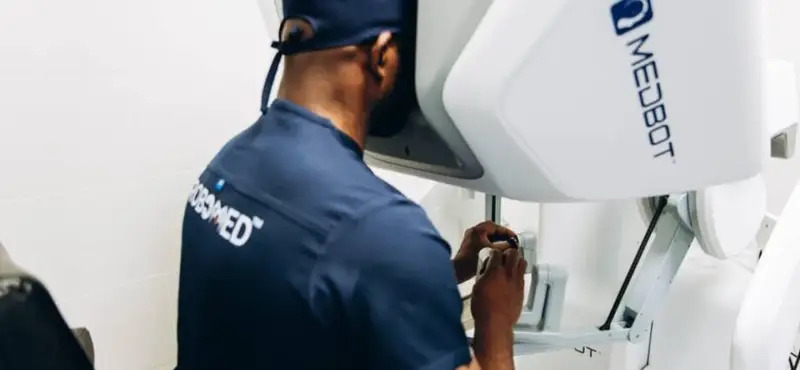
• A surgeon performing tele-robotic surgery.
Nisa Premier Hospital, Abuja, has partnered with RoboMed Global and The Redeemer’s Health Village (RHV) to successfully perform what the hospital described as the first tele-robotic surgery in Nigeria and West Africa.
The landmark kidney cancer surgery was performed on a patient at Nisa Premier Hospital, Abuja, while the surgeon, Professor Obi Ekwenna-Davis, remotely controlled the robotic surgical platform from Redeemer’s Health Village in Lagos.
The procedure, which lasted approximately three hours, was performed to remove a kidney affected by a cancerous tumour.
The hospital said the patient had been discharged following the successful procedure, although details about the patient’s identity and condition were withheld for privacy reasons.
Speaking during an event to mark the milestone, the Chief Executive Officer of Nisa Premier Hospital, Dr Ibrahim Wada, said the development demonstrated the potential of tele-robotic surgery to connect specialist surgical expertise with patients across Nigeria.
Wada said the procedure was carried out using the MicroPort robotic surgical platform installed at Nisa Premier Hospital, with the remote surgeon controlling the system from Lagos.
He said the development could reduce the need for Nigerians to travel abroad for specialised medical treatment, thereby reducing expenditure on international travel, accommodation and medical services.
According to him, the technology also creates an opportunity for Nigerians to access specialised expertise from doctors located in other parts of the world without requiring the doctors to travel physically to Nigeria.
Source: Daily Trust
Health
Ondo ‘Monkey Tail’ herbal drink kills 49
The Commissioner for Health in the State, Dr Banji Ajaka, who disclosed this on Wednesday night, said the number of affected persons has now climbed to 170.

A locally produced herbal concoctions known as ‘Monkey Tail’ in Ondo State has killed 49 people .
The Commissioner for Health in the State, Dr Banji Ajaka, who disclosed this on Wednesday night, said the number of affected persons has now climbed to 170.
He explained that the latest deaths were recorded in Irele Local Government Area of the state, where eight persons have died from suspected poisoning.
Ajaka disclosed that health authorities had deployed response teams to Irele LGA and other affected communities to conduct surveillance, manage cases and trace the source of the suspected toxic substance.


Naira Rates To Dollar, Pound ,Euro… Friday, October 2

Obafemi Hamzat promises to end ‘unauthorised levies’ in Lagos if he is elected

President Tinubu, Other Political Leaders Watch MKO Documentary

Tech Expert, Zuckerberg trains with UFC champions, Adesanya, Alexander

Organ Trafficking: Ekweremadu bags 10 years in UK prison

SAINT OBI: Between his marriage and his death
-

 Business3 days ago
Naira To Dollar, Pound, Euro… Rates Friday, October 1
-

 News3 days ago
Nigeria @ 66: President Tinubu says next phase of reforms’ll cut cost of living
-

 Business3 days ago
Court orders NMDPRA to continue issuing fuel import licences to Matrix Energy, AA Rano, AYM Shafa
-
 News3 days ago
FG launches new digital postcodes
-

 Business3 days ago
Minister Tasks Charcoal Merchants on Sustainable Forestry
-

 International3 days ago
How Passengers Overpowered Flydubai Co-Pilot After Stabbing Pilot, To Crash Plane
-
 Business3 days ago
Obasanjo: “Aliko Embarrass Me”
-

 Sports2 days ago
NBA closes basketball academy in Africa