
International
Dam bursts in war-torn Sudan, kills 60

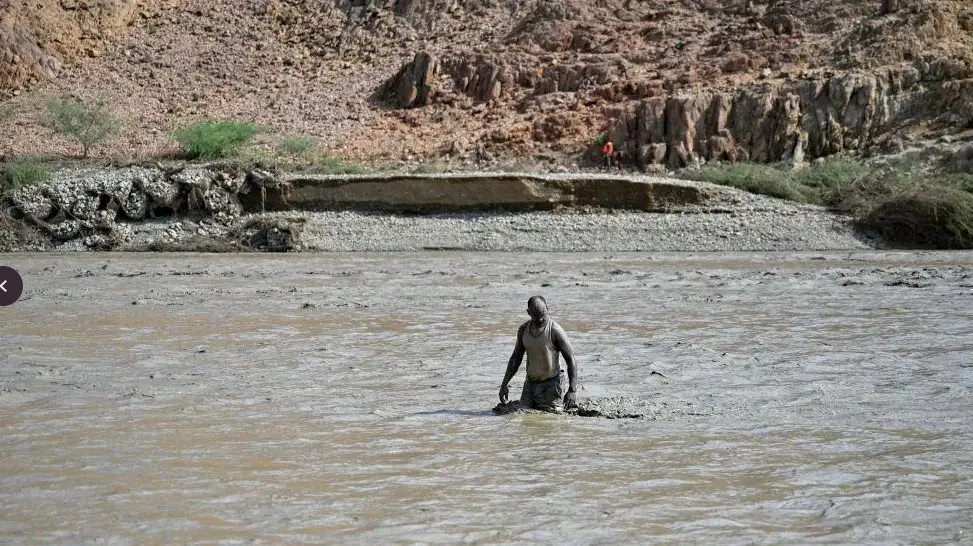
At least 60 people have died after a dam burst in war-torn Sudan due to heavy rainfall, adding to the growing humanitarian crisis in the region.
The Arbat Dam, located in Red Sea State, collapsed under the pressure of torrential rains, leading to catastrophic flooding that swept away farms, villages, and vehicles downstream.
The dam, which has a capacity of 25 million cubic meters, was a crucial source of drinking water for Port Sudan, where the military government is headquartered.
The collapse has left the city and surrounding areas without a stable water supply, further complicating the lives of residents already battered by 16 months of civil war.
Search and rescue operations are currently underway, but authorities fear the death toll may rise as efforts continue to locate missing persons.
Local residents have reported harrowing scenes, with people trapped in vehicles and homes being washed away by the floodwaters.
Ali Issa, a local resident, described the desperate situation: “People were stuck in seven cars—they tried to get them out but couldn’t.
”Another resident, Moussa Mohamad Moussa, reported that entire communities had been wiped out: “All the houses and everything was swept away.”
The flooding has also damaged a major fiber-optic cable, causing a widespread communication outage across several parts of the country.
The disruption has hampered coordination of rescue efforts and left many communities isolated.
The Sudanese Air Force has been deployed to rescue people who sought refuge in the mountains, according to reports from local newspaper Merdameek.
The director of the Red Sea State’s Water Authority, Omar Issa Tahir, confirmed to local news site Akhbar that the flooding had “wiped out the entire area.”
Army chief Abdul-Fattah al-Burhan visited the flood-stricken areas, and the military issued an urgent appeal on social media for federal and state agencies to provide immediate assistance to those affected.
Sudan has been mired in conflict since April 2023, when fighting erupted between the paramilitary Rapid Support Forces (RSF) and the Sudanese army.
The ongoing war has displaced millions and led to widespread famine, with the recent extreme weather only worsening the dire situation.
International
At UN, 80 countries demand reopening of Hormuz, condemn Iran, Houthi attacks
“Iran’s actions in the Strait of Hormuz continue to threaten international security and navigational rights and freedoms,” said a joint statement read out by Bahrain’s Foreign Minister Abdullatif bin Rashid Al Zayani at the United Nations.


• UN General Assembly
Some 80 countries at the ongoing 81st United Nations General Assembly on Thursday demanded the urgent reopening of the Strait of Hormuz and condemned Iran and its Houthi allies for attacks in the region and disruption to international trade and energy security.
“Iran’s actions in the Strait of Hormuz continue to threaten international security and navigational rights and freedoms,” said a joint statement read out by Bahrain’s Foreign Minister Abdullatif bin Rashid Al Zayani at the United Nations.
“We also strongly condemn the Houthis’ decision to resume conflict in Yemen, their continuous strikes on Saudi Arabia, and their reckless attacks in the Red Sea,” the statement said.
The statement’s backers included Gulf Arab states and major Western powers.
It added that the Houthis’ advance towards Bab el-Mandeb Strait would also only heighten risks to international shipping, maritime security and global trade.
Both Iran and the Houthis frame their actions as defensive.
Credit: REUTERS

Teachers trained in Nigeria and Ghana are no longer eligible to apply for Qualified Teacher Status (QTS) in England through the UK’s dedicated overseas-trained teacher application route.
The change, confirmed by the Department for Education (DfE), took effect on 9 September 2026. India was also removed from the list of eligible countries.
Under the updated rules, a country must have a national regulator that can confirm a teacher’s professional standing and must be able to provide references that meet the DfE’s verification standards.
For Nigeria and Ghana, the DfE cited problems with employment references. Official data showed that more than 70% of applications from teachers trained in the two countries included work history references sent from public email addresses such as Gmail or Hotmail, rather than official school email domains. The department said this made verification more difficult and resource-intensive.
India was removed because it does not have a national regulator capable of confirming teachers’ professional standing.
South Africa is now the only African country whose teachers remain eligible to use the direct “Apply for QTS in England” service.
The DfE stated that the stricter requirements are intended to ensure overseas teachers awarded QTS have the skills and experience needed to teach in English schools, and that the information they provide can be properly verified.
Teachers trained in Nigeria, Ghana or India who are no longer eligible for the direct application route can still explore alternative paths into teaching in England. These include assessment-only QTS routes offered by some schools or completing initial teacher training in the UK.
International
Trump launches ‘Trump TV’ as US networks halt White House coverage
The development followed the decision by ABC, CBS, Fox News and NBC to suspend their participation in the White House television pool after CNN was prevented from carrying out its scheduled pool duties.

US President Donald Trump’s administration has launched a 24-hour streaming channel, “Trump TV”, after major American television networks suspended their shared coverage of presidential events amid a growing dispute over access to the White House.
The White House announced the launch on Monday, describing the platform as “TRUMP TV: The Essentials Station” and saying it would provide viewers with past presidential moments, major announcements and the latest content from the administration.
The stream is available through the White House website and its official YouTube channel.
The development followed the decision by ABC, CBS, Fox News and NBC to suspend their participation in the White House television pool after CNN was prevented from carrying out its scheduled pool duties.
CNN, MS NOW and Politico had earlier sued the Trump administration after being barred from the White House grounds, arguing that the restrictions violated their constitutional rights.
The administration has defended the ban, with Trump accusing the affected outlets of publishing what he calls “fake news”.
The television pool normally allows participating networks to rotate responsibility for recording and distributing footage of the President to broadcasters across the United States and other parts of the world.
CNN was scheduled to handle the pool coverage on Monday but was prevented from doing so.
The other networks subsequently declined to provide a replacement, creating an unusual gap in shared television coverage of Trump’s official activities. The decision also affected coverage of the President’s inauguration of a new helipad at the White House on Monday.


South African kills Nigerian bar worker

Djibouti, Ethiopia and Dangote to build $660 million petroleum pipeline

At UN, 80 countries demand reopening of Hormuz, condemn Iran, Houthi attacks

Tech Expert, Zuckerberg trains with UFC champions, Adesanya, Alexander

Organ Trafficking: Ekweremadu bags 10 years in UK prison

SAINT OBI: Between his marriage and his death
-

 Business3 days ago
Gambia Orders Nigerian Banks To Replace Foreign Staff by December 2026
-

 International3 days ago
Trump launches ‘Trump TV’ as US networks halt White House coverage
-
 News3 days ago
Independent Panel Begins Probe into 37 Deaths in Civil Defence Custody
-

 Business3 days ago
Fans shown 65,000 junk food ads at World Cup
-

 Business3 days ago
Dangote Whets Investors Appetite Ahead 2028 Fertiliser IPO
-

 Business3 days ago
Naira To Dollar, Pound, Euro…Rate Today, September 22
-

 Health3 days ago
Nigerian hospital successfully performs kidney cancer surgery via tele-robotic
-

 Sports3 days ago
Mbappé Leaves Nike To Promote Swiss Sportswear Brand On