
Business
MAN, NECA Seeks Governor Sanwo-Olu’s Intervention over Factories Shutdown by LASWARCO

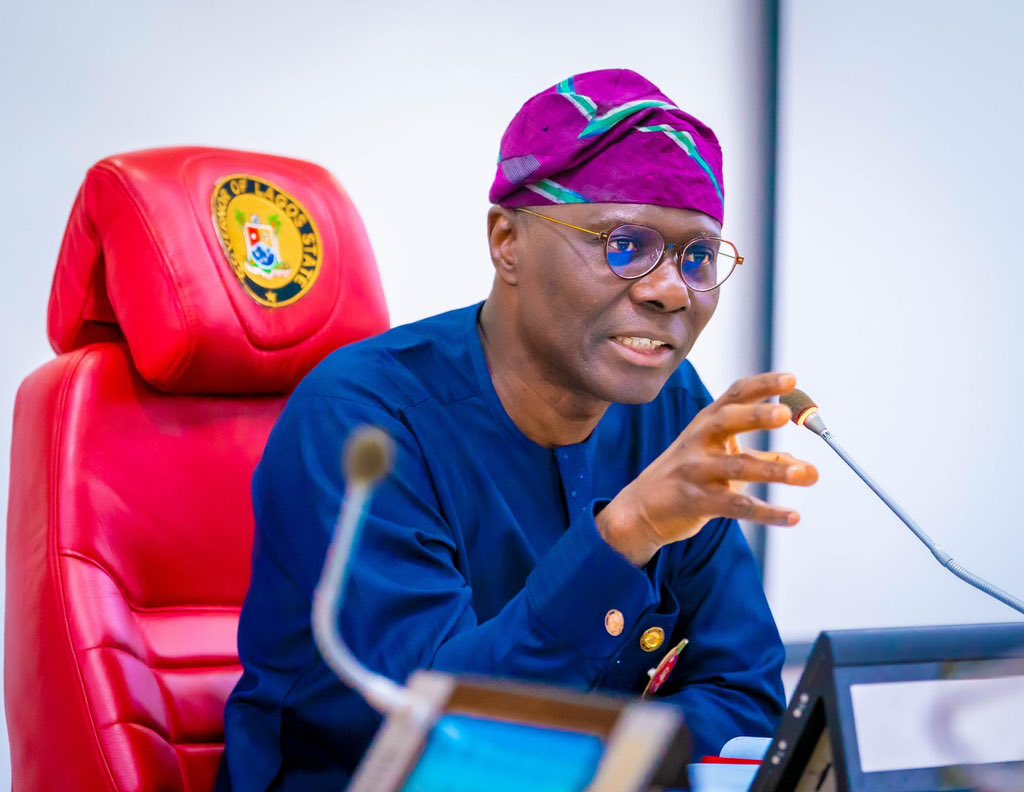
The Manufacturers Association of Nigeria (MAN) is imploring the Governor of Lagos State, Babajide Sanwo-Olu, to use his good office to order the immediate reopening of the closed factories of Nigerian Bottling Company, Friesland Campina, and Guinness Nigeria Plc by the Lagos State Water Regulatory Commission (LASWARCO).
This is even as the Nigeria Employers’ Consultative Association (NECA) condemned the regulatory actions by LASWARCO, warning that it is capable of scaring potential investors away from the state.
In an open message to Governor Sanwo-Olu today, Segun Ajayi-Kadir, the Director-General of MAN, said that the association is constrained to convey this open message to the Governor of Lagos State, as all attempts at approaching the relevant heads of agencies and ministry have failed.
He said: “MAN is appalled by the inauspicious act of sealing factories over their purported refusal to pay the astronomical and unjustifiable water abstraction fees imposed by the Commission.
This action is ill-timed and quite unfortunate, as the Commission and MAN had engaged in meaningful dialogue and reached some agreements over the lingering issue about three months ago.
This was expected to culminate in an MoU to commence in January 2025. Only three weeks ago, another round of discussions took place between LASWARCO and representatives of MAN, including the affected member companies, which led to ongoing discussions in the companies as to the most viable option for addressing the alleged outstanding payments from earlier contested fees.
It was while these discussions were going on and during the Yuletide that the Commission decided to cause this major and unwise shutdown of the companies.
It is important to properly situate this inappropriate action within the context of the prevailing inclement operating environment in general and the downturn in the manufacturing sector in particular.
A situation where industries are burdened with payments above N100 million for generating water for production purposes, in the face of the government’s failure to supply the same, is unfair.
The exorbitant fees and the untoward means of extracting payment exemplify the negative impact of the tyranny of regulation on private business.
To date, manufacturers across the country are saddled with more than N1.2 billion of unsold inventory, borrowing at more than 30 percent and struggling under a debilitating 250 percent increase in the cost of power.
Numerous taxes, fees, and levies by the three tiers of government and non-state actors in some cases, numbering between 60 to 120, confront each manufacturer, not to mention the disruption of production activities due to insecurity and the high cost of logistics.
There are more! So to add this oppressive water abstraction fee in Lagos state that may potentially be adopted by other States presents an ominous and rancorous future for manufacturers in particular and private businesses in general.
MAN, therefore, implores the Governor of Lagos state to use his good office to order the immediate reopening of the closed factories.
This will pave the way for a logical and passable conclusion of the ongoing conversations on how to permanently resolve the matter of outstanding fees, as well as conclude the impending MoU between the Water Commission and the Organised Private Sector.
This is more so that the private sector is currently awaiting the finalization of the text of the MoU from LASWARCO. We are full of expectations that immediate action is taken in the interest of the state’s economy and to forestall a possible degeneration in the already tense business atmosphere.
The possible loss of jobs and its attendant socioeconomic implications, as well as the negative signal to the investing public, should serve as a deterrent and encourage a business-friendly regulatory environment.”
NECA’s Director-General, Mr Adewale-Smatt Oyerinde, appealed to Governor Babajide Sanwo-Olu to intervene in the matter to save businesses in Lagos from further woes.
The director-general emphasized that organized businesses are not against responsible regulations.
He, however, noted that in the quest for revenue generation, the LASWARCO and, indeed, all other regulatory agencies should adopt a more legitimate and civil approach rather than the predominant disruptive pattern of recent times.
“Those patterns are directly against the efforts of the Federal Government to attract investment, promote job creation, and facilitate responsible regulations,” Oyerinde said.
Oyerinde described the demand for unjustifiable multimillion sums as water abstraction levies from businesses that had already paid many other forms of taxes for the same activities they use the water for as unreasonable.
“May we reiterate that it is the responsibility of the government to provide water for its citizens and businesses,” he said.
He noted that the government was not currently fulfilling this noble responsibility. “
It will be highly insensitive, harsh, and punitive for the same government that has failed to adequately provide water to also impose punitive levies on businesses that are constrained to make investments in providing water to run their businesses,” he said.




Business
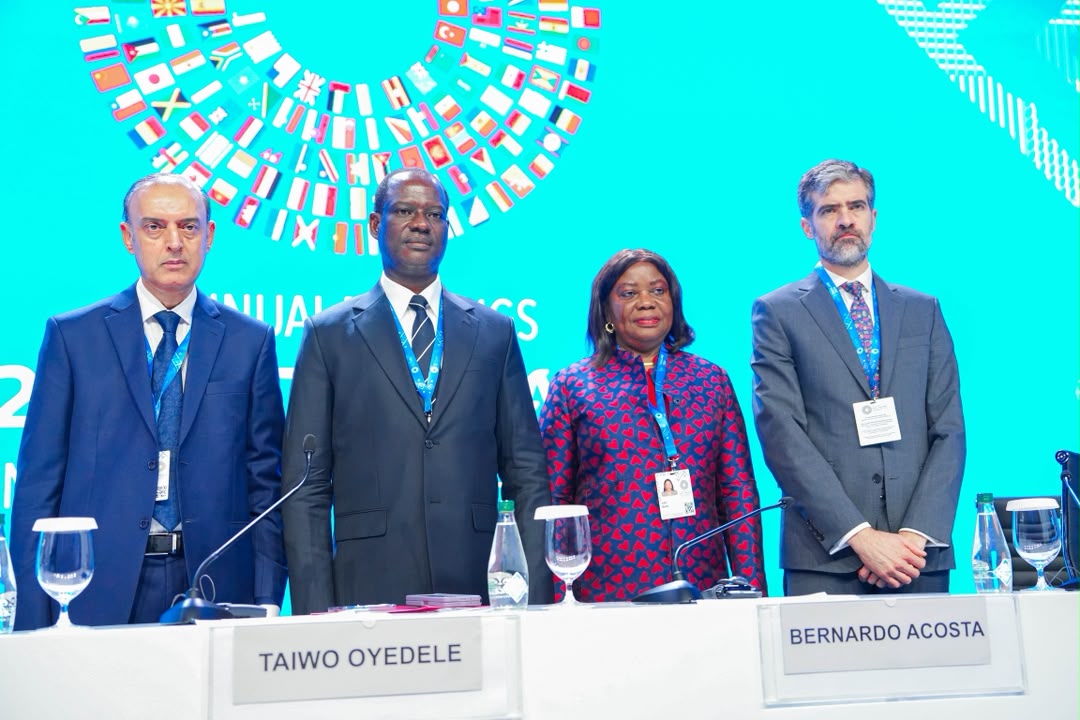
Oyedele Chairs G-24 Call for Fairer Global Financial System, Affordable Development Financing
The meeting concluded that domestic reform alone will not shield developing economies from external shocks — affordable finance, effective debt resolution, fairer representation in international institutions, and sustained cooperation are equally necessary.

Business
NAFDAC scolds fake manufacturers: “You are killing Nigerians in order to make money”
He warned that the circulation of counterfeit drinks posed a serious public health concern, urging suspected manufacturers to abandon the illegal trade.

“You are killing Nigerians in order to make money,which is not good.”
That’s the National Agency for Food and Drug Administration and Control (NAFDAC) scolding Nigerians caught in the act of counterfeiting drinks.
The occasion was at Zamfara Plaza, BBA Trade Fair Complex, along the Badagry Expressway, Ojo, Lagos State.
The Assistant Director of the Investigation and Enforcement Directorate of NAFDAC, Mr Kunle Ojo, who led the enforcement said the agency caught some of the suspects in the act and recovered drums, filters, packaging materials, a heating device and other equipment allegedly used in the illicit production process.
The suspects, identified as Okafor and John, were arrested during an enforcement operation in a two-storey building where equipment and materials allegedly used to repackage and produce counterfeit alcoholic and energy drinks where discovered.
The raid, according to NAFDAC, followed credible intelligence and surveillance on suspected counterfeiters operating within the Trade Fair International Market.
He warned that the circulation of counterfeit drinks posed a serious public health concern, urging suspected manufacturers to abandon the illegal trade.

Shell has agreed to sell its entire interest in the Shell Nigeria Gas Group, which runs a domestic natural gas distribution network, to Nigerian energy firm Vaaris Energy Limited.
The deal, announced on Tuesday, October 13, 2026, covers Shell Petroleum B.V.’s full stake in the business. Shell Nigeria Gas, established in 1998, operates about 170 kilometres of pipelines across Ogun, Abia and Rivers states and supplies more than 130 industrial and commercial customers. Financial terms were not disclosed. Completion remains subject to regulatory approvals and other conditions.
Shell said the business will continue operating as normal and serving customers until the transaction closes. The company does not participate in upstream production, LNG or international gas trading through this unit.
Elohor Aiboni, Shell’s Country Chair in Nigeria, said: “Shell Nigeria Gas has served industrial and commercial customers in Nigeria for more than 25 years, supported by the commitment and expertise of its people. We believe this agreement provides a much stronger platform for the business’ next chapter under new ownership. Shell continues to focus on strategic Deepwater and Integrated Gas positions in Nigeria.”
The sale forms part of Shell’s broader strategy under CEO Wael Sawan to simplify its portfolio and concentrate on higher-return assets. It follows the company’s completed exit from onshore oil production in Nigeria, when it sold the Shell Petroleum Development Company to the Renaissance consortium in 2025.
Vaaris Energy is a privately held Nigerian company with interests across the oil and gas value chain and an existing operational presence in the country.


Sanwo-Olu Appoints Olatunbosun Ogunbanwo, 5 Others as Perm Secs

Exclusion of candidates from INEC list: CD cautions INEC against manipulation by politicians

Oyedele Chairs G-24 Call for Fairer Global Financial System, Affordable Development Financing

Tech Expert, Zuckerberg trains with UFC champions, Adesanya, Alexander

BREAKING: Lagos Govt Declares Today, Thursday Work-Free to Mark 2026 Ìṣẹ̀ṣe Day

Organ Trafficking: Ekweremadu bags 10 years in UK prison
-
 Business3 days ago
Nigeria’s ₦33bn Fruit Import Bill Exposes Missed Opportunities in Jos
-

 Business3 days ago
Naira To Dollar, Pound ,Euro …Rates For Monday, October 12
-
 Politics3 days ago
BEWARE: Fake 2027 Gov’ Candidates List Circulating Online — INEC Raises Alarm
-
 News3 days ago
Forbes Scores GTBank Best Employers 2026
-

 Politics3 days ago
2027: 119 Women Jostle For State’s Governors
-
 Business2 days ago
Dangote Refinery IPO Attracts N8.61trn in Subscriptions, Four Times Offer
-
 News3 days ago
BREAKING: Fire Engulfs First Bank Branch Along Abuja-Keffi Road
-

 Business3 days ago
Afreximbank Hails Africa Credit Rating Agency