
News
JUST IN: CAPPA Warns Nigerians Against Burna Boy’s Vape Deal

Corporate Accountability and Public Participation Africa (CAPPA) has condemned a five-year deal between Grammy Award-winning artiste Burna Boy’s company, BrkFst, and Aspire North America, LLC, a subsidiary of Inspire Technology Inc. for the manufacture and distribution of vaping products in Nigeria, Ghana, South Africa, and Europe.
According to CAPPA, Burna Boy’s BrkFst brand, as detailed on its website and in news reports, sets out to promote cannabis and fashion culture.

However, Nigeria presently classifies cannabis as an illicit substance due to its potential to worsen the country’s challenges with drug proliferation, abuse, and narco-terrorism.
It warned that the business collaboration between Aspire North America, LLC, and BrkFst is likely to engender aggressive marketing of cannabis vaping and e-cigarettes, including vape pens, e-hookahs, JUULs, and other electronic nicotine delivery systems (ENDS), which will further worsen the nation’s Non- Communicable Diseases (NCDs) burden.
CAPPA’s Executive Director, Akinbode Oluwafemi said:
“We are really disappointed that Burna Boy rather than promote healthy lifestyles and noble causes among the youth, has chosen to throw his influence behind habits that cause dangerous health consequences.
“The vape deal is one of the strategies by the tobacco and related industries to use social and cultural influencers like Burna Boy to create the impression that vaping is safe, especially among young, upwardly mobile Nigerians.”
However, contrary to what its promoters would have the public believe, CAPPA pointed out that vapes are banned in no fewer than 34 countries. Some others including the United States and China, which permit vapes, impose heavy regulations on their use.
In January, British Prime Minister Rishi Sunak announced plans to ban disposable vapes in The United Kingdom to protect children’s health and discourage its rising use among teenagers.
Oluwafemi, criticized the tobacco industry’s relentless efforts to make its products appealing to vulnerable groups by producing e-cigarettes in a variety of attractive colours and flavours and using socialites to promote them.
He noted that despite claims that e-cigarettes contain fewer of the over 7,000 toxic chemicals found in smoke from regular cigarettes, aerosols from e-cigarettes still contain harmful and potentially dangerous substances, including nicotine, volatile organic compounds, heavy metals like lead, and carcinogens.
Akinbode added: “E-cigarette promoters claim their products can help people quit smoking. However, evidence shows that these so-called alternatives to tobacco smoke, including vapes, are not healthy at all.
“They are all part of the tobacco industry’s tricks to trap victims, especially young persons, in their web of death and disease. Nicotine used in vapour products is highly addictive and can damage your heart, arteries, and lungs, increasing the risk of heart attack, stroke, and chronic lung disease.
“Just early this month, a study by the American College of Cardiology investigating possible links between vaping and heart failure found that people who use e-cigarettes are significantly more likely to develop heart failure compared with those who have never used them.”
CAPPA noted that the tobacco industry is desperately notorious for its unlawful tactics to recruit new users of its products, so that its shareholders can enjoy immoral profits. At the same time, the public is left to bear the huge financial and health burden of diseases and economic losses caused by their products.
Last December, the Lagos State Signage and Advertisement Agency (LASAA) found that its logo was unlawfully used in the advertisement of the Brkfst vape cigarettes, in Lekki, contrary to tobacco control laws. LASAA swiftly condemned the advert.
CAPPA’s Policy and Research Analyst, Zikora Ibeh urged Nigerians and the government to watch out for more of such industry tricks and plots to undermine the hard-won victories of tobacco control efforts.
“There is a l
atest spin to the tobacco industry. They are flooding black markets with new nicotine products touted as safer alternatives and fashionable. Sadly, these products are just as lethal as any other conventional offerings by them.”
They also reinforce a behavioural pattern that can dissuade smokers from quitting while initiating a new generation of non-smokers, particularly children and adolescents to take up smoking and vaping.
We urge the government and public health advocates to step up vigilance against these deadly products and deceitful claims of the industry.” Ibeh added.
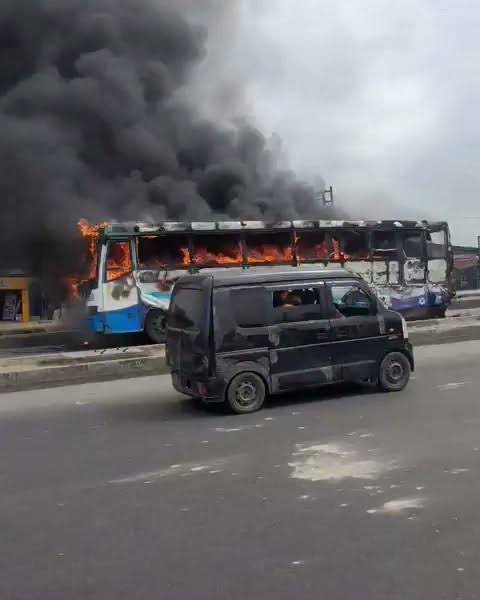
An angry mob has set a Bus Rapid Transit (BRT) bus on fire after it reportedly crushed a commercial motorcyclist to death at Ogolonto Bus Stop along Ikorodu Road in Lagos State.
The incident occurred on Friday, October 16, 2026. Eyewitness accounts and social media reports indicate that the motorcyclist was riding alone along the restricted BRT lane when the collision happened. He died at the scene.
Enraged residents and youths then attacked the bus driver and set the vehicle ablaze. Police officers and officials of the Lagos Neighbourhood Safety Corps (LNSC), who were nearby, intervened promptly and rescued the driver unharmed.
The identity of the deceased motorcyclist and the exact circumstances of the crash had not been officially confirmed at the time of filing this report. It was also unclear whether any arrests had been made in connection with the burning of the bus.
News
ARISE News Wins Seven Honours At Nigerian Broadcasters Merit Awards
The awards recognised the network’s achievements in television journalism and programming, with ARISE News winning the Best TV Channel (Viewer’s Choice) category.


• ARISE News Anchor and host of What’s Trending Ojy Okpe was named Best Newscaster (TV – Female)
ARISE News has emerged as one of the major winners at the just ended Nigerian Broadcasters Merit Awards (NBMA).
ARISE News won seven honours across television broadcasting, news reporting, presentation and production during the ceremony.
The awards recognised the network’s achievements in television journalism and programming, with ARISE News winning the Best TV Channel (Viewer’s Choice) category.
The network’s flagship breakfast programme, The Morning Show, also won the Best TV Talk Show award, further strengthening its recognition in television broadcasting.
ARISE News Anchor and host of What’s Trending Ojy Okpe was named Best Newscaster (TV – Female).
Rufai Oseni was named Nigerian Broadcaster of the Year (Male), while Vimbai Mutinhiri-Ekpeyong received the Nigerian Broadcaster of the Year (Female) award.
The recognition extended to the network’s newsroom, with Ovieteme George winning Best TV News Reporter (Male) for his contributions to television news reporting.
Behind the camera, Sam Adeyemi received the Best Camera Operator/Cinematographer award, recognising his work in television production and visual storytelling.
News
Meta removes 3.7 million accounts in West Africa scam crackdown
The joint operation led to 28 arrests, identified more than 30 suspected scam centres and rescued 117 people allegedly trafficked and forced to work in scam compounds in Ghana.
Meta, the parent company of Facebook and Instagram, has removed more than 3.7 million Facebook and Instagram accounts, pages and groups linked to suspected scam networks operating in West Africa.
The joint operation led to 28 arrests, identified more than 30 suspected scam centres and rescued 117 people allegedly trafficked and forced to work in scam compounds in Ghana.
The company announced the crackdown in a statement on Tuesday, October 13, 2026. It involved 14 technology companies and law enforcement agencies from 10 countries.
The United Kingdom’s National Crime Agency coordinated the operation with the US Department of Justice, the Federal Bureau of Investigation and other agencies. Nigerian authorities were involved.
Other countries included Ghana, Australia, Canada, New Zealand and India.Tech companies that took part included Google, Microsoft, OpenAI, Coinbase, Starlink and Adobe.
Meta said the partnership let participants share intelligence across digital platforms, countries and financial systems to identify criminal networks.


JUST IN: Mob Sets BRT Bus Ablaze After Motorcyclist’s Death in Lagos

BREAKING: DSS Arrests Fugitive Maina Son, Hands Him to EFCC

BREAKING: 5 Arrested Over Imo NYSC Abduction

BREAKING: Lagos Govt Declares Today, Thursday Work-Free to Mark 2026 Ìṣẹ̀ṣe Day

Tech Expert, Zuckerberg trains with UFC champions, Adesanya, Alexander

Organ Trafficking: Ekweremadu bags 10 years in UK prison
-

 Business2 days ago
Naira Exchange Rates For Thursday, October 15
-
 Sports2 days ago
CAF Increases Annual Funding for Member Federations to $700,000
-
 News2 days ago
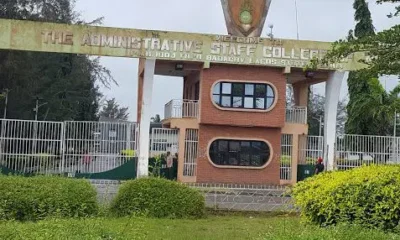
ASCON To Be Rebranded “National School Of Government”
-

 Business2 days ago
Germany plans tax on sugary drinks
-
 Business2 days ago
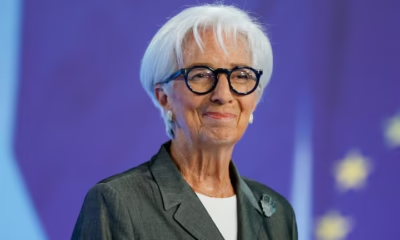
WEF could appoint Lagarde as its next chair, sources say
-

 International2 days ago
“Mother of all bombs,” Trump Plans To Hit Iran
-

 News3 days ago
Sanwo-Olu Appoints Olatunbosun Ogunbanwo, 5 Others as Perm Secs
-

 Business1 day ago
Naira Exchange Rates Friday, October 16