
International
Iran reopens Strait of Hormuz following two-week cease-fire agreement with Trump
Pakistan, which has mediated between Tehran and Washington, said that an immediate ceasefire between Iran and the US had taken effect.

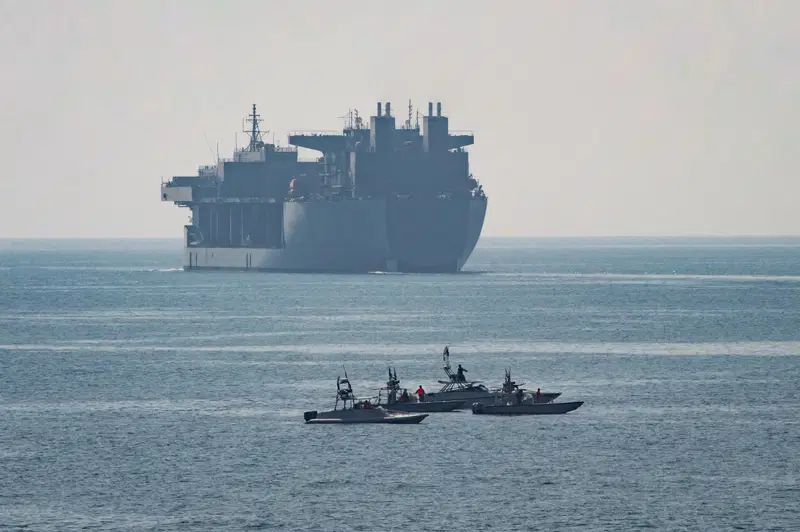
Iranian Foreign Minister Abbas Araghchi said safe passage through the Strait of Hormuz would be possible for two weeks in coordination with Iran’s armed forces “and with due consideration of technical limitations.”
The development follows a two-week ceasefire announced by U.S. President Donald Trump, the Tasnim news agency, which is close to the Islamic Revolutionary Guard Corps (IRGC), reported early on Wednesday.
Pakistan, which has mediated between Tehran and Washington, said that an immediate ceasefire between Iran and the US had taken effect.
Prime Minister Shehbaz Sharif wrote on X that the Islamic Republic of Iran and the U.S., along with their allies, had agreed to an “immediate ceasefire everywhere,” including in Lebanon.“
Trump had made reopening the waterway a condition for the ceasefire and had threatened to target Iran’s energy sector and infrastructure, including bridges, if Tehran failed to comply, setting a deadline of 0000 GMT.
The Strait of Hormuz, crucial to global oil and gas trade, has been largely closed since the United States and Israel launched large-scale attacks on Iran on Feb. 28.
According to a senior U.S. official, Israel will also adhere to what Trump described as a “double sided CEASEFIRE.”








International
Congo military plane crash kills 13, including three officers
“All those on board died; 12 were burned beyond recognition, while the pilot’s lifeless body was found outside the aircraft.”
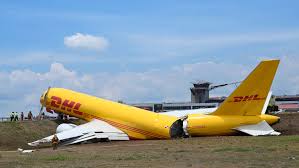
Thirteen people including three army officers were killed on Friday when a military plane crashed in Democratic Republic of Congo, an official said.
Reuters reported that the plane was travelling to the capital, Kinshasa, from the southwestern city of Kikwit when it experienced a technical problem and attempted to land in Kenge, in Kwango province, said Remy Saki Bokinda, the Kwango vice governor.
“With no landing strip available in Kenge, the plane crashed into a residential plot,” he said.
The passengers included General Likulia Bakumi, the army’s auditor general, as well as a major, a captain and other military personnel and civilians, Bokinda said.
“All those on board died; 12 were burned beyond recognition, while the pilot’s lifeless body was found outside the aircraft,” he said.
Congo’s aviation accident investigation authority is launching a probe of the crash, a government statement said.
Congo’s army suffered significant setbacks last year at the hands of Rwanda-backed AFC/M23 rebels who seized large swathes of the east.
International
At UN, 80 countries demand reopening of Hormuz, condemn Iran, Houthi attacks
“Iran’s actions in the Strait of Hormuz continue to threaten international security and navigational rights and freedoms,” said a joint statement read out by Bahrain’s Foreign Minister Abdullatif bin Rashid Al Zayani at the United Nations.

• UN General Assembly
Some 80 countries at the ongoing 81st United Nations General Assembly on Thursday demanded the urgent reopening of the Strait of Hormuz and condemned Iran and its Houthi allies for attacks in the region and disruption to international trade and energy security.
“Iran’s actions in the Strait of Hormuz continue to threaten international security and navigational rights and freedoms,” said a joint statement read out by Bahrain’s Foreign Minister Abdullatif bin Rashid Al Zayani at the United Nations.
“We also strongly condemn the Houthis’ decision to resume conflict in Yemen, their continuous strikes on Saudi Arabia, and their reckless attacks in the Red Sea,” the statement said.
The statement’s backers included Gulf Arab states and major Western powers.
It added that the Houthis’ advance towards Bab el-Mandeb Strait would also only heighten risks to international shipping, maritime security and global trade.
Both Iran and the Houthis frame their actions as defensive.
Credit: REUTERS


Teachers trained in Nigeria and Ghana are no longer eligible to apply for Qualified Teacher Status (QTS) in England through the UK’s dedicated overseas-trained teacher application route.
The change, confirmed by the Department for Education (DfE), took effect on 9 September 2026. India was also removed from the list of eligible countries.
Under the updated rules, a country must have a national regulator that can confirm a teacher’s professional standing and must be able to provide references that meet the DfE’s verification standards.
For Nigeria and Ghana, the DfE cited problems with employment references. Official data showed that more than 70% of applications from teachers trained in the two countries included work history references sent from public email addresses such as Gmail or Hotmail, rather than official school email domains. The department said this made verification more difficult and resource-intensive.
India was removed because it does not have a national regulator capable of confirming teachers’ professional standing.
South Africa is now the only African country whose teachers remain eligible to use the direct “Apply for QTS in England” service.
The DfE stated that the stricter requirements are intended to ensure overseas teachers awarded QTS have the skills and experience needed to teach in English schools, and that the information they provide can be properly verified.
Teachers trained in Nigeria, Ghana or India who are no longer eligible for the direct application route can still explore alternative paths into teaching in England. These include assessment-only QTS routes offered by some schools or completing initial teacher training in the UK.


Congo military plane crash kills 13, including three officers

Manchester City Faces Expulsion For Breaching 114 EPL Financial Rules

TIME Names Moniepoint CTO Felix Ike Among 50 Global Executives of the Year

Tech Expert, Zuckerberg trains with UFC champions, Adesanya, Alexander

Organ Trafficking: Ekweremadu bags 10 years in UK prison

SAINT OBI: Between his marriage and his death
-

 Business3 days ago
Airtel Money Targets October Listing On London Stock Exchange
-

 Business2 days ago
MAN Urges CBN To Consider CRR Cut Next Phase of Monetary Easing
-

 Crime2 days ago
JUST IN: Zamfara LG Chairman Freed After 61 Days in Captivity
-

 Sports2 days ago
FIFA names Nigerian referee among 81 officials for U-17 World Cup
-

 News2 days ago
VP Shettima, Gov Mbah to address Over 500 editors on 2027 election issues
-

 Entertainment2 days ago
MultiChoice launches Wethu+ as DStv overhauls packages
-

 Business2 days ago
Naira To Dollar , Pound, Euro Rate, Thursday September 24
-

 Business2 days ago
Otedola bypasses seven African billionaires as fortune hits $2 billion