
Business
How were Donald Trump’s tariffs calculated?
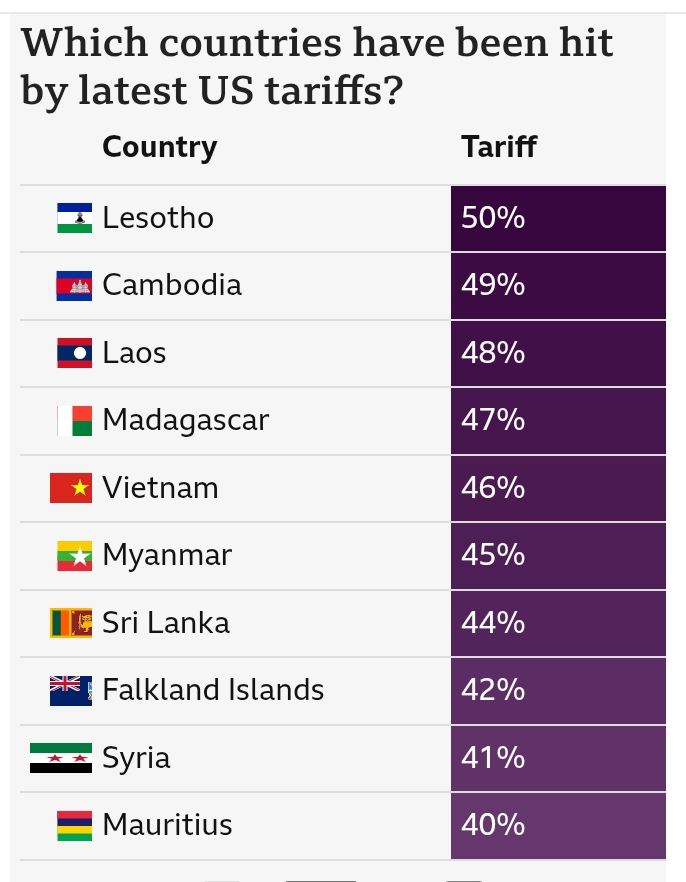
In total, more than 100 countries are covered by the new tariff regime.

Charts credit: White House/ BBC Verify
US President Donald Trump has imposed a 10% tariff on goods from most countries being imported into the US, with even higher rates for what he calls the ”worst offenders”.
But how exactly were these tariffs – essentially taxes on imports – worked out? BBC Verify has been looking at the calculations behind the numbers.
What were the calculations?
When Trump presented a giant cardboard chart detailing the tariffs in the White House Rose Garden it was initially assumed that the charges were based on a combination of existing tariffs and other trade barriers (like regulations).
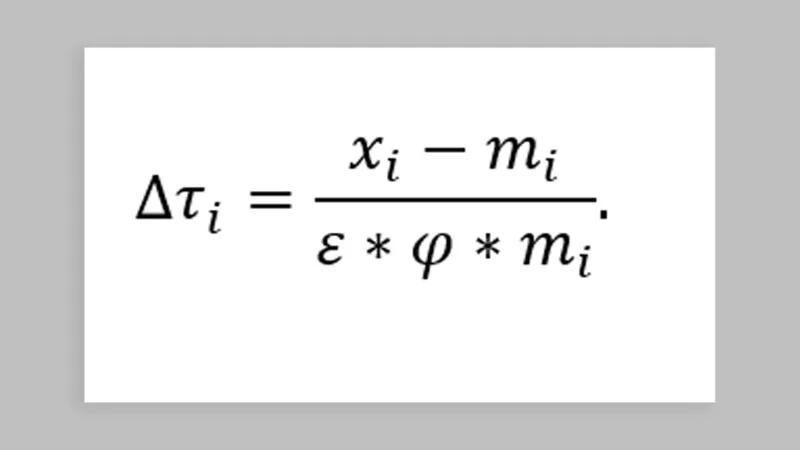
But later, the White House published what might look like a complicated mathematical formula.
But the actual exercise boiled down to simple maths: take the trade deficit for the US in goods with a particular country, divide that by the total goods imports from that country and then divide that number by two.
A trade deficit occurs when a country buys (imports) more physical products from other countries than it sells (exports) to them.
For example, the US buys more goods from China than it sells to them – there is a goods deficit of $295bn.
The total amount of goods it buys from China is $440bn. Dividing 295 by 440 gets you to 67% and you divide that by two and round up. Therefore the tariff imposed on China is 34%.
Similarly, when it applied to the EU, the White House’s formula resulted in a 20% tariff.
Are the Trump tariffs ‘reciprocal’?
Many commentators have pointed out that these tariffs are not reciprocal.
Reciprocal would mean they were based on what countries already charge the US in the form of existing tariffs, plus non-tariff barriers (things like regulations that drive up costs).
But the White House’s official methodology document makes clear that they have not calculated this for all the countries on which they have imposed tariffs.
Instead the tariff rate was calculated on the basis that it would eliminate the US’s goods trade deficit with each country.
Trump has broken away from the formula in imposing tariffs on countries that buy more goods from the US than they sell to it.
For example the US does not currently run goods trade deficit with the UK. Yet the UK has been hit with a 10% tariff.
In total, more than 100 countries are covered by the new tariff regime.‘
Lots of broader impacts’Trump believes the US is getting a bad deal in global trade.
In his view, other countries flood US markets with cheap goods – which hurts US companies and costs jobs.
At the same time, these countries are putting up barriers that make US products less competitive abroad.So by using tariffs to eliminate trade deficits, Trump hopes to revive US manufacturing and protect jobs.
But will this new tariff regime achieve the desired outcome?
BBC Verify has spoken to a number of economists. The overwhelming view is that while the tariffs might reduce the goods deficit between the US and individual countries, they will not reduce the overall deficit between the US and rest of the world.
“Yes, it will reduce bilateral trade deficits between the US and these countries.
But there will obviously be lots of broader impacts that are not captured in the calculation”, says Professor Jonathan Portes of King’s College, London.
That’s because the US’ existing overall deficit is not driven solely by trade barriers, but by how the US economy works.For one,
Americans spend and invest more than they earn and that gap means the US buys more from the world than it sells. So as long as that continues, the US may continue to keep running a deficit despite increasing tariffs with it global trading partners.
Some trade deficits can also exist for a number of legitimate reasons – not just down to tariffs. For example, buying food that is easier or cheaper to produce in other countries’ climates.
Thomas Sampson of the London School of Economics said: “The formula is reverse engineered to rationalise charging tariffs on countries with which the US has a trade deficit.
There is no economic rationale for doing this and it will cost the global economy dearly.”




Business
Brent Holds Above $101bp
Iran said it was ready for a more intense conflict, vowing to resist the US naval blockade and warning that it would intensify its attacks if American forces continued strikes on Iranian territory.

Brent crude traded around $101 per barrel on Thursday, hovering at its highest level since May as the intensifying conflict between the US and Iran raised concerns over further disruptions to energy supplies from the Middle East.
Iran said it was ready for a more intense conflict, vowing to resist the US naval blockade and warning that it would intensify its attacks if American forces continued strikes on Iranian territory.
Meanwhile, President Donald Trump predicted that the conflict would not end until after the November midterm elections and said significant relief in gasoline prices was unlikely before then, signaling limited prospects for near-term de-escalation.
Hostilities intensified over the past week following roughly a month of relative calm, with both sides stepping up attacks.
The conflict broadened after Iran-backed Houthi militants attacked several energy facilities in Saudi Arabia, prompting a temporary suspension of some operations.
Business
Takeaways From CIBN 19th Annual Banking and Finance Conference
The large capital raised by banks during the recapitalisation exercise indicated the depth of capital available locally.
By Ochefa
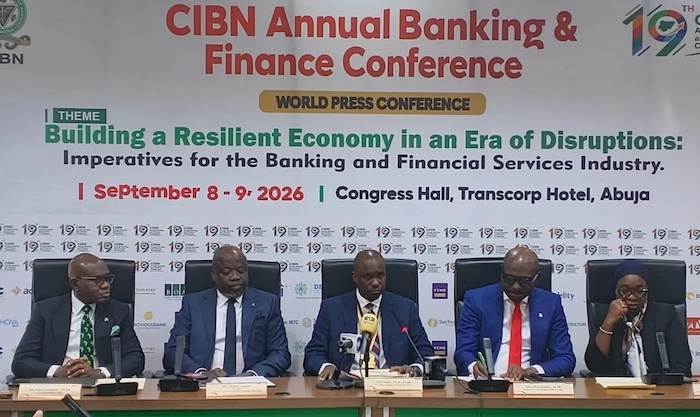
The Chartered Institute of Bankers of Nigeria (CIBN) held its 19th Annual Banking and Finance Conference in Abuja, yesterday.
Themed , “Building a Resilient Economy in an Era of Disruptions: Strategic Imperatives for the Banking and Financial Services Industry,” the conference brought together stakeholders from the banking industry, the World Bank, government officials including economists , business leaders and policy makers.
” The ultimate test of Nigeria’s economic reforms should be their impact on households, businesses and the daily lives of ordinary Nigerians.”
Here are the key points from the discussions:
Dr. Dele Alabi, President and Chairman of Council of CIBN:
•The ultimate test of Nigeria’s economic reforms should be their impact on households, businesses and the daily lives of ordinary Nigerians. Nigeria’s improving macroeconomic indicators will amount to little if they failed to translate into lower living costs, more jobs, higher incomes and better living standards for citizens.
“Macroeconomic progress must, therefore, be felt at the micro level in households, small businesses and the daily lives of ordinary Nigerians. Our task is to build systems that learn, adapt and emerge stronger.”
• Lead Private Sector Development Specialist at the World Bank’s Nigeria Office, Ms Bertine Kamphuis:
Credit to Nigeria’s private sector remain inadequate. She urged banks to channel more financing to sectors with the greatest potential to create jobs, particularly agriculture, manufacturing and MSMEs. According to her, with between three and four million young Nigerians entering the labour market every year, expanding access to productive credit has become imperative.”
• Minister of Finance and Coordinating Minister of the Economy, Mr Taiwo Oyedele:
“Strong bank profits alone are no longer sufficient; financial institutions must contribute more directly to economic growth and the welfare of Nigerians.
“For years, we have measured financial institutions by balance-sheet growth, profitability and shareholder returns. These remain important. But we must increasingly ask: what is the financial system doing for the real economy?
A resilient banking system cannot exist indefinitely where businesses cannot obtain affordable credit, manufacturers struggle to finance expansion, and millions of productive MSMEs remain outside the formal financial system.”
•Central Bank of Nigeria, CBN, Mr. Olayemi Cardoso:
” The large capital raised by banks during the recapitalisation exercise indicated the depth of capital available locally.
Represented by the Deputy Governor in charge of Policy, Mr. Philip Ikeazor, the CBN governor challenged operators in the industry to take advantage of the large capital now available to them to fund the real sectors of the economy, with a view to achieving the rapid growth that would impact on better living standards of Nigerians.
He urged state governments to collaborate with the CBN and the fiscal authorities at the federal level to effectively tame inflation, pledging that with the cooperation of all stakeholders, a single digit inflation was achievable.”
Business
AfCFTA : Nigerian Goods In High Demand In Africa, says Minister
On a trade mission to Botswana with about 11 Nigerian businesses, one of them immediately got an order of 6,000 T-shirts to be supplied there.
The Minister of Trade, Industry and Investment, Dr Jumoke Oduwole, has said that Nigerian goods continue to remain competitive and, in particular, high demand on the continent.
The minister disclosed this yesterday in Abuja at the 2026 Third Quarter meeting of the African Continental Free Trade Area (AfCFTA) Central Coordination Committee (CCC).
She said, ” I think that a lot of Nigerians have the perception that Nigerian goods are not competitive on this continent. Nigerian entrepreneurs have shown that they can compete anywhere in the world, and are doing particularly well in the rest of Africa, and this is demonstrated by our non-oil exports, which have gone up exponentially, and it’s due to the exports of Nigerian goods across the African continent
She said on a trade mission to Botswana with about 11 Nigerian businesses, one of them immediately got an order of 6,000 T-shirts to be supplied there.


I will concede defeat if 2027 election is credible — Obi

JUST IN: One Dead, Many Feared Trapped as Two-Storey Building Collapses in Lagos

Trump promises $5,000 ‘dividend’ to U.S. citizens if Republicans win midterms

Tech Expert, Zuckerberg trains with UFC champions, Adesanya, Alexander

Organ Trafficking: Ekweremadu bags 10 years in UK prison

SAINT OBI: Between his marriage and his death
-

 Business3 days ago
NAFDAC Goes After Chinese Logistics Firms Over Products Counterfeiting
-
 International2 days ago
Kenya gives foreign workers 90 days to formalise status or leave
-
 News3 days ago
JUST IN: Traffic Chaos Expected on Lagos-Ibadan Expressway From Tuesday
-

 Sports3 days ago
Falconets lose World Cup opener to Spain
-

 Entertainment3 days ago
Ikenga becomes highest-grossing Igbo film of all time
-
 Politics3 days ago
2027: Tompolo flags – off campaign for Tinubu with 34 Campaign Vehicles
-
 Business3 days ago
After South Africa, Kenya Cracks Down on Foreign Traders, Retailers
-

 Business3 days ago
Dangote woos ordinary Nigerians to own shares in oil refinery as IPO opens September 14