
News
Federal Govt shares 740 truck-loads of rice to states


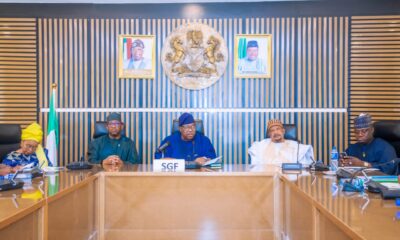
Food crisis dominated discussion at yesterday’s meeting of the Federal Executive Council (FEC) meeting in Abuja.
It was the second meeting of the highest decision making of the Executive in five days to take decision on crucial issues affecting the people.
Minister of Information and National Orientation Mohammed Idris announced after the meeting the supply of 740 trucks of rice to the 36 states and the Federal Capital Territory (FCT).
This is made up of 20 trucks per state containing 1,200 25kg rice bags.
It is part of the Bola Ahmed Tinubu’s intervention to alleviate the food crisis.
The minister, who was with Special Adviser to the President on Information and Strategy, Bayo Onanuga added that President Tinubu directed Agriculture Minister to ensure the food reached the most vulnerable in their states.
He said: “The council deliberated on the state of affairs in Nigeria, especially the issue of food supply and shortage of food on the tables of many Nigerians and after exhaustive deliberation, the Minister of Agriculture had earlier been directed to ensure that food is being made available to Nigerians and the understanding is that about 20 trucks of rice has already been supplied to each of the states of the federation, including the Federal Capital Territory.
Each of the trucks is carrying about 1,200 bags of 25 kilogramme rice.
“This is part of the measures that government is taking, in addition to so many others, to ensure that the hardship being experienced by Nigerians is drastically ameliorated.
“So for recap, each of the state governments has received 20 trucks of rice for onward distribution to the most vulnerable.
This is a first step and the federal government will continue to support all the sub-nationals, so that the hardship being experienced by most Nigerians, in terms of shortage of food supply, is breached.
“It is expected that the state governors will go ahead to distribute this food item to the most vulnerable so that the hardship, like I said, being experienced will be brought down significantly.”







News
FG commissions 37 electric buses for civil servants
Walson-Jack described the commissioning as her “parting gift” to federal civil servants, coming less than 24 hours before the end of her tenure as Head of the Civil Service.


•Head of the Civil Service of the Federation, Mrs Didi Walson-Jack
The Federal Government has commissioned 37 electric buses as the first batch of 100 approved under the Renewed Hope Mass Transit Programme.
Each of the electric buses can carry up to 200 passengers and cover at least 200 kilometres on a full charge.
The full deployment will be completed by December 2026.
The buses were unveiled on Wednesday at Eagle Square, Abuja, with the Head of the Civil Service of the Federation, Mrs Didi Walson-Jack, describing the initiative as a significant step towards improving working conditions for government employees.
Walson-Jack described the commissioning as her “parting gift” to federal civil servants, coming less than 24 hours before the end of her tenure as Head of the Civil Service.
“What we have here is 37 buses, being the first instalment of the 100 Electric Buses,” she said.
She noted that transportation costs and challenges directly affect workers’ finances, safety, punctuality and productivity.
“For many Civil Servants, the daily commute shapes their finances, their safety, their punctuality, and ultimately their productivity,” she said.
The buses will initially operate on selected routes under a pilot phase before being expanded nationwide.
They will eventually be deployed to Federal Secretariats across the states to extend the benefits to civil servants outside Abuja.
News
NIGCOMSAT To Procure Two New Communication Satellites
The deployment is expected to extend connectivity to underserved, unserved and hard -to- reach communities, strengthen national communications resilience and increase Nigeria’s capacity to deliver satellite e-enabled services.
The federal government, through the Federal Executive Council (FEC), has approved the acquisition of two communications satellites, NIGCOMSAT 2A and NIGCOMSAT 2B.
This was contained in a statement released by the Nigerian Communications Satellite Limited (NIGCOMSAT), and signed by the Acting Head, Corporate Affairs Division, Stephen Kwande.
He said that the satellites, to be deployed by Nigeria Communications Satellite Limited (NIGCOMSAT), are designed to expand Nigeria’s satellite capacity and strengthen broadband, broadcasting, enterprise and critical communications services.
NIGCOMSAT will lead implementation under the supervision of the Federal Ministry of Communications, Innovation and Digital Economy.
The deployment is expected to extend connectivity to underserved, unserved and hard -to- reach communities, strengthen national communications resilience and increase Nigeria’s capacity to deliver satellite e-enabled services.
News
Gunmen abduct Dangote Cement senior driver in Ogun
The victim was attacked by three gunmen as he alighted from his motorcycle in front of his residence.
Gunmen have abducted a senior driver with Dangote Cement Company, Ibese Plant, Ogun State, Usman Umar, popularly known as “Baba Olowo,” in Yewa North local government area of the State.
A senior official of Dangote Cement, Ibese Plant, confirmed the incident, saying that Umar was reportedly abducted around midnight on Wednesday at Ajibawo Village, near Ijako-Orile, shortly after returning home from work.
The source said that the victim was attacked by three gunmen as he alighted from his motorcycle in front of his residence.
The assailants were said to have dragged him into a nearby bush while firing shots into the air to scare residents and prevent them from intervening.
The incident has reportedly prompted security operatives to commence efforts to locate the victim and apprehend his abductors.


FG commissions 37 electric buses for civil servants

Naira Exchange Rates Thursday, August 27

NIGCOMSAT To Procure Two New Communication Satellites

Tech Expert, Zuckerberg trains with UFC champions, Adesanya, Alexander

Organ Trafficking: Ekweremadu bags 10 years in UK prison

SAINT OBI: Between his marriage and his death
-
 Business2 days ago
Naira Exchange Rates Tuesday, August 25
-

 Politics2 days ago
President Tinubu Retrieves APC Campaign List For Readjustment
-

 Politics2 days ago
[UPDATED] 2027: APC dismisses report of campaign council list withdrawal
-

 News2 days ago
FG Moves To Fix Benin-Asaba Federal Highway
-

 Politics2 days ago
Amaechi to Sowore: Close Your Mouth When Politicians Are Talking
-
 News2 days ago
Enugu iron-smelting site Gets $125,000 US Grant
-

 Entertainment2 days ago
BREAKING: Country music icon Dolly Parton dies at 80
-
 Business3 days ago
NAFDAC Gives Conditions For Reopening Sealed Factories of Alcoholic Manufacturers