
Business
CBN’s Cardoso Assures Nigeria ‘ll Get Out of Economic Woes

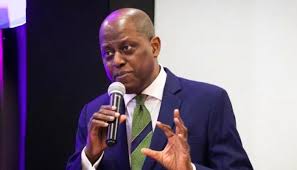
The Governor of the Central Bank of Nigeria (CBN), Olayemi Cardoso, has expressed optimism that despite all the difficulties, there is light at the end of the tunnel, “As long as the country can sustain a positive trajectory, Nigeria will get out of its economic woes and the foreign exchange market will begin to moderate itself.”
Csrdoso expressed this conviction during the opening ceremony of the 2024 First Plenary Assembly of the Catholic Bishops Conference of Nigeria (CBCN) with the theme, “Synod on Synodality: Areas of Concern for the Church in Nigeria.”
The banker blamed the high inflation rate in the country on so much liquidity in the market, and noted that as a result of some of the recent efforts of the CBN, over the course of the last week, about $1.8 billion came into the markets.
The CBN Governor said that in another week, the Apex Bank will have the Monetary Policy Committee meeting, where very critical decisions will be made to continue making the economy more investor-friendly.
He also said that an attempt to merge the outside rates with the official rates and the black market rate has been made, and that the difference between the two is now significantly lower.
Cardoso said, “There is a positive outlook on that. The positive outlook comes from the fact that a series of reforms have been made by the Federal Government and the Central Bank, which are now paying off in such a way that international investors are coming back in again.”
The President of CBCN, Archbishop Lucius Ugorji, said the country is experiencing the worst times, especially in the areas of security and the economy during the administration of President Bola Tinubu.
He stated that the reform agenda of the Federal Government has worsened the plight of Nigerians, with the withdrawal of fuel subsidies and the unification of the foreign exchange market, leading to a sharp increase in the pump price of petroleum products and a steep decline in the value of the Naira.
He said as the government demands additional sacrifice from the struggling masses, there should be a drastic cut in the cost of governance at all levels, adding that on the contrary, top government officials live by the sweat, toil and tears of the poor as they continue spending huge public funds on ostentatious and luxurious lifestyles and seem incapable of feeling compassion for the poor.
Every day, outrageous and spine-chilling stories are told in the media about different public servants who have stolen staggering amounts of money from public coffers in a country where millions of citizens live in deep and debilitating poverty.
“We cannot easily overlook the sordid roles of many fraudulent politicians and Bank Executives in fleecing the whole nation and destroying our national economy through the dirty game of corruption, causing untold hardship and untimely deaths across the nation,” said Archbishop Ugorji.





Business
TIME Names Moniepoint CTO Felix Ike Among 50 Global Executives of the Year
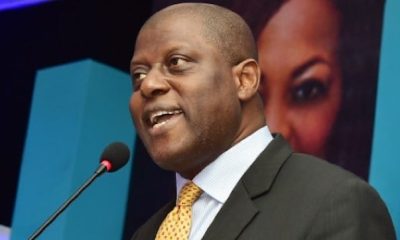
In its citation, TIME said Ike “has helped to establish the business as one of Africa’s leading financial platforms.


TIME magazine has named Felix Ike, co-founder and Chief Technology Officer of Nigerian fintech Moniepoint, to its inaugural Executives of the Year: Tech and Data list.
Ike is the only executive representing an African company among the 50 leaders selected for the 2026 list.
The list, unveiled on Tuesday, September 22, recognises chief information officers, chief technology officers, chief data officers and chief product officers whose decisions are shaping how major organisations deploy technology and use data.
Moniepoint is also the only African company represented on the inaugural list.
Ike was named alongside executives from Netflix, CrowdStrike, Dell, Duolingo, AT&T, OpenAI, Anthropic, Shopify and Reddit, among others.
In its citation, TIME said Ike “has helped to establish the business as one of Africa’s leading financial platforms.
“The recognition follows Moniepoint’s inclusion in TIME’s 2025 list of the 100 Most Influential Companies, giving the Lagos-founded fintech another global distinction.
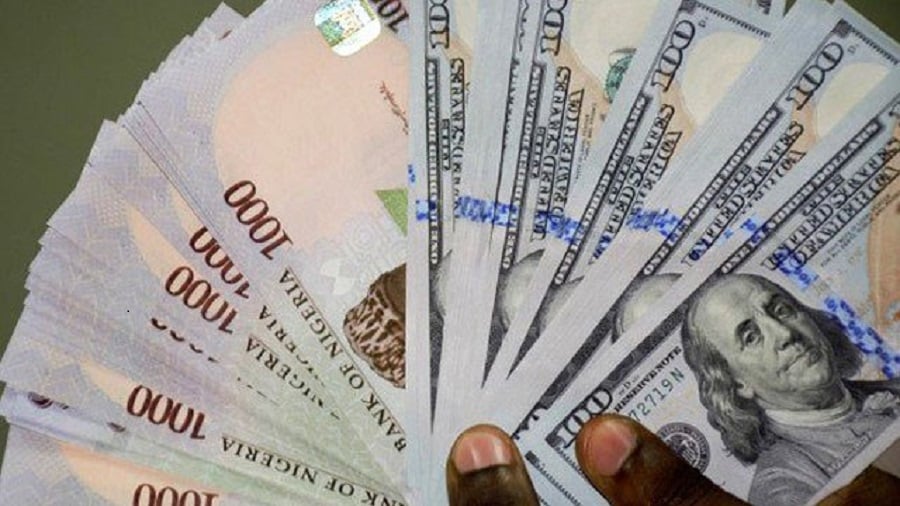
Black Market Rates
₦1382DOLLAR (USD)
₦1855POUND (GBP)
₦1545EURO (EUR)
1000 DOLLAR (CAD)
₦70 RAND (ZAR)
370DIRHAM (AED)
190YUAN (CNY)
₦100G.CEDI (GHS)
₦2350 CFA F.(XOF)
₦2250 CFA F.(XAF)
₦850 AUSSIE (AUD)
Official CBN Exchange Rates
DOLLAR (USD)₦1328.67
POUND (GBP)₦1758.36
EURO (EUR)₦1511.63
SWISS FRANC (CHF)₦1605.45
JAPANESE YEN (JPN)₦8.38
CFA FRANC (XOF)₦2.31
WEST AFRICAN UNIT OF ACCOUNT (WAUA)₦1808.03
CHINESE YUAN (CNY)₦197.92
SAUDI RIYAL (SAR)₦353.86
SOUTH AFRICAN RAND (ZAR)₦81.09
Business
Djibouti, Ethiopia and Dangote to build $660 million petroleum pipeline
In Kenya, Dangote and the government are due to break ground on a new 700,000-barrel-per-day crude oil refinery in Lamu next week.
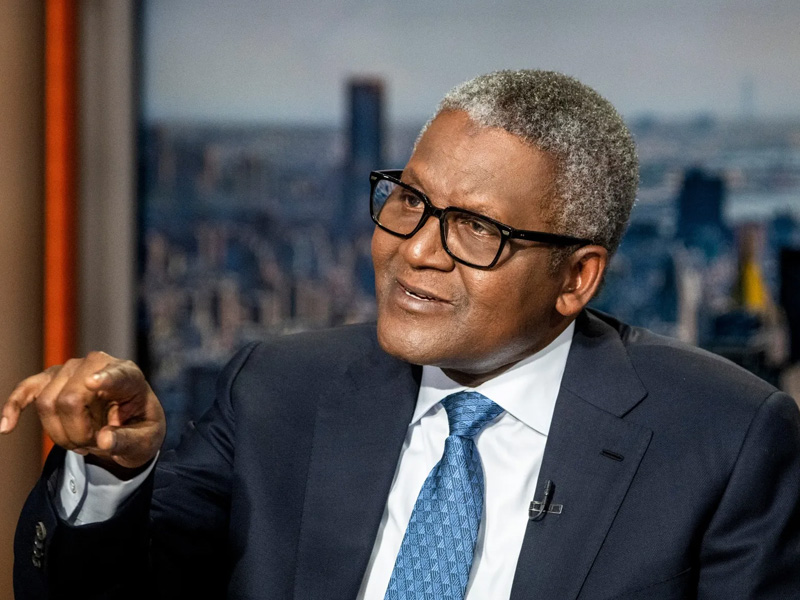
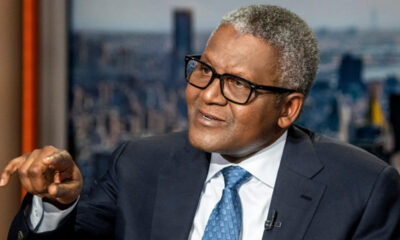
Ethiopia, Djibouti and Nigerian billionaire Aliko Dangote plan to build a $660 million refined petroleum pipeline that will connect Ethiopia and Djibouti, a spokesperson in Ethiopian Prime Minister Abiy Ahmed’s office said on Thursday.
The project will include a 120-km (75-mile) pipeline, as well as approximately 375,000 cubic metres of storage capacity at Damerjog in Djibouti and 800,000 cubic metres at Dewele in Ethiopia, the spokesperson told Reuters, adding it should become operational within 18 months.
Abiy said on his X account the project will be developed through a partnership between Ethiopian Investment Holdings and the Dangote Group, which separately is already building a $4 billion fertiliser pipeline and power plant, and a polypropylene packaging facility, in Ethiopia.
The project aims to reduce logistics costs and delays along the Ethiopia-Djibouti transport corridor, Abiy said.
Developers say the infrastructure will strengthen energy security and improve supply chain resilience for the two countries, he said.
Abiy is on a visit to Djibouti and made the announcement alongside its president, Ismail Omar Guelleh, and Dangote.
In Kenya, Dangote and the government are due to break ground on a new 700,000-barrel-per-day crude oil refinery in Lamu next week.


Congo military plane crash kills 13, including three officers

Manchester City Faces Expulsion For Breaching 114 EPL Financial Rules

TIME Names Moniepoint CTO Felix Ike Among 50 Global Executives of the Year

Tech Expert, Zuckerberg trains with UFC champions, Adesanya, Alexander

Organ Trafficking: Ekweremadu bags 10 years in UK prison

SAINT OBI: Between his marriage and his death
-

 News3 days ago
South African kills Nigerian bar worker
-
 Business3 days ago
China Woos Nigeria To Join WAICO Memberships For Technology Advantages
-

 News3 days ago
Nigerian Editors Brace for Democracy Protection Ahead of 2027 Elections
-

 International3 days ago
At UN, 80 countries demand reopening of Hormuz, condemn Iran, Houthi attacks
-
 Business2 days ago
Naira Exchange Rates, Friday September 25
-
 Business3 days ago
Djibouti, Ethiopia and Dangote to build $660 million petroleum pipeline
-
 Business2 days ago
TIME Names Moniepoint CTO Felix Ike Among 50 Global Executives of the Year
-
 Sports2 days ago
Manchester City Faces Expulsion For Breaching 114 EPL Financial Rules