
News
Bill Gates to Spend Majority of $200 Billion Pledge on Africa’s Future
At the end of 20 years, the foundation will sunset its operations.


ADDIS ABABA (June 2, 2025 :
In an address today in Nelson Mandela Hall at the African Union, Gates Foundation Chair Bill Gates , announced that the majority of his $200 billion spending over the next 20 years will go to Africa with a focus on partnering with governments that prioritize the health and well-being of their people.
Gates therefore urged African leaders to seize the moment to accelerate progress in health and development through innovation and partnership, despite current headwinds.
“I recently made a commitment that my wealth will be given away over the next 20 years.
The majority of that funding will be spent on helping you address challenges here in Africa.”
Addressing over 12,000 government officials, diplomats, health workers, development partners, and youth leaders in person and online, he underscored the critical role of African leadership and ingenuity in driving the continent’s health and economic future.
“By unleashing human potential through health and education, every country in Africa should be on a path to prosperity – and that path is an exciting thing to be part of,” Gates said.
Following his address, Gates joined Paulin Basinga, the foundation’s Africa director, in a fireside chat to discuss Africa’s development agenda and the investments and partnerships needed to drive future progress.
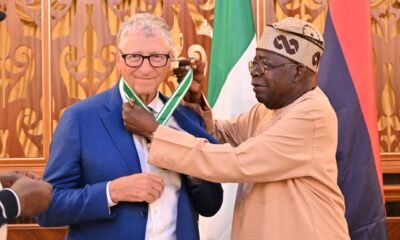
From Addis Ababa, Gates will travel to Nigeria, where he will meet with President Bola Ahmed Tinubu and engage with federal and state leaders to discuss Nigeria’s primary health care reforms.
Calls for collaboration and shared responsibility were delivered by prominent African leaders, including Dr. Ngozi Okonjo-Iweala, director-general of the World Trade Organization, and Amina J. Mohammed, deputy secretary-general of the United Nations.
Renowned advocate for women and children, Mrs. Graça Machel, described the current situation as “a moment of crisis” and emphasized the importance of enduring partnerships in Africa’s development journey.
“Mr Gates’ long-standing partnership with Africa reflects a deep understanding of these challenges and a respect for African leadership, ideas and innovation,” she said.
“We are counting on Mr Gates’ steadfast commitment to continue walking this path of transformation alongside us.”
Dr. Ngozi Okonjo-Iweala emphasized that Africa’s health progress is a result of strong government leadership, resilient communities, and partnerships that deliver results.Gates called for prioritizing primary healthcare, emphasizing that “investing in primary healthcare has the greatest impact on health and wellbeing.”
“With primary healthcare, what we’ve learned is that helping the mother be healthy and have great nutrition before she gets pregnant, while she is pregnant, delivers the strongest results. Ensuring the child receives good nutrition in their first four years as well makes all the difference.”
Gates highlighted how countries like Ethiopia, Rwanda, Zimbabwe, Mozambique, Nigeria, and Zambia are showing what’s possible when bold leadership harnesses innovation.
From expanding frontline health services and using data to cut child mortality to deploying advanced tools against malaria and HIV, and safeguarding primary healthcare despite fiscal strain—these country-led efforts are driving scalable, homegrown progress.
Reflecting on more than two decades of engagement on the continent, Gates said, “I’ve always been inspired by the hard work of Africans even in places with very limited resources.”
He added, “The kind of fieldwork to get solutions out, even in the most rural areas, has been incredible.”Gates spoke about the transformative potential of artificial intelligence, noting its relevance for the continent’s future.
He praised Africa’s young innovators, saying he was “seeing young people in Africa embracing this, and thinking about how it applies to the problems that they want to solve.”
Drawing a parallel to the continent’s mobile banking revolution, he added, “Africa largely skipped traditional banking and now you have a chance, as you build your next generation healthcare systems, to think about how AI is built into that.”
He pointed to Rwanda as an early example of this promise, noting, “Rwanda is using AI to improve service delivery. E.g. AI-enabled ultrasound, to identify high-risk pregnancies earlier, helping women receive timely, potentially life-saving care.”
In Ethiopia and Nigeria this week, Gates will see first-hand the state of health and development priorities in the wake of foreign aid cuts, and he will affirm his and the foundation’s commitment to supporting Africa’s progress in health and development over the next 20 years.
“Our foundation has an increasing commitment to Africa,” Gates said. Our first African office was here in Ethiopia about 13 years ago. Now we have offices in South Africa, Kenya, Nigeria and Senegal.
That’s a great way for us to strengthen partnerships.”While in Ethiopia, Gates met with Prime Minister Abiy Ahmed and heard how Ethiopia is sustaining the momentum on critical reforms, expanding essential services, and remaining resilient amid shifting global aid dynamics.
Gates also took part in a roundtable with the Ethiopian Public Health Institute on the country’s iodine-folic acid double-fortified salt initiative.
From Addis Ababa, Gates will travel to Nigeria, where he will meet with President Bola Ahmed Tinubu and engage with federal and state leaders to discuss Nigeria’s primary health care reforms.
He will also participate in a Goalkeepers Nigeria event focused on Africa’s innovation future and meet with local scientists and partners shaping Nigeria’s national AI strategy and scaling up health solutions.
Gates’s trip follows the foundation’s historic announcement on May 8 that it would spend $200 billion over the next 20 years to advance progress on saving and improving lives and Gates’ commitment to giving away virtually all of his wealth to the foundation in that timeframe.
Over the next two decades, the foundation will work together with its partners to make as much progress as possible towards three primary goals: end preventable deaths of moms and babies; ensure the next generation grows up without having to suffer from deadly infectious diseases; and lift millions of people out of poverty, putting them on a path to prosperity.
At the end of 20 years, the foundation will sunset its operations. Over the last two decades, the Gates Foundation has worked alongside African partners to save lives, develop vaccines, and strengthen systems.
It has helped catalyze more than 100 innovations and contributed to saving more than 80 million lives through Gavi and the Global Fund to Fight AIDS, Tuberculosis, and Malaria.





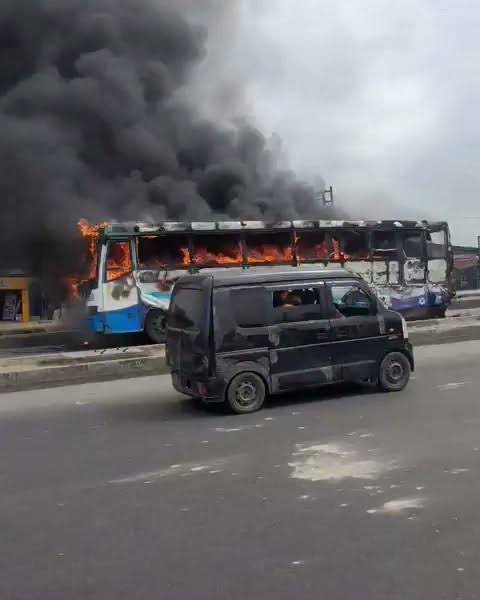
An angry mob has set a Bus Rapid Transit (BRT) bus on fire after it reportedly crushed a commercial motorcyclist to death at Ogolonto Bus Stop along Ikorodu Road in Lagos State.
The incident occurred on Friday, October 16, 2026. Eyewitness accounts and social media reports indicate that the motorcyclist was riding alone along the restricted BRT lane when the collision happened. He died at the scene.
Enraged residents and youths then attacked the bus driver and set the vehicle ablaze. Police officers and officials of the Lagos Neighbourhood Safety Corps (LNSC), who were nearby, intervened promptly and rescued the driver unharmed.
The identity of the deceased motorcyclist and the exact circumstances of the crash had not been officially confirmed at the time of filing this report. It was also unclear whether any arrests had been made in connection with the burning of the bus.
News
ARISE News Wins Seven Honours At Nigerian Broadcasters Merit Awards
The awards recognised the network’s achievements in television journalism and programming, with ARISE News winning the Best TV Channel (Viewer’s Choice) category.
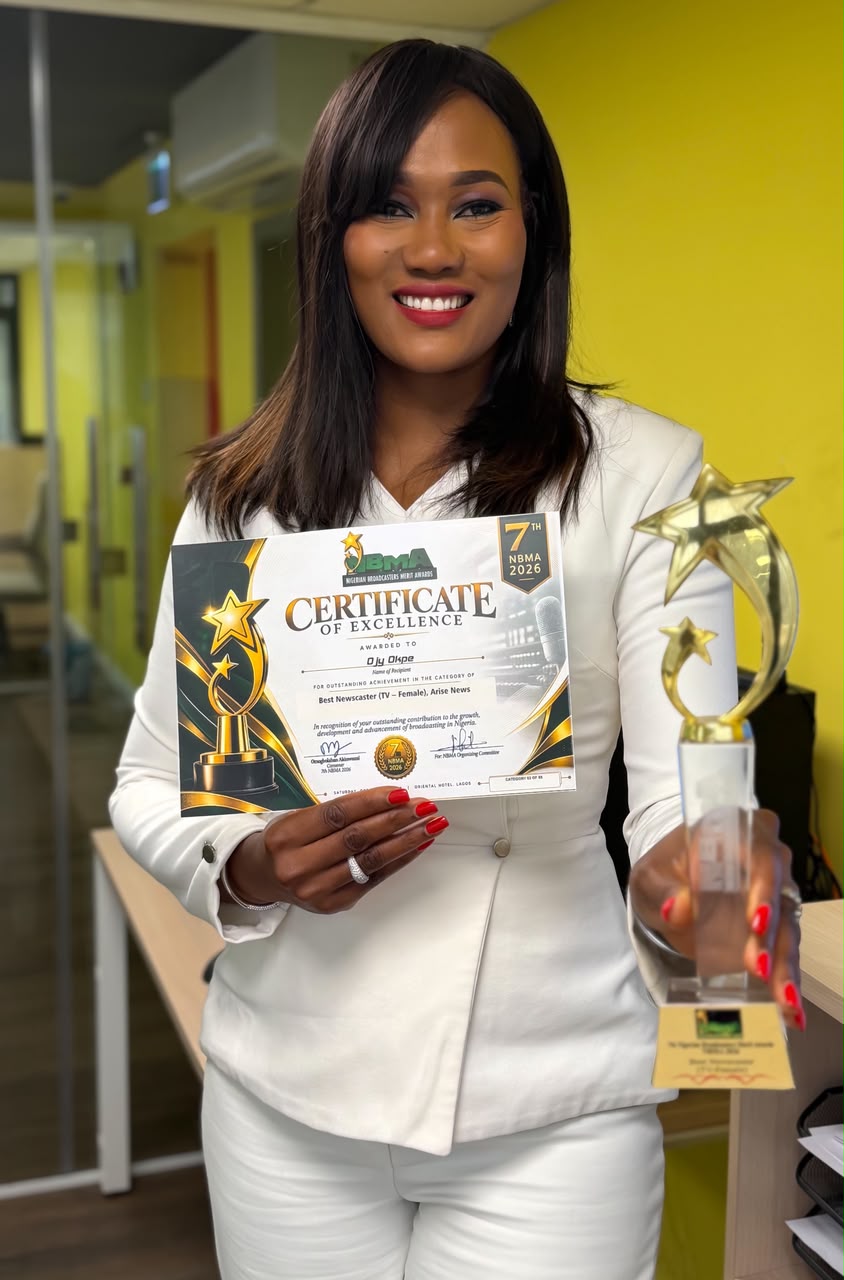
• ARISE News Anchor and host of What’s Trending Ojy Okpe was named Best Newscaster (TV – Female)
ARISE News has emerged as one of the major winners at the just ended Nigerian Broadcasters Merit Awards (NBMA).
ARISE News won seven honours across television broadcasting, news reporting, presentation and production during the ceremony.
The awards recognised the network’s achievements in television journalism and programming, with ARISE News winning the Best TV Channel (Viewer’s Choice) category.
The network’s flagship breakfast programme, The Morning Show, also won the Best TV Talk Show award, further strengthening its recognition in television broadcasting.
ARISE News Anchor and host of What’s Trending Ojy Okpe was named Best Newscaster (TV – Female).
Rufai Oseni was named Nigerian Broadcaster of the Year (Male), while Vimbai Mutinhiri-Ekpeyong received the Nigerian Broadcaster of the Year (Female) award.
The recognition extended to the network’s newsroom, with Ovieteme George winning Best TV News Reporter (Male) for his contributions to television news reporting.
Behind the camera, Sam Adeyemi received the Best Camera Operator/Cinematographer award, recognising his work in television production and visual storytelling.
News
Meta removes 3.7 million accounts in West Africa scam crackdown
The joint operation led to 28 arrests, identified more than 30 suspected scam centres and rescued 117 people allegedly trafficked and forced to work in scam compounds in Ghana.
Meta, the parent company of Facebook and Instagram, has removed more than 3.7 million Facebook and Instagram accounts, pages and groups linked to suspected scam networks operating in West Africa.
The joint operation led to 28 arrests, identified more than 30 suspected scam centres and rescued 117 people allegedly trafficked and forced to work in scam compounds in Ghana.
The company announced the crackdown in a statement on Tuesday, October 13, 2026. It involved 14 technology companies and law enforcement agencies from 10 countries.
The United Kingdom’s National Crime Agency coordinated the operation with the US Department of Justice, the Federal Bureau of Investigation and other agencies. Nigerian authorities were involved.
Other countries included Ghana, Australia, Canada, New Zealand and India.Tech companies that took part included Google, Microsoft, OpenAI, Coinbase, Starlink and Adobe.
Meta said the partnership let participants share intelligence across digital platforms, countries and financial systems to identify criminal networks.


JUST IN: Mob Sets BRT Bus Ablaze After Motorcyclist’s Death in Lagos

BREAKING: DSS Arrests Fugitive Maina Son, Hands Him to EFCC

BREAKING: 5 Arrested Over Imo NYSC Abduction

BREAKING: Lagos Govt Declares Today, Thursday Work-Free to Mark 2026 Ìṣẹ̀ṣe Day

Tech Expert, Zuckerberg trains with UFC champions, Adesanya, Alexander

Organ Trafficking: Ekweremadu bags 10 years in UK prison
-
 Business2 days ago
Naira Exchange Rates For Thursday, October 15
-
 Sports2 days ago
CAF Increases Annual Funding for Member Federations to $700,000
-
 News2 days ago
ASCON To Be Rebranded “National School Of Government”
-

 Business2 days ago
Germany plans tax on sugary drinks
-
 Business2 days ago
WEF could appoint Lagarde as its next chair, sources say
-

 International2 days ago
“Mother of all bombs,” Trump Plans To Hit Iran
-

 News3 days ago
Sanwo-Olu Appoints Olatunbosun Ogunbanwo, 5 Others as Perm Secs
-
 Business1 day ago
Naira Exchange Rates Friday, October 16