
Business
AI’s Market Value Surging to $4.8 trillion by 2033- UNCTAD
Accordingly, the UN trade body urged: ” Countries should act now – by investing in digital infrastructure, building capabilities and strengthening AI governance – to harness the AI potential for sustainable development.


• A data center stores and processes data, the foundation on which AI systems learn, improve, and make decisions. © Shutterstock/Goodenough |
UN Trade and Development’s (UNCTAD) Technology and Innovation Report 2025 has projected that Artificial intelligence (AI) is expected to reach $4.8 trillion in market value by 2033.
Accordingly, the UN trade body urged: ” Countries should act now – by investing in digital infrastructure, building capabilities and strengthening AI governance – to harness the AI potential for sustainable development.”
In the report, UNCTAD Secretary-General Rebeca Grynspan underlined the importance of ensuring people are at the centre of AI development, calling for stronger international cooperation to “shift the focus from technology to people, enabling countries to co-create a global artificial intelligence framework”.
She said;” AI’s economic benefit is massive but must be shared, becoming a prominent force in digital transformation; noting that. however, access to AI infrastructure and expertise remains concentrated in a few economies.”
Just 100 firms, mainly in the US and China, account for 40% of global corporate research and development (R&D) spending. Leading tech giants, such as Apple, Nvidia and Microsoft, each have a market value of around $3 trillion, rivalling the gross domestic product of the whole African continent.
Market dominance, at both national and corporate levels, may widen technological divides, leaving many developing nations at risk of missing out on the benefits of AI.”
She emphasized that AI is reshaping jobs , and therefore, investment in skills is crucial”AI could impact 40% of jobs worldwide, offering productivity gains but also raising concerns about automation and job displacement.
The benefits of AI-driven automation often favour capital over labour, which could widen inequality and reduce the competitive advantage of low-cost labour in developing economies.
However, AI is not just about replacing jobs – it can also create new industries and empower workers.
Investing in reskilling, upskilling and workforce adaptation is essential to ensure AI enhances employment opportunities rather than eliminating them,” said Grynspan.
Business
Obasanjo: “Aliko Embarrass Me”
He got all his workers together in that refinery and said, without telling me, and there, said…
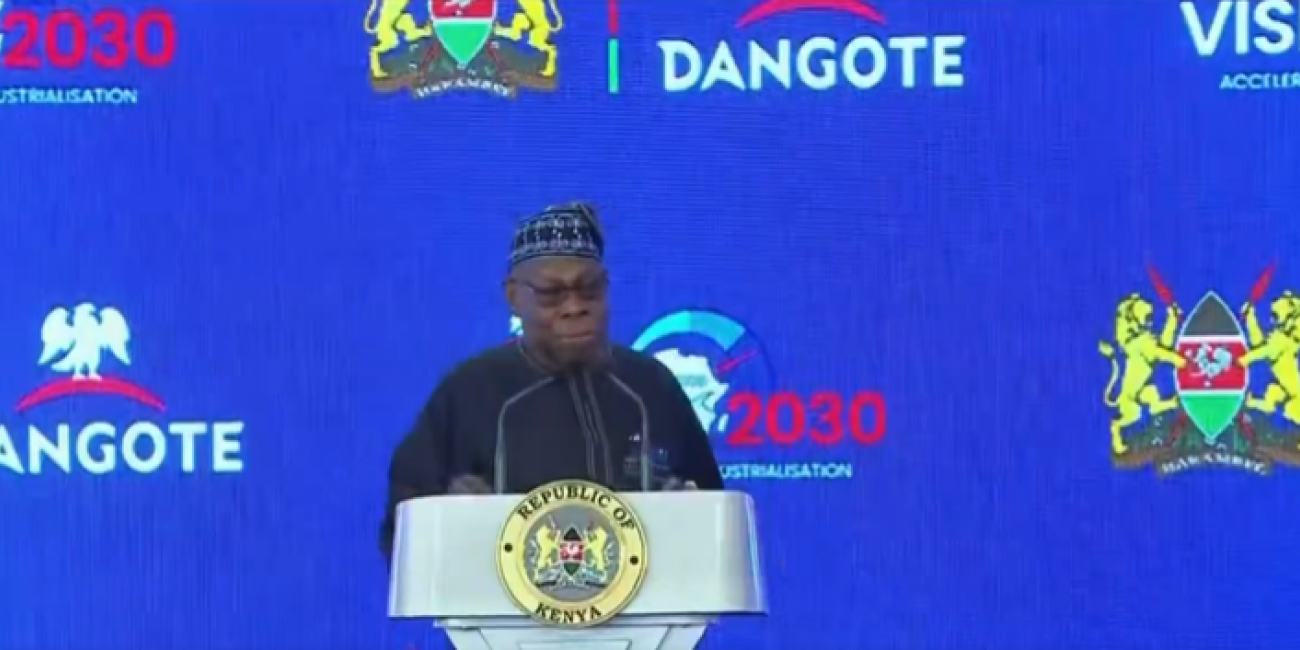
Former President of Nigeria, Olusegun Obasanjo, has described Aliko Dangote as his “boss”, crediting the businessman’s industrial achievements to the policies and encouragement provided by his administration.
Obasanjo said this while speaking at the groundbreaking ceremony of the Dangote East Africa Refinery in Lamu, Kenya, where he recalled his recent visit to the Dangote refinery and the businessman’s acknowledgement of the role he played in his transition from cement importation to production.
He said, “About two months ago, three months ago, I visited the refinery which you visited last week. And I just couldn’t stop being surprised what Aliko did. But then Aliko embarrassed me.”
According to Obasanjo, Dangote had gathered his workers during the visit and publicly attributed part of his success in cement production and the eventual development of his refinery to the policies and encouragement of the former president.
He said, “He got all his workers together in that refinery and said, without telling me, and there, said, all of you working here, all of you, the man you have to thank is this man, that’s me. I didn’t have anything to do with his refinery or what it is.
He said, without this man, I would not have been in cement production.“And it is the cement production that provided the encouragement, the inspiration for the refinery. So, thank you. They all shouted and thanked me.”
Obasanjo said Dangote had expanded the opportunities created by his administration beyond Nigeria, particularly through cement production across Africa, and was now replicating the model in the petroleum refining sector.
“May God continue to expand your coast. And you are my boss. You will continue to be my boss.”
Business
Minister Tasks Charcoal Merchants on Sustainable Forestry
The minister gave the charge at the flag-off of the 2026 Operation One Million Trees Tree Planting Programme organised by the Association for Forest Conservation and Green Industrial Charcoal Merchants at the Faculty of Renewable Natural Resources, University of Ibadan.

•Charcoal merchants and other stakeholders in the forestry sector
The Minister of Environment, Balarabe Abass Lawal, has charged charcoal merchants and other stakeholders in the forestry sector to embrace sustainable practices and support the federal government’s efforts to reverse deforestation and restore Nigeria’s degraded forest landscapes.
The minister gave the charge at the flag-off of the 2026 Operation One Million Trees Tree Planting Programme organised by the Association for Forest Conservation and Green Industrial Charcoal Merchants at the Faculty of Renewable Natural Resources, University of Ibadan.
The programme, which brought together forestry practitioners, charcoal merchants, environmentalists, students, regulators and other stakeholders, is aimed at promoting afforestation and encouraging responsible management of Nigeria’s forest resources.
Speaking at the event, the minister described tree planting as one of the most practical measures for combating climate change, reversing deforestation, restoring biodiversity, controlling desertification and strengthening the resilience of the nation’s ecosystems.
The Chairman of the Association for Forest Conservation and Green Industrial Charcoal Merchants, Mr Adeshola Adebowale Idowu, emphasised that the event carried a clear message for everyone involved in the charcoal business and, indeed, every Nigerian.
Idowu said stakeholders should develop the habit of replacing trees removed from the environment, encouraging Nigerians to plant trees around their homes and communities.
He advocated a practice of planting several trees for every tree cut down, stressing that trees remain indispensable to human existence because many products used by society are derived from them
( THISDAY)
Business
Court orders NMDPRA to continue issuing fuel import licences to Matrix Energy, AA Rano, AYM Shafa
Matrix Energy, AA Rano and AYM Shafa filed the suit in June. The lawsuit challenges the NMDPRA’s handling of fuel import licences.

A Federal High Court in Abuja has ordered the Nigerian Midstream and Downstream Petroleum Regulatory Authority (NMDPRA) to continue issuing fuel import licences and related permits to Matrix Energy, AA Rano and AYM Shafa.
In a ruling this week, Judge Inyang Ekwo of the Federal High Court in Abuja said non-compliance with the PIA and relevant laws would make any regulatory action on import licences legally ineffective.
“The consequences of non-compliance with the PIA and relevant laws make any exercise by the Authority in respect to import licences null and void,” Ekwo said.
Matrix Energy, AA Rano and AYM Shafa filed the suit in June. The lawsuit challenges the NMDPRA’s handling of fuel import licences.
The three marketers told the court they had invested more than $20 billion in infrastructure, logistics and retail networks to support their licensed fuel distribution businesses across Nigeria.


WhatsApp introduces parental controls for teens

Obasanjo: “Aliko Embarrass Me”

How Passengers Overpowered Flydubai Co-Pilot After Stabbing Pilot, To Crash Plane

Tech Expert, Zuckerberg trains with UFC champions, Adesanya, Alexander

Organ Trafficking: Ekweremadu bags 10 years in UK prison

SAINT OBI: Between his marriage and his death
-

 News3 days ago
JUST IN: Fire Engulfs Lagos Customs Command Office
-
 News2 days ago
BREAKING: Court Order Threatens Dangote Kenya Refinery Launch
-

 News3 days ago
BREAKING: Nigerian Airlines Threaten Indefinite Shutdown Over Union Disruptions
-

 Politics3 days ago
BREAKING: AAC sues Tinubu, NASS over Europe vacation
-

 Business5 hours ago
Naira To Dollar, Pound, Euro… Rates Friday, October 1
-
 Politics3 days ago
2027: Atiku, ADC Move to Amend Suit Challenging Tinubu’s Eligibility
-
 News5 hours ago
Nigeria @ 66: President Tinubu says next phase of reforms’ll cut cost of living
-
 Business5 hours ago
Court orders NMDPRA to continue issuing fuel import licences to Matrix Energy, AA Rano, AYM Shafa