
News
₦570bn Hardship Grant: FG Didn’t Give Any State Money, Makinde Counters Tinubu


The Governor of Oyo State, Seyi Makinde has denied taking part in the ₦570bn hardship grant claimed to have been given to the state governments by the Federal Government.
President Bola Tinubu while addressing Nigerians in a broadcast during the #EndBadGovernance nationwide protests against hunger and hardship, said the government has disbursed ₦570bn to the 36 states.
Tunubu also said that Nigeria spends ₦2tn monthly to import Premium Motor Spirit, popularly called petrol, and Automotive Gas Oil, otherwise known as diesel.
He disclosed that ₦9.1tn was accumulated as total fiscal revenue to the Federal Government’s coffers during the first half of 2024, marking a significant increase from what was earned by the previous administration.
“Also, more than ₦570bn has been released to the 36 states to expand livelihood support to their citizens, while 600,000 nano-businesses have benefitted from our nano-grants.
An additional 400,000 more nano-businesses are expected to benefit,” the President stated.
“Let me state categorically that this is yet another case of misrepresentation of facts. The said funds were part of the World Bank-assisted NG-CARES project—a Programme for Results intervention.
“The World Bank facilitated an intervention to help States in Nigeria with COVID-19 Recovery.
CARES means COVID-19 Action Recovery Economic Stimulus. It was called Programme for Results because States had to use their money in advance to implement the programme.
After the World Bank verified the amount spent by the State, it reimbursed the States through the platform provided at the Federal level.
The Federal Government did not give any State money; they were simply the conduit through which the reimbursements were made to States for money already spent.
“It is important to note that the World Bank fund is a loan to States, not a grant. So, States will need to repay this loan.
Note also that NG-CARES, which we christened Oyo-CARES in our State, predates the present federal administration.
“So, in direct response to the message, the Federal Government did not give Oyo State any money.
We were reimbursed funds (N5.98 billion in the first instance and N822 million in the second instance) we invested in the three result areas of NG-CARES, which includes inputs distribution to smallholder farmers within our State.
In fact, when the World Bank saw our model for the distribution of inputs preceded by biometric capturing of beneficiary farmers, they adopted it as the NG-CARES model.”
“Let me state categorically that this is yet another case of misrepresentation of facts. The said funds were part of the World Bank-assisted NG-CARES project—a Programme for Results intervention.
“The World Bank facilitated an intervention to help States in Nigeria with COVID-19 Recovery. CARES means COVID-19 Action Recovery Economic Stimulus. It was called Programme for Results because States had to use their money in advance to implement the programme.
After the World Bank verified the amount spent by the State, it reimbursed the States through the platform provided at the Federal level.
The Federal Government did not give any State money; they were simply the conduit through which the reimbursements were made to States for money already spent.
“It is important to note that the World Bank fund is a loan to States, not a grant. So, States will need to repay this loan.
Note also that NG-CARES, which we christened Oyo-CARES in our State, predates the present federal administration.
“So, in direct response to the message, the Federal Government did not give Oyo State any money.
We were reimbursed funds (N5.98 billion in the first instance and N822 million in the second instance) we invested in the three result areas of NG-CARES, which includes inputs distribution to smallholder farmers within our State.
In fact, when the World Bank saw our model for the distribution of inputs preceded by biometric capturing of beneficiary farmers, they adopted it as the NG-CARES model.”
Makinde’s denial comes on the heels of controversies that greeted the nationwide hunger and hardship protests.
The protest reported to have been peaceful in many states, had also turned violent in some northern states, with hoodlums carting away goods and facilities belonging to both the government and individuals.
Some protesters in the north were also seen brandishing the Russian flag, a development which has been widely condemned and described as a treasonable offence.
The Department of State Service (DSS) has since announced the arrest and investigation of sponsors of the violent protests, including the arrest of seven Polish nationals.
The Services also vowed to announce the names of the sponsors behind the violent protests.






News
Katsina Flood Sweeps Away Siblings Returning From Islamiyya School
Fighting back tears, the children’s father, Malam Salisu Arabi, described the loss as the most painful moment of his life.


Two brothers, Muhammad Salisu, 12, and Abdurrahman Salisu, 7, lost their lives after they were carried away by flood in Janbago, a community in Katsina State.
The victims, were said to be returning home from a nearby Islamiyya school when downpour, accompanied by strong winds, turned the streets into raging torrents.
The Daily Trust reported that their bodies were later recovered from different locations after frantic search efforts by residents.
The incident plunged the entire community into mourning as sympathisers thronged the family residence to console the bereaved parents.
Fighting back tears, the children’s father, Malam Salisu Arabi, described the loss as the most painful moment of his life.
“They left home that day like every other child going to Islamiyya school. I never imagined that the same rain we all witnessed would take away my two children,” he lamented.
News
An alleged fake university discover in Lagos
The university was operating from a three-bedroom apartment at Ilado, Olorunda Local Council Development Area of Lagos State.
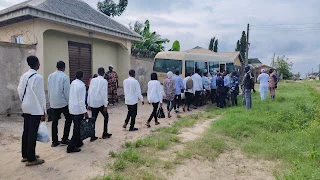
Photo:Students of the university during the raid by NSCDC. Credit: NSCDC
The proprietor of an alleged fake university in Lagos , has been arrested by operatives of Nigeria Security and Civil Defence Corps (NCDC).
The NSCDC Badagry Area Command, who enforced the arrest, said that the university was operating from a three-bedroom apartment at Ilado, Olorunda Local Council Development Area of Lagos State.
The command also rescued 106 students of the institution from across Nigeria and neighbouring West African countries with promises of admission into a foreign university.
According to the corps, the operation was carried out in the early hours of Monday following days of intelligence gathering and covert surveillance by NSCDC operatives
” The suspected institution was operating without an official name, registration, signboard or recognised campus, while allegedly presenting itself online as a distance-learning centre affiliated with a foreign university,”said NSCDC.
Investigations revealed that the rescued youths, mostly between the ages of 19 and 24, came from several Nigerian states, including Kogi, Oyo and some northern states. Others reportedly travelled from neighbouring countries such as Niger, Cameroon and Togo after being recruited online.
News
Ayo Fayose Gets Presidential Portfolio As REA Board Chairman
Fayose will head the board of REA, with Alhaji Ahmadu Abubakar and Engineer Ilyasu Ibrahim Makinta appointed as members and non-executive directors,” said Onanuga.
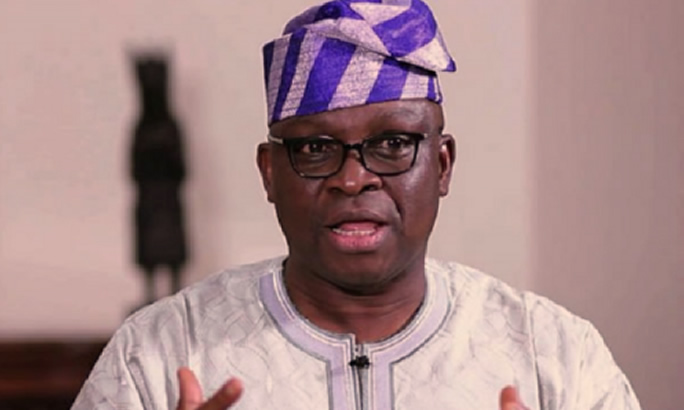
President Bola Tinubu has appointed the former governor of Ekiti State, Ayo Fayose, as chairman of the Rural Electrification Agency (REA) Board.
The President also appointed Major General Junaid Bindawa as chairman of the National Salaries, Incomes and Wages Commission.
24 others were also appointed to 10 federal government agencies and commissions.
The appointments were contained in a statement issued by the presidential spokesman, Bayo Onanuga, in Abuja.
According to the statement, “All the appointments take immediate effect.”
“Fayose will head the board of REA, with Alhaji Ahmadu Abubakar and Engineer Ilyasu Ibrahim Makinta appointed as members and non-executive directors,” said Onanuga.


Katsina Flood Sweeps Away Siblings Returning From Islamiyya School

An alleged fake university discover in Lagos

Cardoso Urges Banks To Lend Out Idle Funds With CBN * Retains MPR at 26.5%

Tech Expert, Zuckerberg trains with UFC champions, Adesanya, Alexander

Organ Trafficking: Ekweremadu bags 10 years in UK prison

SAINT OBI: Between his marriage and his death
-
 News1 day ago
BIJAMIC College Charges Class of 2026 Graduates to Embrace Resilience, Learn from Thomas Edison
-
 Sports3 days ago
Who made the FIFA World Cup trophy?
-
 News2 days ago
Senegal President, Faye elected new ECOWAS chairman
-
 Crime2 days ago
Students Killed as Troops Foil ISWAP Abduction Bid in Borno
-
 News2 days ago
Badejo-Okusanya Emerges NBA National President (2026-2028)
-
 Sports2 days ago
FIFA To Review Hydration Breaks After World Cup Final – Wenger
-
 Sports2 days ago
England beat France 6-4 to claim World Cup third place
-
 News1 day ago
Abbas inaugurating today committee to investigate illegal PFIPC agency