
Opinions
NUJ and the Question of Membership: Why It’s Time to Embrace Journalism Beyond the Newsrooms
In sports, Ernest Okonkwo, who never worked in a newsroom, electrified Nigerian radio with football commentary; John Motson commanded global football coverage; and Charles Anazodo, armed with an English degree but no newsroom training, became a defining voice on SuperSport Nigeria and SportZone.

By Babs Daramola
For decades, a quiet question has stirred in Nigeria’s media landscape: what does it truly mean to be a journalist?
Is it the newsroom, the microphone, or perhaps something in between?
This conversation spans those who honed their craft behind the scenes and those who connect with audiences on air.
As the profession evolves globally, exploring these different paths offers a fascinating glimpse into the many faces of journalism today.
The NUJ, as Nigeria’s foremost professional body for journalists, has naturally found itself at the center of this conversation.
Its membership guidelines and standards reflect a long-standing commitment to professional rigor—but they also raise interesting questions about how journalism is defined today.
Exploring the NUJ’s role offers a window into how traditional paths intersect with modern practice, and how the profession continues to recognize both experience and innovation in telling the country’s stories.
One of the most enduring points of discussion lies between those who “grew up in the newsroom” and those who made their mark on air.
Newsroom-trained journalists have long been celebrated for their investigative rigor and adherence to editorial processes, while broadcasters bring immediacy, connection, and often a deep understanding of current affairs directly to the audience.
Both paths contribute to the media landscape in meaningful ways, yet the conversation around recognition and professional legitimacy continues to spark curiosity – and sometimes controversy – within the industry.
I must admit that I too once leaned toward a narrow definition.
I argued that only those directly involved in news gathering and dissemination should rightly be called journalists.
My point, however, was not to dismiss broadcasting.
A disc jockey, an on-air personality, or a presenter of purely entertainment content is not a journalist by default.
But once a broadcaster ventures into news, current affairs, or issue-driven programming; once they engage the public in conversations that inform, interrogate power, and shape opinion, they are squarely within journalism, regardless of whether they passed through a newsroom.
As someone who has spent nearly 37 years in the profession, working in newsrooms, programme production rooms, managing broadcast outfits, and training upcoming broadcasters, I speak not as an outsider but as one deeply immersed in the craft.
Over these decades, I have seen first-hand how broadcasters and programme hosts, even those without formal newsroom training, have risen to handle current affairs with a depth and rigour that match, and sometimes surpass, their newsroom-trained colleagues.
My vantage point convinces me that the NUJ’s narrow criteria exclude valuable voices that have enriched Nigerian journalism.
History proves it: you don’t need a newsroom or a journalism degree to shape public discourse.
Larry King became a global icon with his probing interviews; Oprah Winfrey turned daytime TV into a platform for national reflection; Trevor Noah transformed comedy into incisive political analysis.
In one state, a media aide to a deputy governor was barred by the local NUJ chapter from using the title of Chief Press Secretary simply because she was not a card-carrying member of the Union
In Nigeria, Funmi Iyanda’s New Dawn fearlessly interrogated social issues, Mo Abudu’s Moments with Mo and EbonyLife TV elevated African narratives, and Ebuka Obi-Uchendu has grilled political leaders on Rubbin’ Minds with unmatched precision.
Bisi Olatilo’s multilingual presentations chronicled Nigeria’s political, social, and cultural life for decades.
In sports, Ernest Okonkwo, who never worked in a newsroom, electrified Nigerian radio with football commentary; John Motson commanded global football coverage; and Charles Anazodo, armed with an English degree but no newsroom training, became a defining voice on SuperSport Nigeria and SportZone.
None were newsroom-bred, yet all embodied journalism’s hallmarks: rigour, relevance, and undeniable public impact.
For anyone to denounce these iconic personalities as journalists is simply criminal!
The consequences of NUJ’s rigid posture are not merely theoretical.
In one state, a media aide to a deputy governor was barred by the local NUJ chapter from using the title of Chief Press Secretary simply because she was not a card-carrying member of the Union.
Her professional affiliation lay instead with the Radio, Television, Theatre and Arts Workers’ Union (RATTAWU).
She eventually settled for the title of Director of Communications. That kind of trivial gatekeeping does little to promote professionalism; instead, it hurts developmental journalism by erecting artificial barriers where none should exist.
Some defenders of the NUJ argue that its restrictive membership posture is a way of ensuring standards among practitioners. But this line of reasoning is weak and unacademic.
How does limiting membership to those with newsroom training or formal certificates guarantee professional standards?
Doctors and lawyers are licensed because their trades rest on highly technical knowledge with life-or-death consequences. Journalism is different.
It is not about certificates or regulatory seals; it is about truth-telling, verification, accountability, and informing society.
Indeed, UNESCO has consistently defined journalism not by degrees but by practice: “the activity of gathering, assessing, creating, and presenting news and information.”
The African Union’s Windhoek+30 Declaration on Information as a Public Good (2021) affirms the same spirit, urging states and institutions to recognize diverse media actors in advancing democracy.
And as Bill Kovach and Tom Rosenstiel remind us in their influential book The Elements of Journalism, the profession is ultimately defined by enduring principles: verification, independence, and a commitment to citizens; not by a union card or a newsroom pedigree.
Across the world, professional associations in journalism tend to be more inclusive.
The U.S. Society of Professional Journalists (SPJ) admits practitioners across the broad spectrum of news and current affairs, whether they are print reporters, online editors, talk-show hosts, or multimedia producers.
The UK’s National Union of Journalists (NUJ) similarly accommodates a wide variety of roles, from broadcasters to photojournalists.
Even within Africa, countries like South Africa and Kenya run relatively liberal systems where unions and associations recognize the diversity of the modern media space, instead of reducing journalism to one path. Nigeria cannot afford to lag behind.
What our own NUJ needs now is a rethink. It must broaden its tent, not narrow it. It must recognize that journalism is not a one-size-fits-all craft tied to old newsroom hierarchies.
The media landscape has expanded: citizen journalists, digital storytellers, and broadcasters who shape public discourse all fall within journalism’s wider orbit. To continue excluding them is to deny reality.
The Union has played a vital role in defending press freedom in Nigeria’s history, and it can play an even greater role in shaping the future.
But to do so, it must align itself with international best practices and with the lived realities of the profession. Journalism thrives not on exclusion but on relevance, adaptability, and fidelity to truth.
For the NUJ, the choice is clear: evolve into a forward-looking institution that embraces diversity in practice, or risk irrelevance in a world that has already moved on.
∆ Babs Daramola is a Lagos-based broadcast journalist with nearly four decades of experience in newsrooms, programme production, management of broadcast outlets, and training of upcoming media professionals.
Opinions
Am I A Thief?
Sometimes, we think being a thief is only about taking what is not ours in obvious ways.
One of our Sudanese brothers once shared a deeply touching story titled “Am I a Thief?”—and honestly, it’s not just a story… it’s a mirror to the soul.
He spoke of two moments that seemed small on the surface, yet carried profound weight.
He had traveled to Ireland for a medical exam. The fee was £309, but without change, he paid £310. It felt insignificant—just £1 extra. He completed his exams and eventually returned to Sudan, probably never thinking about it again.
But then… a letter arrived.
Inside was a check for £1, with a message that pierced deeper than the money itself:
“You made a mistake when paying your exam fees. The fee was £309, but you paid £310. This is your £1… we do not take more than what is rightfully ours.”
Pause for a moment and let that sink in…
The envelope, the stamp, the process—it all costs more than £1. Yet, integrity was not measured by cost, but by principle.
It wasn’t about the money. It was about doing what is right… even when no one is watching, even when it doesn’t “make sense.”
The second moment:
On his daily route between college and home, he would stop by a small grocery shop run by a woman and buy chocolate for 18 pence.
One day, he noticed something different. The same chocolate—same size, same quality—but now there were two prices: 18 pence and 20 pence.
Curious, he asked why.
She calmly explained:
“There were issues in Nigeria, where we get cocoa. Prices have gone up. The new stock is 20 pence, but the old one remains 18.”
He thought logically, like many of us would:
“Then people will only buy the 18 until it finishes, before moving to 20.”
She nodded, “Yes, I know.”
So he suggested what seemed like a “smart” solution:
“Why not mix them together and sell everything at 20? No one will know the difference.”
She leaned closer… lowered her voice… and asked a question that struck like lightning:
“Are you a thief??”
He was stunned. Speechless.
He walked away—but that question followed him… echoed within him… refused to let him go:
“Am I a thief??!!”
Sometimes, we think being a thief is only about taking what is not ours in obvious ways.
But this story challenges something deeper.
It asks:
What do we do with the little things?
The unnoticed moments?
The quiet opportunities to bend the truth… just a little?
Because integrity is not proven in grand gestures.
It is revealed in the smallest decisions—when profit is possible, when shortcuts are easy, when no one would ever know.
And perhaps the real question is not what others call us…but what our conscience whispers when we are alone.

As Nigerians commemorate Democracy Day, the Peoples Democratic Party (PDP) has declared that three decades after the historic June 12, 1993 presidential election, democracy remains under severe threat in the country.
In a strongly worded press statement issued on Thursday, the PDP paid tribute to the freest and fairest election in Nigeria’s history and the sacrifices made by citizens who defended the people’s mandate.
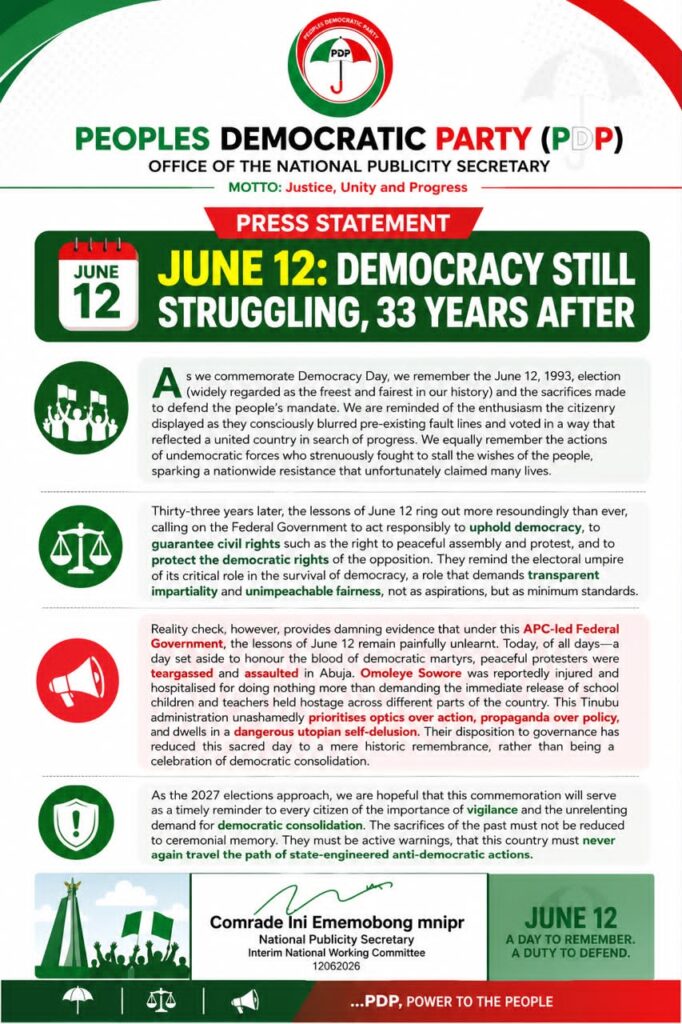
The party recalled the remarkable enthusiasm displayed by Nigerians during the 1993 polls, when citizens transcended ethnic and religious fault lines to vote for national progress.
The statement, signed by Comrade Ini Ememobong, National Publicity Secretary of the PDP Interim National Working Committee, noted that undemocratic forces aborted the popular will, triggering a prolonged resistance that claimed many lives.
“Thirty-three years later, the lessons of June 12 ring out more resoundingly than ever,” the PDP said, urging the Federal Government to uphold democratic principles, guarantee civil rights including the right to peaceful assembly and protest, and protect the rights of the opposition.
The party also reminded the Independent National Electoral Commission (INEC) of its sacred duty to conduct elections with “transparent impartiality and unimpeachable fairness,” describing these as minimum standards rather than mere aspirations.
However, the PDP expressed deep disappointment over what it described as the current administration’s failure to learn from history.
“Reality check, however, provides damning evidence that under this APC-led Federal Government, the lessons of June 12 remain painfully unlearnt,” the statement read. “Today, of all days — a day set aside to honour the blood of democratic martyrs — peaceful protesters were teargassed and assaulted in Abuja.”
The party highlighted the case of activist Omoleye Sowore, who was reportedly injured and hospitalised while demanding the immediate release of schoolchildren and teachers held hostage in different parts of the country.
The PDP accused the Tinubu administration of prioritising “optics over action, propaganda over policy,” and living in “a dangerous utopian self-delusion,” thereby reducing Democracy Day to a mere historic remembrance instead of a celebration of democratic consolidation.
Looking ahead to the 2027 general elections, the opposition party called on all citizens to remain vigilant and unrelenting in their demand for genuine democratic consolidation.
“The sacrifices of the past must not be reduced to ceremonial memory. They must be active warnings that this country must never again travel the path of state-engineered anti-democratic actions,” the PDP warned.
Comrade Ini Ememobong, mnipr is the National Publicity Secretary, Interim National Working Committee of the Peoples Democratic Party.
Opinions
Nigeria Cannot Build Flood Resilience While Destroying Its Wetlands
The next 10 to 20 years are likely to bring even more dangerous combinations of intense rainfall, river flooding, urban flooding, and coastal flooding/erosion.
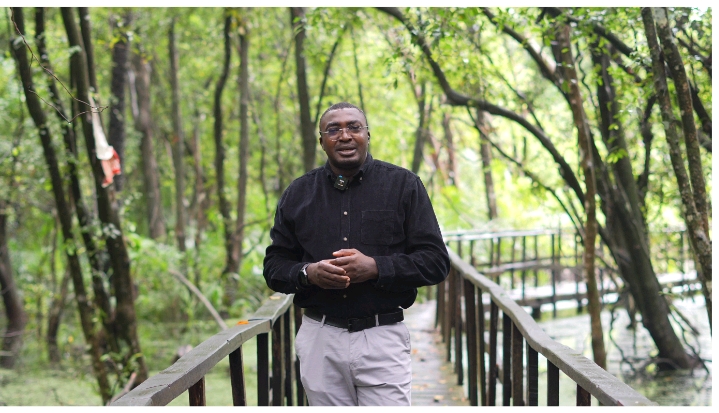
By DrJoseph Onoja
Every rainy season in Nigeria now arrives with a familiar sense of anxiety. Roads disappear beneath floodwaters, homes are submerged, businesses are disrupted, and lives are displaced.
What was once considered a seasonal inconvenience has become a recurring national emergency.
But Nigeria’s flooding crisis is no longer simply about rain.It is the result of a dangerous collision between climate change, environmental degradation, and weak urban planning.
Climate change is intensifying rainfall patterns across Africa, but human activities like deforestation, wetland destruction, poor drainage systems, and uncontrolled development on floodplains are multiplying the scale of destruction.
The uncomfortable truth is this: flooding in Nigeria is becoming structural.
Climate change may trigger the rainfall, but environmental degradation determines whether rain becomes disaster.
Climate Change Is Intensifying the Risk
Scientific evidence continues to show that extreme rainfall events are becoming more intense across Africa.
According to the Intergovernmental Panel on Climate Change (IPCC), both the frequency and intensity of heavy precipitation events are projected to increase as global warming accelerates.
In cities like Lagos, the impacts are already visible. Urban flooding has become more widespread, with both short-duration high-intensity rainfall and prolonged rainfall events increasing flood risks.
However, climate change alone does not explain the scale of devastation we are witnessing.
Ordinarily, heavy rainfall should not automatically become a disaster.
Healthy wetlands, functional drainage systems, protected floodplains, and well-planned urban infrastructure are designed to absorb and manage excess water.
” In Lagos, this issue is particularly critical. Water bodies, lagoons, creeks, and wetlands cover more than 62% of the state’s land area, while another significant portion remains seasonally flood prone.”
But when these natural and engineered systems fail or are deliberately compromised, communities become increasingly vulnerable.Nigeria’s flood challenge is therefore not only a climate issue. It is also a planning and governance issue.
Nigeria Is Destroying Its Natural Flood Defences
One of the most overlooked aspects of flood resilience in Nigeria is the role of nature itself.
Forests, wetlands, mangroves, and floodplains act as natural flood buffers. They absorb excess water, slow runoff, reduce erosion, and minimize flood peaks.
In many ways, they function as invisible infrastructure protecting communities from disaster.
Yet across Nigeria, these ecosystems are being degraded at alarming rates.
Deforestation reduces the soil’s ability to absorb water, increasing surface runoff and erosion. Sediments washed into drainage systems reduce their capacity and worsen urban flooding.
At the same time, wetlands and floodplains are increasingly being sandfilled and converted for construction and urban expansion.
The irony is embedded in the name itself: floodplains exist to absorb floods.
In Lagos, this issue is particularly critical. Water bodies, lagoons, creeks, and wetlands cover more than 62% of the state’s land area, while another significant portion remains seasonally flood prone.
When these ecosystems are filled, degraded, or built over, floodwater has fewer places to disperse safely. Instead, it ends up in homes, roads, and communities.
Wetlands are not vacant land waiting for development; they are natural infrastructure protecting cities from collapse.
The implications are enormous. Sensitive ecological areas such as the Lekki Conservation Centre continue to serve as natural buffers by receiving, retaining, and absorbing water from surrounding environments.
If such ecological buffers are lost to uncontrolled development, entire communities become significantly more exposed to flooding risks with attendant consequences for human health, livelihoods, wellbeing, infrastructure, and property.
Nigeria’s Adaptation Gap Is Growing
Nigeria is not standing completely still. There are signs of progress.
The Lagos Climate Adaptation and Resilience Plan identify dozens of adaptation projects and estimates financing needs between US$9 billion and US$16 billion by 2035.
This reflects increasing recognition that climate resilience must become a development priority.
But adaptation efforts are still not keeping pace with the speed of urban growth and climate risk.
Rapid urbanization, inadequate drainage systems, weak urban governance, and insufficient climate-resilient infrastructure continue to increase exposure across many Nigerian cities.
The next 10 to 20 years are likely to bring even more dangerous combinations of intense rainfall, river flooding, urban flooding, and coastal flooding/erosion.
Sea level rise will further worsen risks in low-lying coastal cities, especially Lagos.
Without urgent intervention, the economic, social, and environmental costs will continue to rise.
The cost of protecting ecosystems today is far lower than the cost of rebuilding cities tomorrow.
Nature-Based Solutions Must Become National Policy
Nigeria cannot engineer its way out of this crisis through concrete alone. Flood resilience requires a combination of infrastructure investment and ecological protection.
Nature-based solutions must become central to national and subnational climate adaptation strategies.
This means:
- • Protecting and restoring forests, wetlands, mangroves, and floodplains
• Strengthening drainage and storm water systems
• Enforcing risk-sensitive urban planning regulations
• Preventing development on ecologically sensitive areas
• Improving solid waste management to prevent blocked drainage systems
• Investing in low-carbon and climate-resilient growth pathways.
These actions are not optional environmental luxuries. They are essential investments in public safety, economic stability, and national resilience.
The future of flood resilience in Nigeria will depend as much on ecological protection as on engineering.
A Defining Choice for Nigeria
Floods are no longer isolated disasters. They are warning signs. They reveal the growing consequences of ignoring environmental limits while cities expand faster than resilience systems can keep pace.
They expose the cost of treating ecosystems as expendable rather than essential.
Nigeria still has a choice. We can continue reacting to flood disasters after they occur, or we can invest in prevention, resilience, and nature-based infrastructure before the next crisis arrives.
Protecting Forests, wetlands, restoring degraded ecosystems, and strengthening climate adaptation systems are not simply environmental priorities.
They are national development imperatives.The future resilience of Nigeria’s cities may well depend on how seriously we take them today.
• Dr Joseph Onoja , a conservation scientist, is the Director – General of the Nigerian Conservation Foundation (NCF).


A Review of Akwa Ibom State Government’s July Delivery Meeting

Explosion rocks Apapa tank farm; NPA, NIMASA move to curtail spread

FG slams 8-count charges on Adeyemi over fake agency ” I’m not a criminal”, he defends

Tech Expert, Zuckerberg trains with UFC champions, Adesanya, Alexander

Organ Trafficking: Ekweremadu bags 10 years in UK prison

SAINT OBI: Between his marriage and his death
-
 Business3 days ago
Naira Exchange Rates Thursday July 2, 2026
-
 News3 days ago
NIPSS: Gunmen attacks again, one killed
-
 News3 days ago
FG Launches Digital Education Database, Seeks Full School Participation
-
 Politics3 days ago
Atiku appoints Kenneth Okonkwo as spokesperson
-
 Business2 days ago
Issue: Cloning Nigerian Investment Promotion Commission (NIPC)
-
 News2 days ago
FG Hails End of Oyo Teacher’s Strike
-

 International1 day ago
General Hydrocarbons Floors FBN as S’Court Sets Aside Appeal Court Ruling
-

 Sports1 day ago
Cape Verde faces defending world cup champions , Argentina today