
Business
“Why I Don’t Take Food and Beverages in Aba “


Image credit: toppng
By Ichaburu Ochefa
Some time ago, a friend of mine living in Lagos State told me that whenever he is on business travels to Aba, Abia State, he doesn’t drink water or tea neither in the hotel he lodges nor buys from the shops outside.
Curiously, I asked him why.? “
They are fake products,” he replied. He added, “From water to tea, wine, spirits, juices, etc.
“I further asked, “So how do you survive while you are there.?
“I prepared myself from Lagos,” he said. “But there are fake products in Lagos, too, and all over Nigeria,” I told him as a matter of fact.
They are at Oke-Arin market on Lagos Island, Alaba International; the Oyingbo market … they are at Ogbete main market, Enugu …”
“I know, he cut me short and said: “Not like Aba; Aba is worst in counterfeiters…”
What my friend told me months ago matches the NAFDAC’s recent regulatory actions against fake product manufacturers in Aba.
An official statement from the agency on Tuesday, 28 January 2025, signed by Prof Mojisola Adeyeye, the NAFDAC Director-General, described the Cemetery market Aba as ” the most dreaded and hitherto safe haven for the largest cartel ring for the manufacture of fake wines and beverages in Africa.”
NAFDAC further said that its enforcement agents, in collaboration with a large contingency of the military, DSS, and Nigeria Police, in a rare display of inter-agency cooperation, confiscated adulterated wines, fake food, and beverages valued at over N5 billion. ”
The current action of NAFDAC is the most audacious in the history of the market, with specific zones barricaded with iron welding and access gates locked to date.
The operation carried out was a follow-up to a similar raid that was carried out in December 2023.
Some of the nefarious activities of the counterfeiters included the manufacturing of all kinds of adulterated products especially different kinds of wine from a wide variety of brands ranging from the following: · Seaman Schnapps, Henessy, Four Cousins · Carlo Rossi, Jenney, Chelsea London Dry Gin · Schnapp Dry Gin, McDowells, Black Labels · Gordons, Martell, Campari, Smirnoff ice · Eva Non-Alcoholic Drink, Evra Non-Alcoholic Drink, Cartel and others.
As a consequence of the extensive operation, the agency raided over 240 shops and turned factories where the harmful products were being produced and marketed.
The shops turned factories are very filthy, using water from very unhygienic sources, harmful chemicals, saccharin, coloring, dirty recycled bottles, and cloned packaging materials of other brands.
The adulteration of alcoholic beverages by criminal elements in the country is done by mixing cheaper sources of sugar and starch besides grapes or fruit, among other harmful chemicals unsuitable for human consumption.
Over 1500 cartons of fake and substandard products were destroyed during the operation.
The street value of the confiscated and destroyed fake products in 2023 is estimated at over seven hundred and fifty million naira only. (N750,000,000).
The estimated value of products mopped up during the December 15, 2024, operation is five billion naira.
The products being revalidated and mopped up include: · Soft and carbonated drinks such as Fanta, Coca-Cola · Schweppes, Lacasera, Sprite, Hollandia Yoghurt · Super Commando Energy Drink, Feyrouz and Amstel Malta. Aside from drinks, notable fake home-use beverages such as: · Peak Sachet Milk, Cowbell Sachet Milk, Peak Chocolate Drink · Miksi Sachet Milk, Cadbury Chocolate Drink, and Ovaltine adulterated versions.
Before the evacuation of the products by NAFDAC, they were being produced in the market and neatly packaged and sold to unsuspecting consumers.
NAFDAC management appreciates the support from the Government of Abia State led by His Excellency Governor Alex Otti for his unwavering support for this project OPERATION CLEAN UP ABA.
The Mayor of Aba South, the interim management committee of the market, and other stakeholders have been working assiduously with NAFDAC on the project, leading to another discovery of three major warehouses stockpiling expired HOLLANDIA YOGHURT for revalidation on the 22nd of January 2025.




Business
History of Naira Revaluation and Devaluation (1973–2026) (Part 1)
Why was the naira devalued?
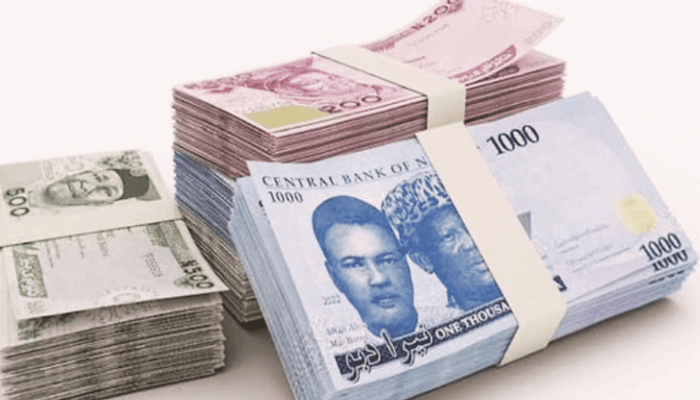
The history of the Nigerian naira is marked by two major developments: periods when the currency gained value or was officially strengthened, and prolonged periods when it lost value against major international currencies, particularly the US dollar.
Since its introduction in 1973, the naira has undergone several exchange-rate policy changes, including fixed exchange rates, currency devaluations, foreign-exchange market liberalisation, attempts to unify exchange rates and market-driven depreciation.
The Central Bank of Nigeria (CBN) has played a central role in managing these changes.
- Introduction of the Naira in 1973
Nigeria introduced the naira on January 1, 1973, replacing the Nigerian pound.
The conversion rate was:
£1 Nigerian pound = ₦2.
₦1 = 10 shillings under the old currency system.
₦1 = 100 kobo.
The new currency was introduced during a period of expanding oil revenues and economic growth.
Nigeria initially maintained a relatively strong, managed exchange rate, supported by foreign-exchange controls and the country’s oil earnings.
The introduction of the naira was a currency change, not a devaluation.- The 1970s: A Relatively Strong Naira
During the 1970s, rising oil revenues strengthened Nigeria’s foreign-exchange position.
The government maintained a controlled exchange-rate system, initially linking the naira to the US dollar before moving to a basket of currencies representing major trading partners in 1978.
The oil boom provided foreign exchange for imports, infrastructure and public expenditure.
However, Nigeria’s dependence on crude oil revenues left the economy vulnerable to fluctuations in international oil prices.
Key development: The naira benefited from a relatively strong external position, although its exchange rate was managed by the authorities rather than determined by an unrestricted market.- The Early 1980s: Mounting Pressure on the Naira
The economic situation deteriorated in the early 1980s as oil revenues weakened and foreign-exchange shortages intensified.
Nigeria faced several economic challenges:
• Declining oil receipts.
• Rising import bills.
• Pressure on foreign reserves.
• Growing external debt and trade arrears.
• Increasing demand for foreign currency.
The government maintained controls on foreign exchange, but the official rate became increasingly disconnected from the rate at which foreign currency could be obtained in the parallel market.
This created pressure for exchange-rate reform.
The crisis set the stage for the introduction of the Structural Adjustment Programme (SAP) in 1986.- 1986: Major Naira Devaluation Under SAP
September 26, 1986, marked a turning point in the history of the naira.
Under the military government of General Ibrahim Babangida, Nigeria introduced the Second-Tier Foreign Exchange Market (SFEM) as part of the Structural Adjustment Programme.
The objective was to allow market forces to play a greater role in determining the naira’s exchange rate.
According to an International Monetary Fund account, the naira’s value was discounted by approximately 66 per cent at the inaugural SFEM auction.
The exchange rate moved from about ₦1.60 per US dollar under the previous administered rate to approximately ₦4.60 per dollar at the initial auction.
Why was the naira devalued?
The policy was intended to:
•Reduce the overvaluation of the naira.
•Improve the allocation of scarce foreign exchange.
•Encourage non-oil exports.
•Improve the competitiveness of Nigerian products.
•Reduce distortions in the foreign-exchange market.
However, the weaker currency also increased the naira cost of imported goods and production inputs.
The 1986 reform began a prolonged period of exchange-rate adjustments.- …To be continued
Business
Obasanjo Accuses Tinubu : “You Made Every Nigerian Poor By 300% Naira Devaluation”
The former President also rejected the argument that Tinubu needed more time to complete his reforms, saying he did not see the economy improving.
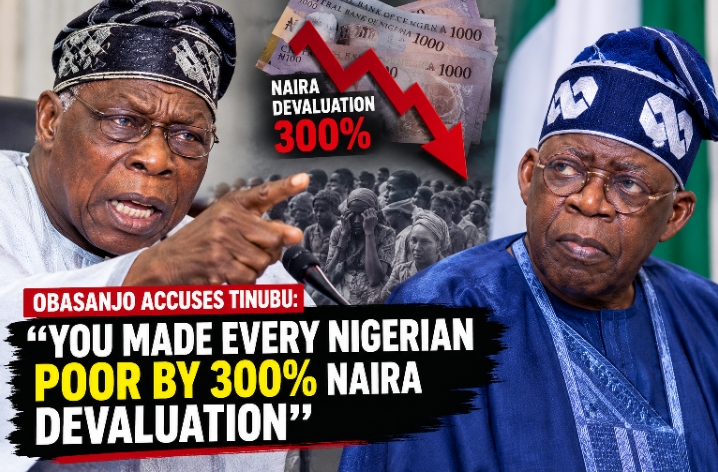
Image: AI generated
Former President Olusegun Obasanjo has accused President Bola Tinubu of making every Nigerian poor by 300 per cent through the devaluation of the naira.
Obasanjo spoke on Wednesday during the Financial Times Africa Summit 2026 in London, United Kingdom.
He said that the naira lost its value overnight due to economic reforms undertaken by the Tinubu administration in 2023.
“We do not live in isolation as a country. We interact with the rest of the world. And overnight, you devalue the currency by 300 per cent. The naira went from N500 to a dollar to N1,500 to a dollar. What that meant was that every Nigerian is made poor by 300 per cent.”
Obasanjo said that had made Nigeria “the poverty capital of the world,” which he said meant the country had the largest number of poor people in the world.
“You cannot say to me that that is good for Nigeria. You cannot say to me that that is good for us in any sense,” he noted.
The former President also rejected the argument that Tinubu needed more time to complete his reforms, saying he did not see the economy improving.
Business
CBN Licences Abbey Bank to Start Full Commercial Banking in November 2026
Adewumi said: “The year 2026 represents a defining moment in the history of Abbey. Our approval to transition to commercial banking is a testament to the work invested in building this institution and the confidence placed in us by our regulators, shareholders, customers and employees.”

The Central Bank of Nigeria (CBN) has approved Abbey Bank Plc to begin operation as a regional commercial bank, effectively from November 2026.
The licence opens retail banking, small and medium-sized enterprise lending, trade finance and corporate banking to the lender.
Abbey Bank had operated as a mortgage bank for more than three decades.
The commercial banking licence was issued in June 2026 after the bank completed its capital-raising process.
Managing Director and Chief Executive Officer Mobolaji Adewumi said the bank began internal discussions on the transition in 2023 and submitted a formal application in 2024.
He said regulatory approval arrived in October 2024.
Adewumi said: “The year 2026 represents a defining moment in the history of Abbey. Our approval to transition to commercial banking is a testament to the work invested in building this institution and the confidence placed in us by our regulators, shareholders, customers and employees.”


History of Naira Revaluation and Devaluation (1973–2026) (Part 1)

JUST IN: 1 Dead, 3 Rescued in Fadeyi Building Collapse, Lagos

Obasanjo Accuses Tinubu : “You Made Every Nigerian Poor By 300% Naira Devaluation”

BREAKING: Lagos Govt Declares Today, Thursday Work-Free to Mark 2026 Ìṣẹ̀ṣe Day

Tech Expert, Zuckerberg trains with UFC champions, Adesanya, Alexander

Organ Trafficking: Ekweremadu bags 10 years in UK prison
-
 Business3 days ago
Currency Words You Should Know
-
 Business3 days ago
Naira Exchange Rates Wednesday, October 21, 2026
-

 Business3 days ago
NCC, CBN To Warn Companies By Flagging Fraudulent Phone Numbers
-
 Business3 days ago
JPMorgan Eyeing Entry Into Nigeria’s Banking Industry
-

 Business16 hours ago
Naira To Dollar, Pound, Euro… Today October 23
-

 Business3 days ago
RMRDC Taking 2027 Africa Raw Materials Summit To Kenya
-

 Health3 days ago
Ebola In Nigeria: Symptoms, Spread and How To Protect Yourself
-

 Health2 days ago
Ebola Outbreak: Don’t Panic, FG Assures Nigerians