
Business
Where Will the Lagos-Calabar Coastal Road Pass? Land Speculators Alert!By Dennis Isong
Spanning approximately 700 kilometers, the road is designed to stretch from Lagos, Nigeria’s beating commercial heart, all the way to Calabar in Cross River State.

The morning sun had barely pushed through the Lagos skyline when Emeka received the phone call that shook his world.
His uncle, who owned a modest piece of land near Eleko, was practically yelling on the phone:”Emeka! They’re building a massive highway right through our area! The government men came yesterday with their measuring tapes and equipment.
This thing is real, oh!”For Emeka, and many like him, that single call wasn’t just gist—it was a wake-up call to the kind of transformation that only infrastructure of historic scale can bring.
In a country where road projects often drag or die midway, the Lagos-Calabar Coastal Highway is a different beast entirely. It is not just a road. It is a symbol. A promise. And, depending on how you position yourself, it can either make or break fortunes.
This kind of scene is playing out across Nigeria’s southern coast—small landowners scrambling to understand what is happening, speculators eyeing quick gains, investors calculating their next moves, and everyday Nigerians wondering if this project will truly deliver on its promise.
So, where exactly will this superhighway pass, and what does it mean for those who own or plan to own land in its path? Let’s dive deeper.
The Grand Vision: A 700-Kilometer Journey Along Nigeria’s Coast
The Lagos-Calabar Coastal Highway represents one of the boldest infrastructure projects Nigeria has seen in decades.
Spanning approximately 700 kilometers, the road is designed to stretch from Lagos, Nigeria’s beating commercial heart, all the way to Calabar in Cross River State, hugging the coastline and connecting seven states along its path.
This is not a mere patchwork road; it is planned as a modern superhighway with ten lanes in total—five on each side—built to international standards.Why does this matter?
Because this isn’t just transportation. This is economic transformation laid out in asphalt and concrete.
By deliberately tracing the coastline, the government has chosen a route that will connect Nigeria’s key ports, industrial zones, and tourism hubs, while simultaneously opening up communities that have long been ignored in national development.
For land speculators and investors, this positioning is everything.
Places that once looked like sleepy fishing communities will suddenly find themselves positioned as gateways to Nigeria’s next economic corridor.
Phase One: Lagos to Eleko Junction – The Reality on Ground
When it comes to massive projects like this, talk can be cheap. But the Lagos-Calabar Coastal Highway is already moving from blueprint to bulldozers.
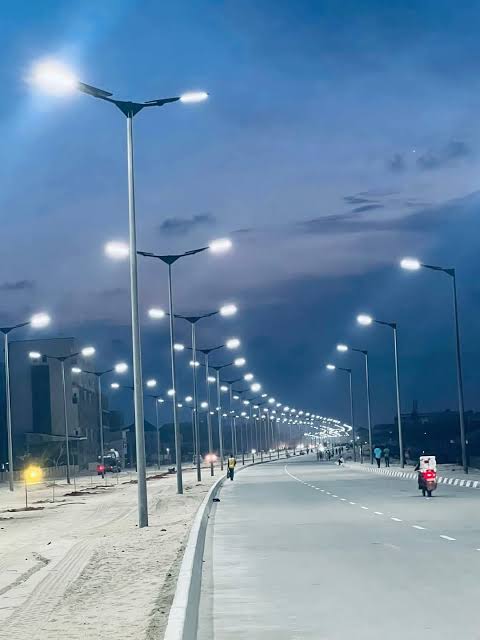
The first section of the highway, measuring roughly 47.47 kilometers, runs from Ahmadu Bello Way in Victoria Island to Eleko Junction in Lagos State.
This stretch—already commissioned—provides the clearest picture of where land opportunities currently exist.
Works began in March 2024, with the government promising to complete this section by May 29, 2025. That timeline matters, because for investors and speculators, time is money.
The earlier you position yourself in areas adjacent to the development, the greater the potential upside when the project fully matures.
And let’s not miss the strategic brilliance here: this Lagos stretch links directly to the Lekki Deep Seaport, which is a multi billion-dollar game changer.
Think about it—Nigeria’s busiest commercial hub, Lagos, directly tied to a world-class seaport by a brand-new highway.
The result? A logistics, trade, and industrial hub unlike anything the country has seen before.No wonder places like Ibeju-Lekki, Eleko, and the Lekki Free Trade Zone are buzzing with activity. Property inquiries have shot up.
Land values are rising. Developers are circling. And communities that once felt like far-flung outposts now find themselves in the glare of investor attention.
Works began in March 2024, with the government promising to complete this section by May 29, 2025. That timeline matters, because for investors and speculators, time is money.
The Wider Corridor: What Each State Stands to Gain
To truly understand the impact of the Lagos-Calabar Coastal Highway, you must look beyond Lagos. The real story lies in how each state it passes through will be reshaped.
Ogun State: Sitting right next to Lagos, Ogun is already known for its industrial clusters. The highway will only accelerate this by making Ogun’s coastal communities prime for both residential and commercial expansion. Lagos is bursting at the seams; Ogun will absorb much of that overflow.
Ondo State: With rich natural resources and agricultural potential, Ondo’s coastal areas have been relatively cut off. Improved access will turn sleepy fishing villages and farmlands into investment hotspots.
Delta State: Already an oil-rich state, Delta could diversify its economy with better access. Expect agriculture, trade, and services to grow once the coastal road improves logistics.
Bayelsa State: Known for oil but underserved in infrastructure, Bayelsa’s coastal communities could finally open up to tourism and commerce.
Rivers State: With Port Harcourt already a major commercial hub, the coastal highway provides an alternative to inland congestion, positioning more coastal towns for growth.
Akwa Ibom & Cross River: Tourism and trade could boom here. Imagine smooth access to Calabar Carnival, Tinapa, or Akwa Ibom’s beaches, making these states magnets for local and foreign investors, and thus, .making these states magnets for local and foreign investors.
The Demolition Dilemma: Right-of-Way Challenges
Projects rarely happen without pain. And for many small land and property owners, the highway has already been a bulldozer nightmare.In April 2024, bulldozers rolled into Oniru waterfront in Lagos, clearing kiosks, restaurants, and beachside businesses.
By December, 750 structures across different stretches of the coastal states had been affected.
This highlights a key reality: if your land sits directly on the highway’s path, you may lose it. But if your property lies slightly off the road—still close enough to benefit from its presence—you might be sitting on a goldmine.
The government, to its credit, has announced compensation programs. For example, in Section 1 alone, the federal government paid ₦2.75 billion in compensation for affected properties within the first 3 kilometers.
That not only shows seriousness but also gives speculators a benchmark for property values in these zones.Investment Hotspots: Where Smart Money Is FlowingSo, where should the alert investor look?
Lekki Free Trade Zone: This is the no-brainer. With direct ties to the seaport and highway, it’s a magnet for industry and logistics.
Eleko: Once a quiet community, it now marks the endpoint of the first phase. Land values here are rising sharply.Ibeju-Lekki: Already touted as “the new Lagos,” the highway cements its place as a hotspot for both residential estates and industrial projects.Beyond Lagos, expect hotspots to emerge in Ogun’s border communities, Ondo’s coastal villages, and eventually in Akwa Ibom and Cross River when the highway nears completion.
Timeline & Tolling: The Next 10 Years
According to Minister of Works, Dave Umahi, the first Lagos section will be ready by May 2025. But the plan isn’t just to build and abandon—the road will be tolled for 5 to 10 years to recover costs and ensure maintenance.
This matters because tolled roads generally receive better upkeep than free ones.
For investors, this means areas along the road are less likely to fall into disrepair, protecting land and property values.Interestingly, the government isn’t just building from Lagos outward.
Construction has also begun on Sections 3 and 4 from Calabar, meaning both ends are being tackled simultaneously. This could shorten the overall timeline and bring benefits faster than expected.
Beyond Transport: The Ripple Effects
The Lagos-Calabar Coastal Highway isn’t just a road—it’s an economic multiplier.Tourism: Beach towns, cultural centers, and resorts will become more accessible, boosting hospitality investments.Agriculture: Farmers along the coast will move goods to major markets more efficiently, making agribusiness attractive.Industry: Manufacturing and processing plants will spring up near the road, cutting transportation costs.Services: Retail, banking, telecoms, and education services will follow population growth along the corridor.In short, entire towns could spring up where there was once only bush.
Risks: What Investors Must Watch
Not every land along the road is a jackpot. Risks abound.Environmental concerns may slow or alter parts of the route.
Funding risks exist, though current progress looks promising.Land title disputes—always a Nigerian headache—could derail your investment.
Speculative oversupply may flood some markets, depressing values.Competing infrastructure projects could draw attention away from certain stretches. Due diligence is non-negotiable. Verify titles. Study local government plans.
Don’t just buy because everyone else is rushing in.
The Decade Ahead: What to Expect in Fast 10 years Ahead.
The Lagos-Calabar Coastal Highway is fully operational. What will Nigeria’s coast look like?Coastal towns from Lagos to Calabar will likely become bustling hubs.
Migration patterns will shift as people move to newly accessible areas.
International investors will look more favorably at Nigeria’s coastline.
Government will likely designate new special economic zones along the route.
The highway may even link into wider West African trade routes, cementing Nigeria’s position as a regional hub.
For the alert investor, the message is clear: this road is not just geography, it is opportunity.
Final Word: Land Speculators, Be Alert!
So, wlhere will the Lagos-Calabar Coastal Road pass? Through Lagos, Ogun, Ondo, Delta, Bayelsa, Rivers, Akwa Ibom, and Cross River.
But more importantly, it will pass through the heart of Nigeria’s economic future.From Lagos Island to Calabar, this project is about more than concrete—it’s about reshaping communities, economies, and lives.If you are a land speculator or investor, your success won’t just depend on knowing where the road physically runs, but on understanding how it will transform everything around it.
Some will lose their land to bulldozers. Others will turn bush plots into multimillion-naira estates.
History is being built on Nigeria’s coastline.
The question is: will you just watch, or will you position yourself to ride the wave?


Business
History of Naira Revaluation and Devaluation (1973–2026) (Part 1)
Why was the naira devalued?

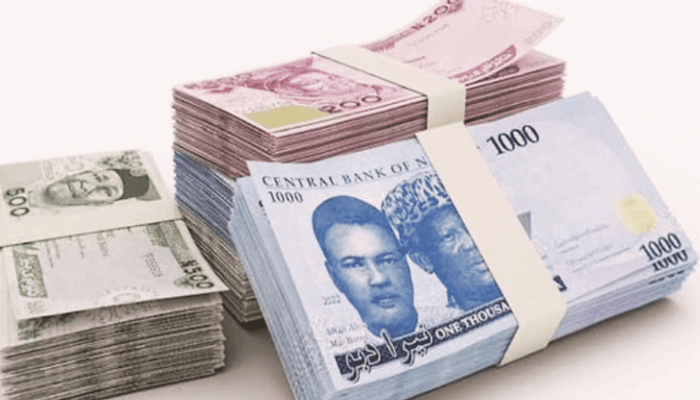
The history of the Nigerian naira is marked by two major developments: periods when the currency gained value or was officially strengthened, and prolonged periods when it lost value against major international currencies, particularly the US dollar.
Since its introduction in 1973, the naira has undergone several exchange-rate policy changes, including fixed exchange rates, currency devaluations, foreign-exchange market liberalisation, attempts to unify exchange rates and market-driven depreciation.
The Central Bank of Nigeria (CBN) has played a central role in managing these changes.
- Introduction of the Naira in 1973
Nigeria introduced the naira on January 1, 1973, replacing the Nigerian pound.
The conversion rate was:
£1 Nigerian pound = ₦2.
₦1 = 10 shillings under the old currency system.
₦1 = 100 kobo.
The new currency was introduced during a period of expanding oil revenues and economic growth.
Nigeria initially maintained a relatively strong, managed exchange rate, supported by foreign-exchange controls and the country’s oil earnings.
The introduction of the naira was a currency change, not a devaluation.- The 1970s: A Relatively Strong Naira
During the 1970s, rising oil revenues strengthened Nigeria’s foreign-exchange position.
The government maintained a controlled exchange-rate system, initially linking the naira to the US dollar before moving to a basket of currencies representing major trading partners in 1978.
The oil boom provided foreign exchange for imports, infrastructure and public expenditure.
However, Nigeria’s dependence on crude oil revenues left the economy vulnerable to fluctuations in international oil prices.
Key development: The naira benefited from a relatively strong external position, although its exchange rate was managed by the authorities rather than determined by an unrestricted market.- The Early 1980s: Mounting Pressure on the Naira
The economic situation deteriorated in the early 1980s as oil revenues weakened and foreign-exchange shortages intensified.
Nigeria faced several economic challenges:
• Declining oil receipts.
• Rising import bills.
• Pressure on foreign reserves.
• Growing external debt and trade arrears.
• Increasing demand for foreign currency.
The government maintained controls on foreign exchange, but the official rate became increasingly disconnected from the rate at which foreign currency could be obtained in the parallel market.
This created pressure for exchange-rate reform.
The crisis set the stage for the introduction of the Structural Adjustment Programme (SAP) in 1986.- 1986: Major Naira Devaluation Under SAP
September 26, 1986, marked a turning point in the history of the naira.
Under the military government of General Ibrahim Babangida, Nigeria introduced the Second-Tier Foreign Exchange Market (SFEM) as part of the Structural Adjustment Programme.
The objective was to allow market forces to play a greater role in determining the naira’s exchange rate.
According to an International Monetary Fund account, the naira’s value was discounted by approximately 66 per cent at the inaugural SFEM auction.
The exchange rate moved from about ₦1.60 per US dollar under the previous administered rate to approximately ₦4.60 per dollar at the initial auction.
Why was the naira devalued?
The policy was intended to:
•Reduce the overvaluation of the naira.
•Improve the allocation of scarce foreign exchange.
•Encourage non-oil exports.
•Improve the competitiveness of Nigerian products.
•Reduce distortions in the foreign-exchange market.
However, the weaker currency also increased the naira cost of imported goods and production inputs.
The 1986 reform began a prolonged period of exchange-rate adjustments.- …To be continued
Business
Obasanjo Accuses Tinubu : “You Made Every Nigerian Poor By 300% Naira Devaluation”
The former President also rejected the argument that Tinubu needed more time to complete his reforms, saying he did not see the economy improving.
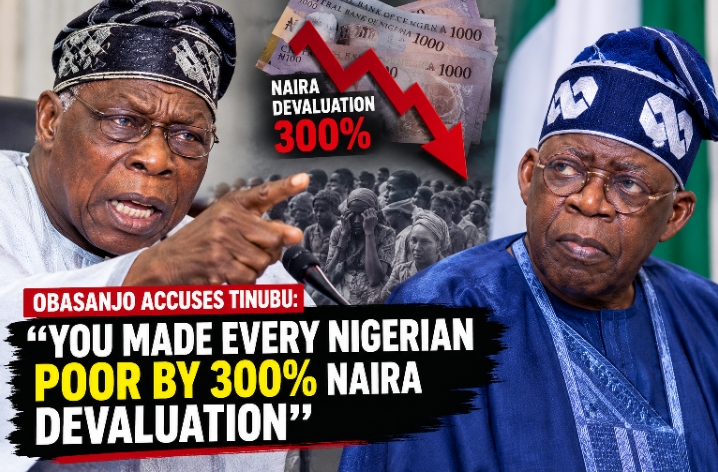
Image: AI generated
Former President Olusegun Obasanjo has accused President Bola Tinubu of making every Nigerian poor by 300 per cent through the devaluation of the naira.
Obasanjo spoke on Wednesday during the Financial Times Africa Summit 2026 in London, United Kingdom.
He said that the naira lost its value overnight due to economic reforms undertaken by the Tinubu administration in 2023.
“We do not live in isolation as a country. We interact with the rest of the world. And overnight, you devalue the currency by 300 per cent. The naira went from N500 to a dollar to N1,500 to a dollar. What that meant was that every Nigerian is made poor by 300 per cent.”
Obasanjo said that had made Nigeria “the poverty capital of the world,” which he said meant the country had the largest number of poor people in the world.
“You cannot say to me that that is good for Nigeria. You cannot say to me that that is good for us in any sense,” he noted.
The former President also rejected the argument that Tinubu needed more time to complete his reforms, saying he did not see the economy improving.
Business
CBN Licences Abbey Bank to Start Full Commercial Banking in November 2026
Adewumi said: “The year 2026 represents a defining moment in the history of Abbey. Our approval to transition to commercial banking is a testament to the work invested in building this institution and the confidence placed in us by our regulators, shareholders, customers and employees.”

The Central Bank of Nigeria (CBN) has approved Abbey Bank Plc to begin operation as a regional commercial bank, effectively from November 2026.
The licence opens retail banking, small and medium-sized enterprise lending, trade finance and corporate banking to the lender.
Abbey Bank had operated as a mortgage bank for more than three decades.
The commercial banking licence was issued in June 2026 after the bank completed its capital-raising process.
Managing Director and Chief Executive Officer Mobolaji Adewumi said the bank began internal discussions on the transition in 2023 and submitted a formal application in 2024.
He said regulatory approval arrived in October 2024.
Adewumi said: “The year 2026 represents a defining moment in the history of Abbey. Our approval to transition to commercial banking is a testament to the work invested in building this institution and the confidence placed in us by our regulators, shareholders, customers and employees.”


JUST IN: Four Pilots Die After Mid-Air Collision of Military Planes in Philippine

JUST IN: Another Nollywood Actor, Dies After Brief Illness

Ebola patient in Abuja showing signs of recovery – FG

BREAKING: Lagos Govt Declares Today, Thursday Work-Free to Mark 2026 Ìṣẹ̀ṣe Day

Tech Expert, Zuckerberg trains with UFC champions, Adesanya, Alexander

Organ Trafficking: Ekweremadu bags 10 years in UK prison
-

 Business2 days ago
Naira To Dollar, Pound, Euro… Today October 23
-

 Health3 days ago
Ebola Outbreak: Don’t Panic, FG Assures Nigerians
-

 Health3 days ago
UPDATE: Identity of Woman Who Flew into Nigeria with Ebola Virus Revealed
-

 Business2 days ago
Obasanjo Accuses Tinubu : “You Made Every Nigerian Poor By 300% Naira Devaluation”
-
Business3 days ago
Dollar to Naira Exchange Rate – Thursday, October 22, 2026
-

 News3 days ago
UNILAG School Teachers Begin Work-to-Rule Over Unpaid Arrears
-

 Entertainment2 days ago
JUST IN: Nollywood Veteran Francis Duru Dies at 57 After Brief Illness
-

 News2 days ago
JUST IN: 1 Dead, 3 Rescued in Fadeyi Building Collapse, Lagos