
Business
Vintage FM came to promote our culture, a dream come through – Abiola Adedoja

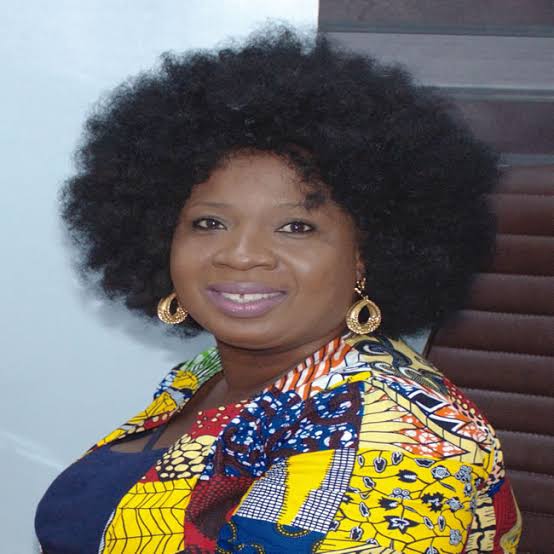
The Managing Director of Vintage 93.7FM Ibadan, Mrs. Abiola Ibrahim Adedoja, studied Agricultural Engineering up to Master’s degree level but has veered to media management.
In this interview, Adedoja shared her experience in the Media industry, explaining the idea behind Vintage FM:
I had been thinking of having a platform through which I can address people, most especially women but how it would happen, I didn’t know. God has a way of making things happen. It was a dream I had been nurturing but how it would happen, I wouldn’t know. In 2019, I met a friend and we were talking about radio station. We talked about what it might take us to set up a radio station. We said if we had the radio station, what exactly do we want to achieve with it? We agreed that we should promote our culture and also promote religion and create further understanding of our religion among other things. In 2022, the dream came true.
How has it been since that time, looking back to the idea and the road you travelled to bring it to fruition and the goals you set for yourselves?
It has not been easy owing to challenges here and there but we give God all the glory. We are tackling and surmounting the challenges as they present themselves. We know that as we are forging ahead it’s going to be better.
Between idea and reality, what are the tangible things? A functional radio station, media management and management of people and so on cannot be totally left in the realm of ideas. Would you say the vision is in motion or you would change direction?
To a very large extent, we have been able to translate the idea. We have been able to bring the idea to reality and make it a tangible thing. Now, we are working to fine-tune things and we can see that things are taking the right shape as we envisage. We have been moving with the team to translate the idea. Like I said, we are tackling issues as they crop up and we are making steady progress.
When we look at the cultural and, sometimes, religious issues that often crop up when issues involve the womenfolk in Africa, do you think things are better being managed now than before?
Before now, it was a difficult thing for women to be in positions of authority but in recent times the situation is changing. Women are now accepted at the helm of affairs because women have been tested and it has been confirmed that women can do a whole lot of things other than the traditional things we associate with women. However, some of the successes men and women achieve are with the assistance of men and women. It is a common saying that ‘behind every successful man there is a woman’ I will also say that behind every successful woman too, there are men. It could be a father, a brother, an uncle, her friends, her colleagues and so on with whom they share ideas and how to translate them. So, I think it is the same for both genders. However, I hope that we are moving in the right direction in Nigeria with regards to gender issues and I believe that it can only get better.
Women now voice out and some of the inhibitive cultural practices are gradually giving way. The culture is now getting used to women handling some of the things they initially thought that we could not do. Women are no longer limited to the kitchen; women multi-task a lot and they are still doing that even more than ever before. Aside the kitchen and the ‘other room’, women are playing actively in the banking sector, in ICT, in Engineering and nearly all the sectors of human endeavour. I play in the media sector which wasn’t such a common thing. More women are now getting involved – even in politics and the 35 per cent affirmative action could be better. However, I think there should still be more representation of women in politics and they should be given more support in their respective fields. There are women doing excellently in many professions and entrepreneurial endeavours and they are making impact in the community and the people around them.
Women media executives like you are not very many. In Oyo State where there are dozens of radio stations, and Ibadan where most of them are operating, women owners are very few. What is it like out there as a lone ranger in this jungle? Are you intimidated?
It is not in any way intimidating. We are all operating based on the same set of rules and guidelines. So, there is nothing to be afraid of. Secondly, the people I meet, both men and women, have been supportive. The men folk that I meet have been supportive and have been helpful with some of the things we need. I heard that the new COO of Splash FM is a woman. So women are coming up. Something like sisterhood is coming up.
So, are you ready to take over or you would just be tagging along?
I will not say we are taking over, but we are ready to play the game with them. For us at Vintage FM, our mission is to bring the lost values in the society back. It is our aim to put a touch of positive Western civilisation to our culture and society so as to make it more acceptable. Our vision is to deliver unbiased information and make positive impact in our community. These are the ideas driving us and there is nothing about it other than to make our society better for all and sundry.
If you have an opportunity to sit one-on-one with Governor Seyi Makinde of Oyo State, vis a vis what the media world is like, what would you tell him?
To the best of my knowledge, he is doing good in many facets of the Oyo State economy and he has been good to the media. However, I will tell him to be more accommodating of the media.
Your immediate police in the broadcast business is the National Broadcasting Commission (NBC). Does this agency inhibit you or, does the NBC affect the way you look at the broadcast media business?
I think the NBC has been like the Big Brother, monitoring what we feed the listening public. Rather than see the commission as an inhibition, I think they are of assistance. They ensure that the public is not misled or misguided by what we feed the society through our stations. The media has a unique audience and the NBC is there to ensure that we do not mislead or misinform them.
There are issues of taxation in Nigeria. Sometimes, it could be multiple-taxation; sometimes, the issue could be the amount payable. The print media is not left out in this. What do you think the government can do for the media outfits in this regard?
My recent experience with the Oyo State government is worrisome. We had expected the government to have given emerging and new businesses some breather as the businesses are set up. The window would allow then breathe and settle in before they are levied some amounts as tax. Sadly, this is not what obtains. Aside the PAYE tax that we do on the staff members, and the one paid by the owners of the company, the company itself also pays and the bill we got recently was ridiculously high. We started this business in December 2022 and we have received different types of levies and taxes that are, to put it mildly, shocking. I think they should allow new businesses some time to grow. There should be a tax holiday to allow them settle and master the ropes and get themselves immersed in that business before the taxes begin to roll in.
Is there a convergence of broadcast executives in Ibadan through which issues as the one you raised above could be tables and shared for a healthier business environment?
There is a platform to which most of the media heads belong. Media staff members also have theirs. On the platform we share ideas and discuss various issues. However, I think it is possible to have a kind of association through which issues like that of taxation and how the authorities go about it can be tabled as a collective issue and discussed. For now, I have not seen us doing that but I think it is possible. I agree that we need a group that can present as a common front for media outfits with regards to issues bordering on taxation, welfare and promotion of the broadcast outfits.
So, what stands Vintage 93.7 FM out?
I think it is the fact that we have a crop of young and purposeful staff members who are desirous of results. One of the best things that can happen to you as a leader is to have a crop of dedicated people in your team. That is one of our fortes at Vintage FM and we are grateful for that. Then we have some unique programmes which people can also listen to on our social media platforms and our demography is from the age 18 to 75. We are also on Radio Garden and through that, people can listen to us from anywhere in the world. Our philosophy in terms of programmes is 70 per cent Yoruba and 30 per cent English. In less than one year, we were able to gather eminent personalities, including the Chief Imam of Ibadanland for our Ramadan Lecture which was delivered by Dr Bada. We also organised a grand Children’s Day programme in which 11 different companies supported us. People were wondering how we were able to pull this off in barely 6 months of coming up as a radio station. Three of our children-winners at the Children’s Day celebration won tickets to train at RAIN – Robotics and Artificial Intelligence Nigeria, which is worth about N1million each.
What are the things you readily tell children to motivate them, especially the girls?
I always tell them: If you believe, you can and where there is a will there is always a way. Have the dream, believe you can do it. Pursue it. You will be there.








Business
History of Naira Revaluation and Devaluation (1973–2026) (Part 1)
Why was the naira devalued?

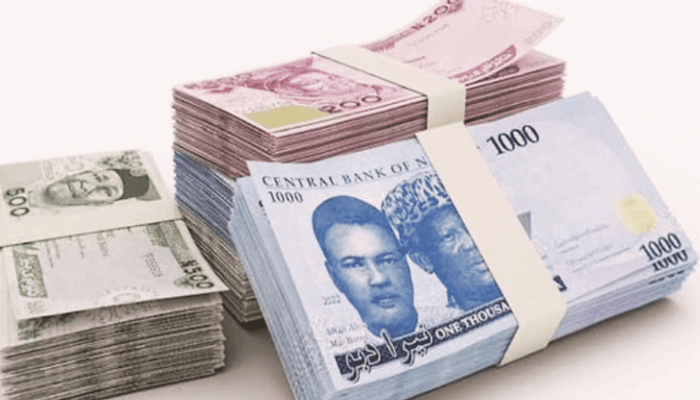
The history of the Nigerian naira is marked by two major developments: periods when the currency gained value or was officially strengthened, and prolonged periods when it lost value against major international currencies, particularly the US dollar.
Since its introduction in 1973, the naira has undergone several exchange-rate policy changes, including fixed exchange rates, currency devaluations, foreign-exchange market liberalisation, attempts to unify exchange rates and market-driven depreciation.
The Central Bank of Nigeria (CBN) has played a central role in managing these changes.
- Introduction of the Naira in 1973
Nigeria introduced the naira on January 1, 1973, replacing the Nigerian pound.
The conversion rate was:
£1 Nigerian pound = ₦2.
₦1 = 10 shillings under the old currency system.
₦1 = 100 kobo.
The new currency was introduced during a period of expanding oil revenues and economic growth.
Nigeria initially maintained a relatively strong, managed exchange rate, supported by foreign-exchange controls and the country’s oil earnings.
The introduction of the naira was a currency change, not a devaluation.- The 1970s: A Relatively Strong Naira
During the 1970s, rising oil revenues strengthened Nigeria’s foreign-exchange position.
The government maintained a controlled exchange-rate system, initially linking the naira to the US dollar before moving to a basket of currencies representing major trading partners in 1978.
The oil boom provided foreign exchange for imports, infrastructure and public expenditure.
However, Nigeria’s dependence on crude oil revenues left the economy vulnerable to fluctuations in international oil prices.
Key development: The naira benefited from a relatively strong external position, although its exchange rate was managed by the authorities rather than determined by an unrestricted market.- The Early 1980s: Mounting Pressure on the Naira
The economic situation deteriorated in the early 1980s as oil revenues weakened and foreign-exchange shortages intensified.
Nigeria faced several economic challenges:
• Declining oil receipts.
• Rising import bills.
• Pressure on foreign reserves.
• Growing external debt and trade arrears.
• Increasing demand for foreign currency.
The government maintained controls on foreign exchange, but the official rate became increasingly disconnected from the rate at which foreign currency could be obtained in the parallel market.
This created pressure for exchange-rate reform.
The crisis set the stage for the introduction of the Structural Adjustment Programme (SAP) in 1986.- 1986: Major Naira Devaluation Under SAP
September 26, 1986, marked a turning point in the history of the naira.
Under the military government of General Ibrahim Babangida, Nigeria introduced the Second-Tier Foreign Exchange Market (SFEM) as part of the Structural Adjustment Programme.
The objective was to allow market forces to play a greater role in determining the naira’s exchange rate.
According to an International Monetary Fund account, the naira’s value was discounted by approximately 66 per cent at the inaugural SFEM auction.
The exchange rate moved from about ₦1.60 per US dollar under the previous administered rate to approximately ₦4.60 per dollar at the initial auction.
Why was the naira devalued?
The policy was intended to:
•Reduce the overvaluation of the naira.
•Improve the allocation of scarce foreign exchange.
•Encourage non-oil exports.
•Improve the competitiveness of Nigerian products.
•Reduce distortions in the foreign-exchange market.
However, the weaker currency also increased the naira cost of imported goods and production inputs.
The 1986 reform began a prolonged period of exchange-rate adjustments.- …To be continued
Business
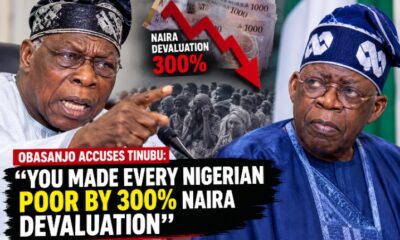
Obasanjo Accuses Tinubu : “You Made Every Nigerian Poor By 300% Naira Devaluation”
The former President also rejected the argument that Tinubu needed more time to complete his reforms, saying he did not see the economy improving.
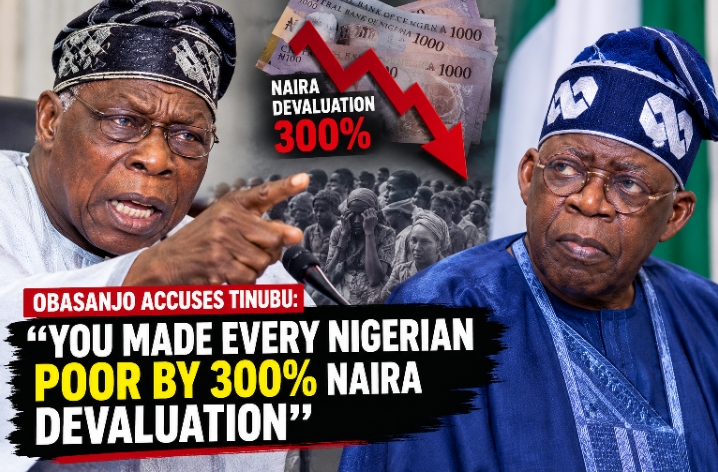
Image: AI generated
Former President Olusegun Obasanjo has accused President Bola Tinubu of making every Nigerian poor by 300 per cent through the devaluation of the naira.
Obasanjo spoke on Wednesday during the Financial Times Africa Summit 2026 in London, United Kingdom.
He said that the naira lost its value overnight due to economic reforms undertaken by the Tinubu administration in 2023.
“We do not live in isolation as a country. We interact with the rest of the world. And overnight, you devalue the currency by 300 per cent. The naira went from N500 to a dollar to N1,500 to a dollar. What that meant was that every Nigerian is made poor by 300 per cent.”
Obasanjo said that had made Nigeria “the poverty capital of the world,” which he said meant the country had the largest number of poor people in the world.
“You cannot say to me that that is good for Nigeria. You cannot say to me that that is good for us in any sense,” he noted.
The former President also rejected the argument that Tinubu needed more time to complete his reforms, saying he did not see the economy improving.
Business
CBN Licences Abbey Bank to Start Full Commercial Banking in November 2026
Adewumi said: “The year 2026 represents a defining moment in the history of Abbey. Our approval to transition to commercial banking is a testament to the work invested in building this institution and the confidence placed in us by our regulators, shareholders, customers and employees.”

The Central Bank of Nigeria (CBN) has approved Abbey Bank Plc to begin operation as a regional commercial bank, effectively from November 2026.
The licence opens retail banking, small and medium-sized enterprise lending, trade finance and corporate banking to the lender.
Abbey Bank had operated as a mortgage bank for more than three decades.
The commercial banking licence was issued in June 2026 after the bank completed its capital-raising process.
Managing Director and Chief Executive Officer Mobolaji Adewumi said the bank began internal discussions on the transition in 2023 and submitted a formal application in 2024.
He said regulatory approval arrived in October 2024.
Adewumi said: “The year 2026 represents a defining moment in the history of Abbey. Our approval to transition to commercial banking is a testament to the work invested in building this institution and the confidence placed in us by our regulators, shareholders, customers and employees.”


JUST IN: Four Pilots Die After Mid-Air Collision of Military Planes in Philippine

JUST IN: Another Nollywood Actor, Dies After Brief Illness

Ebola patient in Abuja showing signs of recovery – FG

BREAKING: Lagos Govt Declares Today, Thursday Work-Free to Mark 2026 Ìṣẹ̀ṣe Day

Tech Expert, Zuckerberg trains with UFC champions, Adesanya, Alexander

Organ Trafficking: Ekweremadu bags 10 years in UK prison
-

 Business2 days ago
Naira To Dollar, Pound, Euro… Today October 23
-

 Health3 days ago
Ebola Outbreak: Don’t Panic, FG Assures Nigerians
-

 Health2 days ago
UPDATE: Identity of Woman Who Flew into Nigeria with Ebola Virus Revealed
-
 Business2 days ago
Obasanjo Accuses Tinubu : “You Made Every Nigerian Poor By 300% Naira Devaluation”
-
Business3 days ago
Dollar to Naira Exchange Rate – Thursday, October 22, 2026
-

 News3 days ago
UNILAG School Teachers Begin Work-to-Rule Over Unpaid Arrears
-

 Entertainment2 days ago
JUST IN: Nollywood Veteran Francis Duru Dies at 57 After Brief Illness
-

 News2 days ago
JUST IN: 1 Dead, 3 Rescued in Fadeyi Building Collapse, Lagos