
Politics
Transmission of election results: ADC Differs With Senate; ” Pass the law, don’t decide for INEC”
Akpabio said the concern was that mandating real-time transmission could lead to legal disputes if network failures occurred during elections.

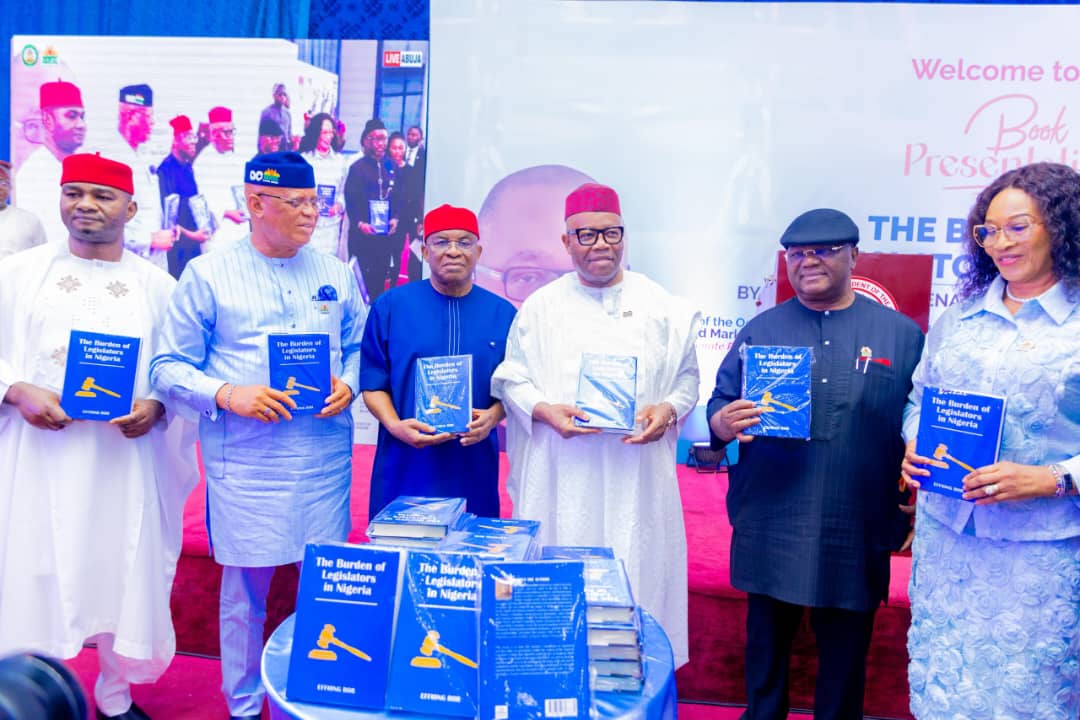
• Book Launch: “The Burden of Legislators in Nigeria”, authored by Senator Effiong Bob, in Abuja.
Senate President Godswill Akpabio has dismissed criticisms trailing the Senate’s amendment of the Electoral Act, saying commentators and civil society actors are misjudging the legislature based on an incomplete legislative process and misunderstanding of parliamentary procedures.
Akpabio spoke in Abuja as special guest of honour at the unveiling of a book, “The Burden of Legislators in Nigeria”, authored by Senator Effiong Bob, in Abuja.
Speaking on the controversy surrounding the removal of the phrase “real-time” electronic transmission of election results, Akpabio said that the Senate had not concluded work on the bill and that public debate was premature.
“The Electoral Act amendment is incomplete. We have not completed it, but they are already on television. They don’t understand lawmaking.
“They don’t even know that what is in the Senate is not completed until we look at the Votes and Proceedings,” he said.
Akpabio explained that the Votes and Proceedings stage allows senators to correct, amend, or clarify decisions made on the floor before final approval, stressing that only after this process can the Senate’s position be considered final.
“When we bring out the Votes and Proceedings, any senator has a right to rise and say, ‘On clause three, this was what we agreed upon.’ That is the only time you can talk about what the Senate has done or not done,” he said.
He criticised commentators for what he described as “abuse” of the legislature, accusing some civil society actors of attempting to impose their views on lawmakers.
“People have become mouth legislators. Go and contest election if you want to talk about lawmaking and go and join them and make the law.
Retreats are not lawmaking; retreats are part of consultations. So why do you think that the paper you agreed in Lagos during a retreat must be what is agreed on the floor?” he asked.
Akpabio insisted that the Senate did not remove electronic transmission of election results, clarifying that lawmakers only questioned the requirement for real-time transmission.
“I must state clearly, without ambiguity, that the Senate has not removed any means of transmission. If you want to use a bicycle to carry your votes from one polling unit to the ward centre, do so. If you want to use your phone to transmit, do so. If you want to use your iPad, do so,” he said.
Akpabio said the concern was that mandating real-time transmission could lead to legal disputes if network failures occurred during elections.
“All we said was that we should remove the word ‘real time,’ because if you say real time and there is grid failure and the network is not working, when you go to court somebody will say it ought to have been real time,” he explained.
According to him, the Independent National Electoral Commission (INEC) should determine the mode and timing of result transmission within the framework of the law.
The Senate President warned that insisting on real-time transmission could invalidate results in areas with poor connectivity or insecurity.
“Real time means that in over nine states where networks are not working because of insecurity, there will be no election results.
Nationally, if the national grid collapses and no network is working, no election results will be valid,” he said.
He cited a Supreme Court ruling which, he said, acknowledged Nigeria’s inadequate infrastructure and emphasised that electronic transmission is only supplementary to the statutory collation process.
“The result is in Form EC8A. It will be carried from the polling unit to the ward centre, from there to the local government collation centre, to the senatorial collation centre, to the state collation centre, and finally the national collation centre,” he said.
Akpabio stressed that the amendment bill had not yet completed the bicameral legislative process and that a conference committee would reconcile differences between the Senate and House of Representatives versions before final passage.
“It is only when we have finished that that you will now say the National Assembly has passed any amendment to the Electoral Act,” he said.
He urged critics to allow the process to run its course, warning against attempts to “rubbish the process” before its conclusion.
Akpabio said electoral reforms must be grounded in legal and institutional capacity, warning against imposing technology beyond the country’s infrastructure.
“We insist that electoral reforms must be anchored in law, guided by capacity, secured against abuse and applied uniformly across the nation.
Technology must serve democracy; it must not endanger democracy,” he said.
He added: “You stay in a place that has no wire, no light, and you want to put in the law ‘real time.’ Progress must not bring about injustice.”
The Senate President warned that mistrust of institutions without understanding legislative processes could weaken democracy.
“When people do not understand their legislature, democracy is at risk. Democracy is measured not by passion alone, but by principles,” he said.
He also recalled that the current Electoral Act enabled competitive elections in 2023, including losses by the then ruling party in key states.
“This same Electoral Act made the incumbent party almost lose millions of votes. We lost in places like Lagos and Kano. New parties won whole regions with the same act, whether real-time electronic transfer or not,” he said.
Akpabio concluded that laws must be made for posterity rather than partisan advantage, adding: “You don’t make law for an individual or for opposition. You make law to outlast you, for generations unborn.”
Earlier in his opening remarks, the National Chairman of the African Democratic Congress (ADC) and former President of the Senate, Senator David Mark, who was the chairman of occasion, urged the National Assembly to pass the Bill and not to speak for the Independent National Electoral Commission (INEC).
“What the ADC is saying is, pass the law. Let INEC decide whether they can do it (real-time electronic transmission) or not. Don’t speak for INEC.
“The stand of ADC is clear; pass the bill and let INEC decide on what it will do with it”, Mark said.
Several speakers at the event, including Akwa Ibom State Governor, Pastor Umo Eno, and the book reviewer, Professor Maxwell Gidado SAN, praised Senator Bob’s courage in writing the book to bring to light the challenges the Nigerian legislator faces in the course of performing his duties.
The author Senator Bob enumerated some of the challenges, saying that they included electoral battles, conflict with governors/godfathers, the judiciary through cancellation of victory, addressing the private issues of the electorate and self-inflicted challenges.
“The courage to defend democracy is in the legislature and the legislators”, he said.





Politics
Timipre Sylva resigns from APC membership
“As a founding member of the APC, and one who joined other well-meaning Nigerians in building the Party with sweat and money, it is deeply saddening to witness how the ideals we espoused have been so thoroughly and unrecognisably thwarted.”
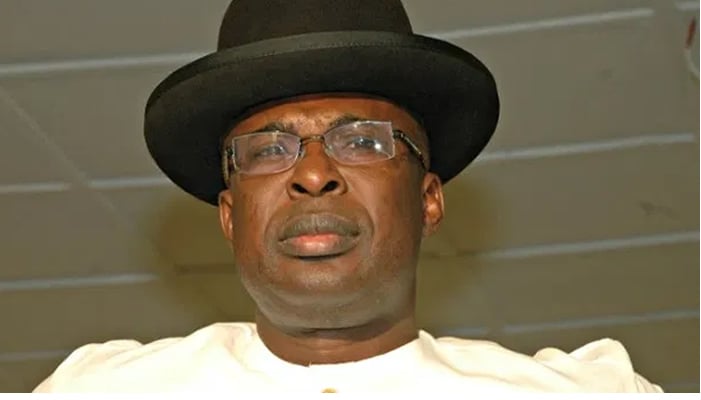
Former governor of Bayelsa State Timipre Sylva on Monday resigned from the All Progressives Congress (APC) with immediate effect.
Sylva announced his resignation in a letter addressed to the APC chairman in Ward 4, Brass Local Government Area of Bayelsa State.
Sylva, who described himself as a founding member of the APC, said he was saddened by the direction the party had taken.
“As a founding member of the APC, and one who joined other well-meaning Nigerians in building the Party with sweat and money, it is deeply saddening to witness how the ideals we espoused have been so thoroughly and unrecognisably thwarted,” he said.
His resignation comes amid legal and political controversies surrounding him.
In November 2025, the Economic and Financial Crimes Commission (EFCC) declared Sylva wanted over an alleged case involving conspiracy and dishonest conversion of $14,859,257.
He was also named among suspects in an alleged plot to overthrow President Bola Tinubu’s administration and is listed as one of the defendants in a 13-count charge filed by the federal government over the alleged coup plot.
Sylva, however, said his decision to leave the APC was driven by his opposition to what he described as a political mentality that considers “all is fair in politics”.
Politics
G100 Opposition Summit Proposes Single 4-year Term
The summit was attended by representatives of the African Democratic Congress (ADC), Allied Peoples Movement (APM), Nigeria Democratic Congress (NDC), Peoples Democratic Party (PDP), Peoples Redemption Party (PRP) and Social Democratic Party (SDP), alongside their presidential and vice-presidential candidates, and the Minority Leader of the House of Representatives.
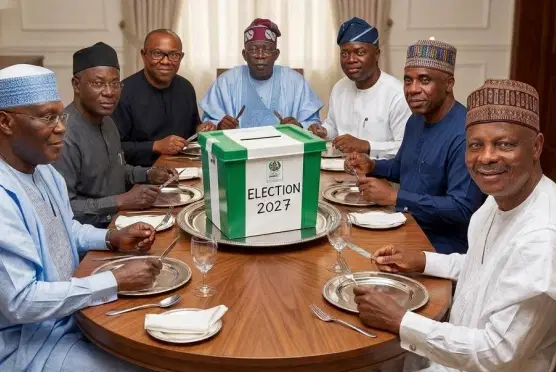
• AI generated: President Bola Tinubu and opposition candidates
The G100 has proposed a Government of National Competence anchored on a single four-year transition term.
The call was made today during the Summit of Nigeria’s Opposition Political Parties held at the Shehu Musa Yar’Adua Centre, Abuja.
In an opening address delivered on behalf of the G100 by Mallam Salihu Moh. Lukman , he said that the proposed government would be built on competence, integrity, national inclusion and fair representation of every party contributing to the effort, and would be bound to a disciplined, time-bound Four-Year National Reset Programme.
” The Framework before you propose something more demanding than a merger of ambitions: a Government of National Competence, built on competence, integrity, national inclusion, and fair representation of every party that contributes to the effort,” he said.
Lukman emphasised that such a government should be “secured by a political commitment to a single four-year term, written into an enforceable Transition Charter.”
The summit was attended by representatives of the African Democratic Congress (ADC), Allied Peoples Movement (APM), Nigeria Democratic Congress (NDC), Peoples Democratic Party (PDP), Peoples Redemption Party (PRP) and Social Democratic Party (SDP), alongside their presidential and vice-presidential candidates, and the Minority Leader of the House of Representatives.
Politics
Atiku’s campaign promises (2): ” I’ll reopen borders if elected president 2027
Atiku made the pledge while addressing supporters in a video circulating online and shared by ADC chieftain, Dele Momodu, on Friday.
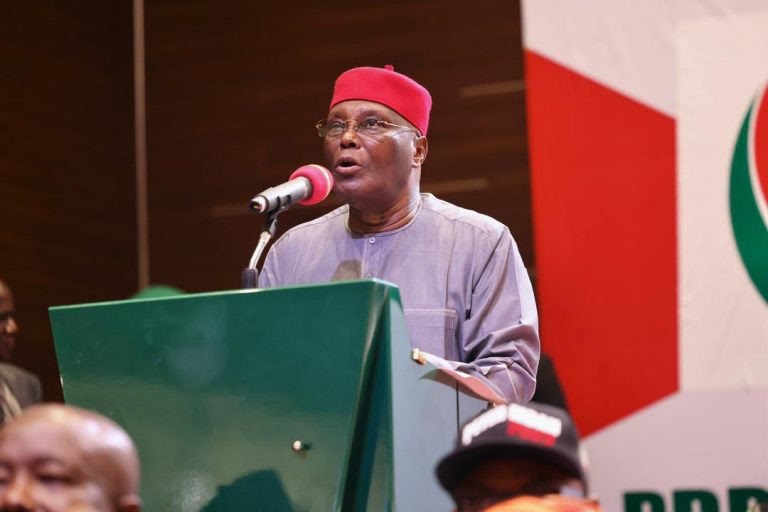
The African Democratic Congress presidential candidate, Atiku Abubakar has said he will reopen Nigeria’s land borders if elected president in the next year general election.
Atiku made the pledge while addressing supporters in a video circulating online and shared by ADC chieftain, Dele Momodu, on Friday.
Atiku said that the closure of Nigeria’s borders with neighbouring countries had negatively affected transborder trade and contributed to unemployment among young people.
“The Northern states is bordering Cameroon, Chad, Niger, Benin Republic. And you close all those borders. All our young men who are doing trading between these countries, they carry goods across, they do this and that, all what we call transborder trade is a legitimate business,” Atiku said.
He said many young people who previously operated businesses with capital running into millions of naira had been forced out of business following the border closures.“All the upcoming young men and women who used to have a capital of 10 million, 20 million, and they were employing two, three other people, and then all of them went bankrupt and unemployed. How can there be security?” he asked.


China -Egypt lubricate over 70 years trade, diplomatic relation

BREAKING: Uber winds down operations in Nigeria, effective September 2

Eko Electricity blames Lekki-Ajah power outages on feeders disruption

Tech Expert, Zuckerberg trains with UFC champions, Adesanya, Alexander

Organ Trafficking: Ekweremadu bags 10 years in UK prison

SAINT OBI: Between his marriage and his death
-

 Business2 days ago
Naira Exchange Rates Today, Monday August 31
-

 Business3 days ago
PZ Cussons Reports N45.2bn PAT, Proposes N2.50 Dividend
-

 News2 days ago
JAMB introducing facial scan to catch UTME impersonators
-

 Business2 days ago
Commercial Banks Borrowing From CBN Drops By 89% in August
-

 Business2 days ago
Emzor Pharma raises N26.7bn bond to boost local drug manufacturing
-

 Entertainment2 days ago
Dolly Parton Buried By Husband’s Grave In Private Cemetry
-
 Politics2 days ago
G100 Opposition Summit Proposes Single 4-year Term
-
 Business2 days ago
Nigeria’s GDP grew 4.43% in Q2 2026, says NBS