
Business
Nigeria’s food inflation rises to 28.92% in December 2023

In December 2023, the headline inflation rate increased to 28.92% relative to the November 2023 headline inflation rate which was 28.20%. Looking at the movement, the December 2023 headline inflation rate showed an increase of 0.72% points when compared to the November 2023 headline inflation rate.
On a year-on-year basis, the headline inflation rate was 7.58% points higher compared to the rate recorded in December 2022, which was 21.34%. This shows that the headline inflation rate (year-on-year basis) increased in December 2023 when compared to the same month in the preceding year (i.e., December 2022).
Furthermore, on a month-on-month basis, the headline inflation rate in December 2023 was 2.29%, which was 0.20% higher than the rate recorded in November 2023 (2.09%). This means that in December 2023, the rate of increase in the average price level is more than the rate of increase in the average price level in November 2023.
The report indicated a 10.18 per cent increment compared to the rate recorded in the corresponding period in 2022.
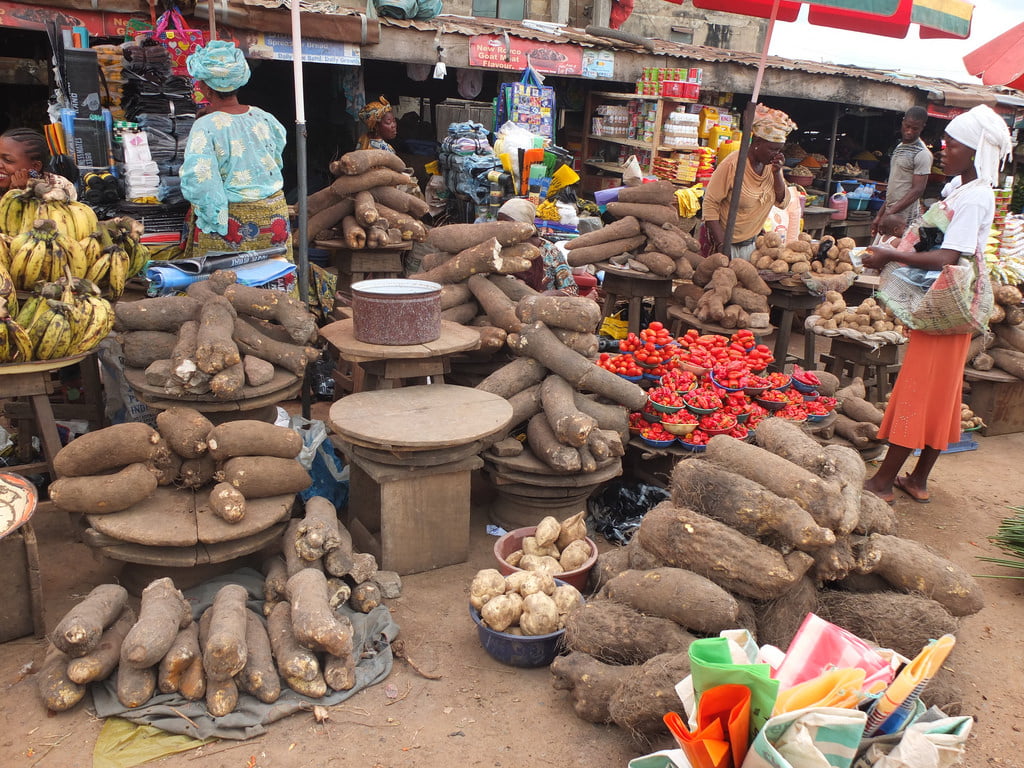
The food inflation on a Month-on-Month basis was caused by a rise in the average prices of Oil and fat, Meat, Bread and Cereals, Potatoes, Yam & Other Tubers, Fish and Milk, as well as Cheese and Egg.
The Nigeria’s headline inflation rose to 28.92 percent in December for the twelfth consecutive time in 2023.


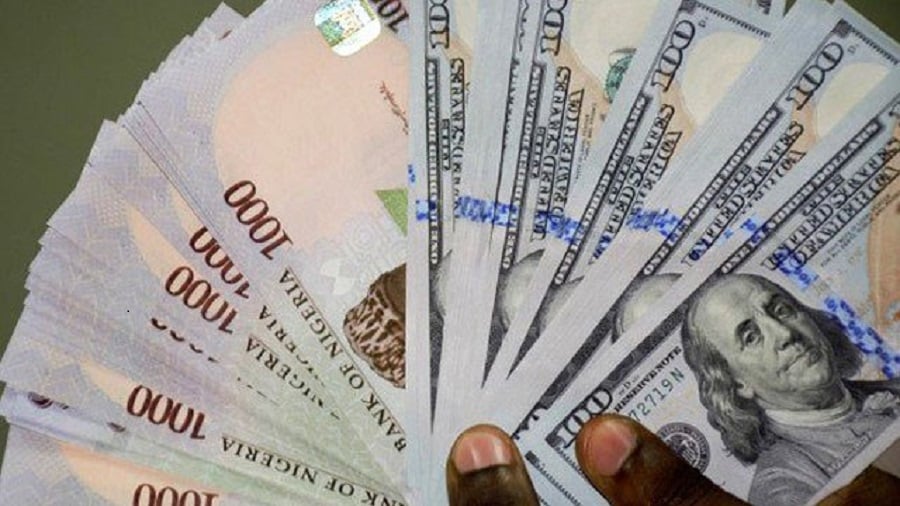
BLACK MARKET RATES
US Dollar (USD) Buy ₦1,410 Sell ₦1,420
Great British Pound (GBP) Buy ₦1,890 Sell: ₦1,910
EURO (EUR) Buy ₦1,580 Sell ₦1,605
Canadian Dollar (CAD) Buy ₦1,020 Sell ₦1,080
South African Rand (ZAR) Buy ₦75 Sell ₦90
Ghana Cedi (GHS) Buy ₦95 Sell ₦110
West African CFA Buy ₦2, 300 Sell ₦2, 400
Central African CFA Buy ₦2,150 Sell 2,250
CBN Exchange Rates
US Dollar (USD) ₦1,357. 61
Great British Pound (GBP) ₦1,840.10
EURO (EUR) ₦1,571.70
Swiss Franc (CHF) ₦1,673.58
Chinese Yuan (CNY) ₦201.37
West African CFA (XOF) ₦2. 39
West African Unit Account (WAUA) ₦1,853.65
Saudi Riyal (SAR) ₦361. 59
South African Rand (ZAR) ₦83.85
BLACK MARKET RATES
US DOLLAR (USD) Buy ₦1,416 Sell ₦1,423
GREAT BRITISH POUND (GBP) Buy ₦1,890 Sell: ₦1,910
EURO (EUR) Buy ₦1,590 Sell ₦1,610
CANADIAN DOLLAR (CAD) Buy ₦1,020 Sell ₦1,080
SOUTH AFRICAN RAND (ZAR) Buy ₦75 Sell ₦90
UAE DIRHAM Buy ₦350 Sell ₦370 CHINESE YUAN Buy ₦190 Sell ₦205
GHANA CEDI (GHS) Buy ₦95 Sell ₦110
WEST AFRICAN CFA Buy ₦2, 300 Sell ₦2, 400
CENTRAL AFRICAN CFA Buy ₦2,150 Sell 2,250
AUSTRALIAN DOLLAR Buy ₦800 Sell ₦900
CBN Exchange Rates
US DOLLAR (USD) ₦1,357. 65
GREAT BRITISH POUND (GBP) ₦1,834.04
EURO (EUR) ₦1,567.00
SWISS FRANC (CHF) ₦1,671. 98
JAPANESE YEN (JPN) ₦8.53
CHINESE YUAN (CNY) ₦201. 34
WEST AFRICAN CFA (XOF) ₦2. 39
WEST AFRICAN UNIT ACCOUNT (WAUA) ₦1,858.02
SAUDI RIYAL (SAR) ₦361.62
SOUTH AFRICAN RAND (ZAR) ₦84.23
Business
Traders shut down Enugu ‘s Obollo-Afor market over N25,000 haulage levy
However, Chairman of ESIRS, Emmanuel Nnamani, in a letter to the traders, said the haulage levy was not paid by traders buying or selling goods in the markets, but was applicable strictly to truck drivers plying interstate routes.

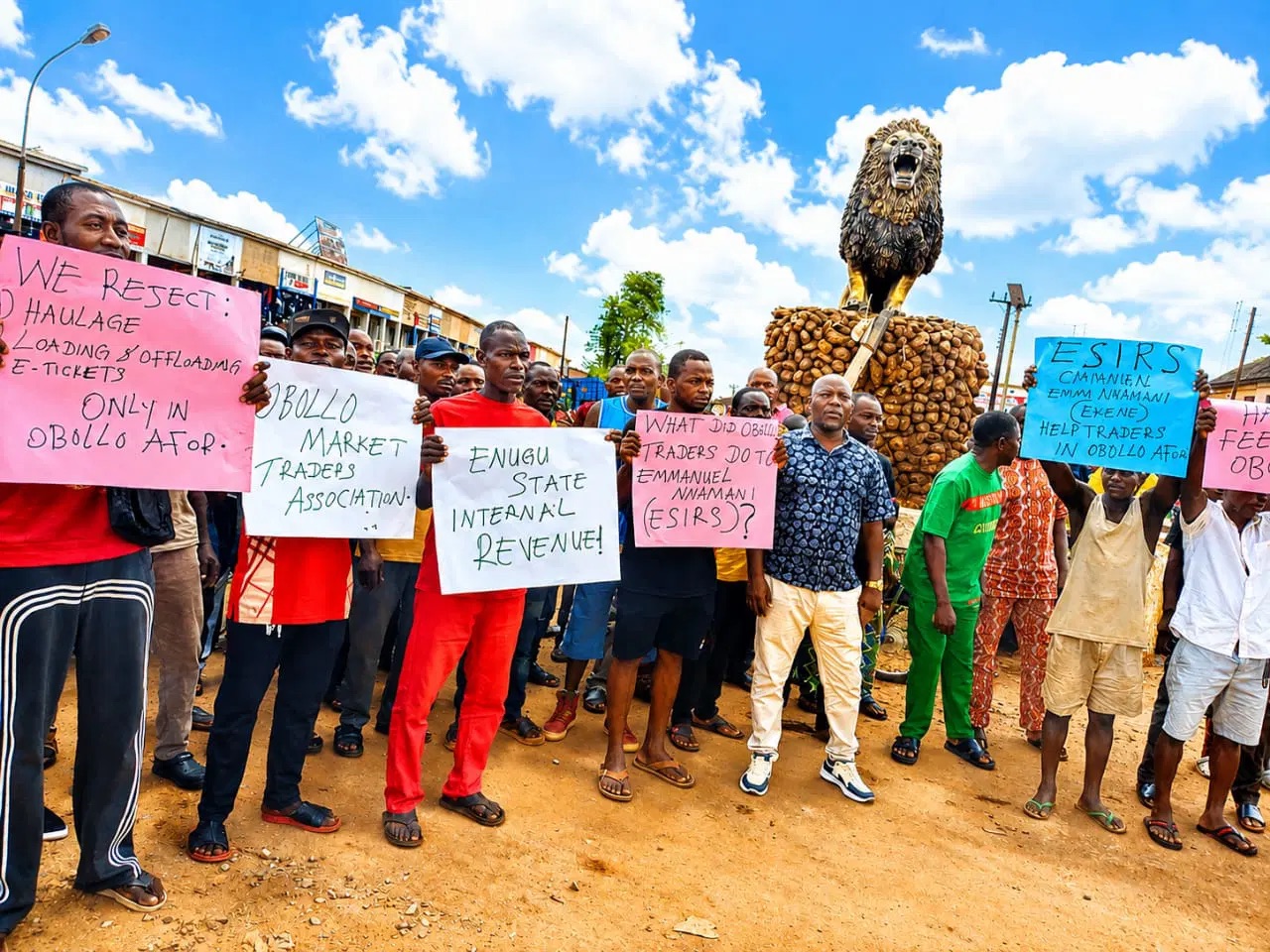
All shops and markets at Obollo-Afor, Udenu Local Government Area of Enugu State were shut yesterday, as traders staged a peaceful protest against alleged selective collection of a N25,000 haulage levy in the market.
The traders, who locked their shops and took to the streets in large numbers, carried placards with various inscriptions, alleging that the Enugu State Internal Revenue Service (ESIRS) had singled out Obollo-Afor Market for the collection of N25,000 haulage fee on every truckload of goods loaded or offloaded in the market.
However, Chairman of ESIRS, Emmanuel Nnamani, in a letter to the traders, said the haulage levy was not paid by traders buying or selling goods in the markets, but was applicable strictly to truck drivers plying interstate routes.
Addressing officials of the Udenu Local Government Council at the council secretariat, where the protesters marched to present their grievances, Chairman, Obollo-Afor Market Traders Association, Charles Eze, lamented that truck operators bringing foodstuffs, building materials, and other commodities to the market had stopped coming because of the levy.


US Actress Hayden Panettiere Dies At 36

Kebbi Governor picks new running mate , Ibrahim Augie

Osun poll: ADC’s Salaam, Tambuwal Hail Adeleke for Second Term Win

Tech Expert, Zuckerberg trains with UFC champions, Adesanya, Alexander

Organ Trafficking: Ekweremadu bags 10 years in UK prison

SAINT OBI: Between his marriage and his death
-

 Health3 days ago
Gov Mbah Invest in world-class Enugu International Hospital
-

 Politics2 days ago
#OsunDecides2026: First Results Emerge as Voting Ends, Collation Begins at Polling Units
-

 Politics2 days ago
(UPDATED) #OsunDecides2026: INEC Uploads 3,119 of 3,763 Polling Unit Results as Collation Continues
-

 Politics3 days ago
HAPPENING NOW: Security Beefed up at INEC Office in Osun Ahead of Saturday’s Governorship Election
-
 Politics2 days ago
#OsunDecides2026: Adeleke Urges Tinubu to Protect Votes During Collation
-

 Politics2 days ago
Osun Poll: Youths Accuse APC of Vote-Buying in Ejigbo (Video)
-

 Politics2 days ago
#OsunDecides2026: Accord Party in early lead, APC trails behind
-

 Politics1 day ago
BREAKING: Adeleke coasts to victory winning 19 LGs, APC’s Oyebamiji secures 11 LGs