
Business
MAN Calls For Civility In Operations By Government’s Agencies

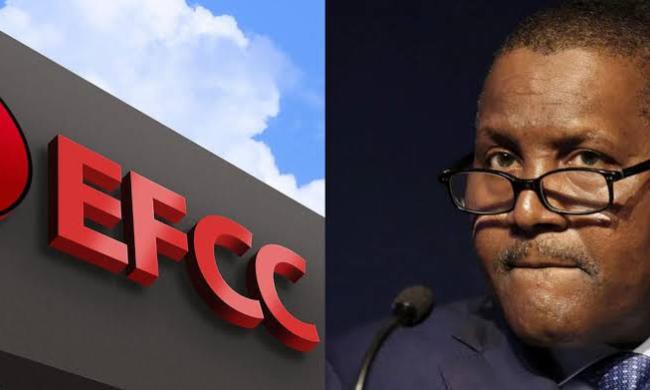
Manufacturers Association of Nigeria (MAN), has called for civility by the EFCC and the other operatives of the government agencies, when demanding documents from existing domestic investors in the country, rather than armed invasion.
The Association made the call, while reacting to the recent invasion of the Dangote Industries Limited (DIL) headquarters by dozens of Economic and Financial Crimes Commission (EFCC) operatives.
Segun Ajayi-Kadir, it’s Director-General, noted that the fact that the Federal Government is currently actively engaged in activities aimed at attracting foreign investors should dictate a more circumspect and civil way to make enquiries and secure documents from existing/domestic operators.
” We received the news with great shock. We also understand that about 50 other companies are also been investigated, probably with a likelihood of receiving the same ill treatment.
Not that any company is above investigation, but it is about the appropriateness of the method and the sheer brigandage we saw on display.
… this news has gone around the world and many, including would be investors, would be taken aback and anxiously awaiting how the story will end.
It is whether it will take an armed invasion by dozens of security operatives to get documents from a well-structured and clearly identifiable company like DIL.
What we understand is that it is part of EFCC’s ongoing investigation into forex allocations in the country.
We believe it is within the remit of EFCC to do so. But the question is: what is the wisdom in security operatives swooping on the headquarters of a leading African conglomerates only to demand for documents relating to allocation of foreign exchange to the Group in the last 10 years?
Is it that the company refused to respond to a request to present those documents?
Are those documents only available with DIL and not in the Central Bank or the relevant commercial banks? Was there a possibility of armed resistance, if the EFCC operatives had come unarmed and devoid of the gestapo style invasion?
Why hurt the corporate image and disrupt the business operations of the company?
There is no doubt that this news has gone around the world and many, including would be investors, would be taken aback and anxiously awaiting how the story will end.
This may not be the best way to show that Nigeria is committed to good corporate governance.
Because of the status of DIL within the Nigerian economy, Africa and the world, the outcome of this rather unfortunate incident may have great impact on how we are perceived as respecters of the right of business entities.
Government agencies should exercise restraints and be mindful of the wider implications of their actions on our fragile business environment.
I think it is important for the EFCC to take steps to clear the air on the negative interpretation being adduced to this action.
This is necessary to reassure existing business concerns and encourage would be investors.”
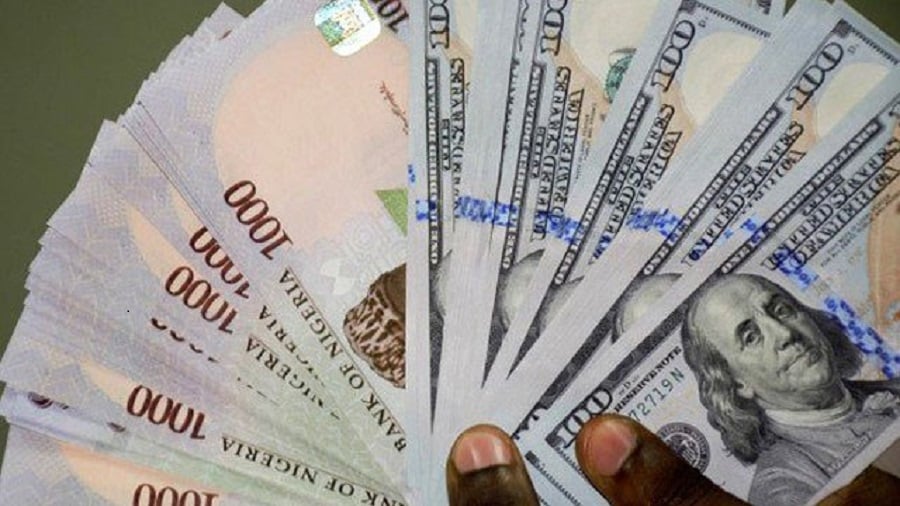
BLACK MARKET RATES
US Dollar (USD) Buy ₦1,410 Sell ₦1,420
Great British Pound (GBP) Buy ₦1,890 Sell: ₦1,910
EURO (EUR) Buy ₦1,580 Sell ₦1,605
Canadian Dollar (CAD) Buy ₦1,020 Sell ₦1,080
South African Rand (ZAR) Buy ₦75 Sell ₦90
Ghana Cedi (GHS) Buy ₦95 Sell ₦110
West African CFA Buy ₦2, 300 Sell ₦2, 400
Central African CFA Buy ₦2,150 Sell 2,250
CBN Exchange Rates
US Dollar (USD) ₦1,357. 61
Great British Pound (GBP) ₦1,840.10
EURO (EUR) ₦1,571.70
Swiss Franc (CHF) ₦1,673.58
Chinese Yuan (CNY) ₦201.37
West African CFA (XOF) ₦2. 39
West African Unit Account (WAUA) ₦1,853.65
Saudi Riyal (SAR) ₦361. 59
South African Rand (ZAR) ₦83.85
BLACK MARKET RATES
US DOLLAR (USD) Buy ₦1,416 Sell ₦1,423
GREAT BRITISH POUND (GBP) Buy ₦1,890 Sell: ₦1,910
EURO (EUR) Buy ₦1,590 Sell ₦1,610
CANADIAN DOLLAR (CAD) Buy ₦1,020 Sell ₦1,080
SOUTH AFRICAN RAND (ZAR) Buy ₦75 Sell ₦90
UAE DIRHAM Buy ₦350 Sell ₦370 CHINESE YUAN Buy ₦190 Sell ₦205
GHANA CEDI (GHS) Buy ₦95 Sell ₦110
WEST AFRICAN CFA Buy ₦2, 300 Sell ₦2, 400
CENTRAL AFRICAN CFA Buy ₦2,150 Sell 2,250
AUSTRALIAN DOLLAR Buy ₦800 Sell ₦900
CBN Exchange Rates
US DOLLAR (USD) ₦1,357. 65
GREAT BRITISH POUND (GBP) ₦1,834.04
EURO (EUR) ₦1,567.00
SWISS FRANC (CHF) ₦1,671. 98
JAPANESE YEN (JPN) ₦8.53
CHINESE YUAN (CNY) ₦201. 34
WEST AFRICAN CFA (XOF) ₦2. 39
WEST AFRICAN UNIT ACCOUNT (WAUA) ₦1,858.02
SAUDI RIYAL (SAR) ₦361.62
SOUTH AFRICAN RAND (ZAR) ₦84.23
Business
Traders shut down Enugu ‘s Obollo-Afor market over N25,000 haulage levy
However, Chairman of ESIRS, Emmanuel Nnamani, in a letter to the traders, said the haulage levy was not paid by traders buying or selling goods in the markets, but was applicable strictly to truck drivers plying interstate routes.
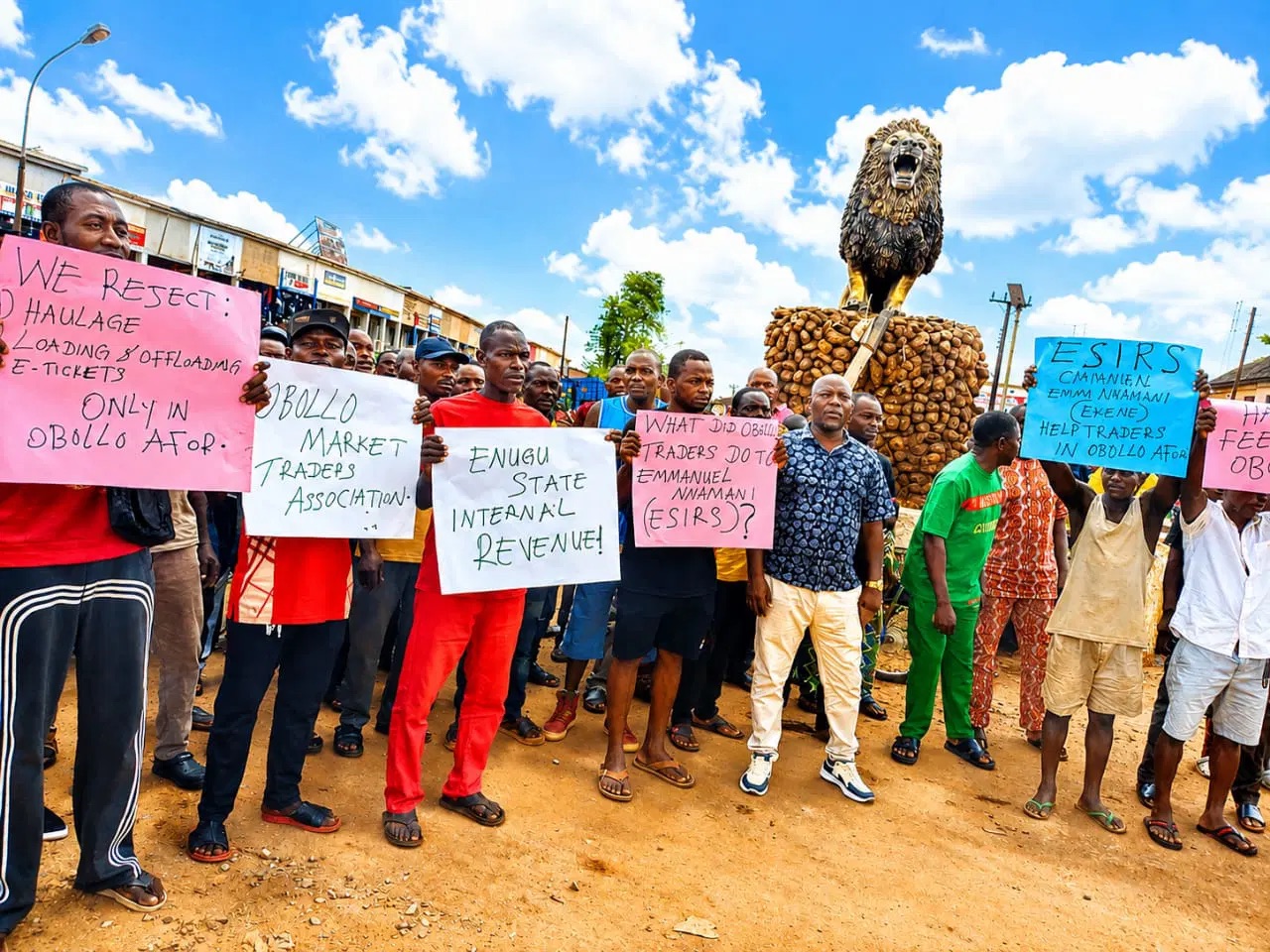
All shops and markets at Obollo-Afor, Udenu Local Government Area of Enugu State were shut yesterday, as traders staged a peaceful protest against alleged selective collection of a N25,000 haulage levy in the market.
The traders, who locked their shops and took to the streets in large numbers, carried placards with various inscriptions, alleging that the Enugu State Internal Revenue Service (ESIRS) had singled out Obollo-Afor Market for the collection of N25,000 haulage fee on every truckload of goods loaded or offloaded in the market.
However, Chairman of ESIRS, Emmanuel Nnamani, in a letter to the traders, said the haulage levy was not paid by traders buying or selling goods in the markets, but was applicable strictly to truck drivers plying interstate routes.
Addressing officials of the Udenu Local Government Council at the council secretariat, where the protesters marched to present their grievances, Chairman, Obollo-Afor Market Traders Association, Charles Eze, lamented that truck operators bringing foodstuffs, building materials, and other commodities to the market had stopped coming because of the levy.


BREAKING: Edo Assembly Speaker Agbebaku Resigns

Cameroon Win First WAFCON Cup Title

US Actress Hayden Panettiere Dies At 36

Tech Expert, Zuckerberg trains with UFC champions, Adesanya, Alexander

Organ Trafficking: Ekweremadu bags 10 years in UK prison

SAINT OBI: Between his marriage and his death
-

 Health3 days ago
Gov Mbah Invest in world-class Enugu International Hospital
-

 Politics2 days ago
#OsunDecides2026: First Results Emerge as Voting Ends, Collation Begins at Polling Units
-

 Politics2 days ago
(UPDATED) #OsunDecides2026: INEC Uploads 3,119 of 3,763 Polling Unit Results as Collation Continues
-
 Politics3 days ago
HAPPENING NOW: Security Beefed up at INEC Office in Osun Ahead of Saturday’s Governorship Election
-

 Politics2 days ago
Osun Poll: Youths Accuse APC of Vote-Buying in Ejigbo (Video)
-
 Politics2 days ago
#OsunDecides2026: Adeleke Urges Tinubu to Protect Votes During Collation
-

 Politics2 days ago
#OsunDecides2026: Accord Party in early lead, APC trails behind
-

 Politics1 day ago
BREAKING: Adeleke coasts to victory winning 19 LGs, APC’s Oyebamiji secures 11 LGs