
Business
Nigerian Govt’s Policies Force Manufacturers To lay off 3,567 Workers Within Six Months of 2023 – MAN


▪︎Cover image: President Bola Tinubu
THE Manufacturers Association of Nigeria (MAN) says that unfavourable policies of the government forced some of its member companies to laidoff a total of 3,567 workers in the first half of 2023.
This indicated, 855 more job lost when compared with the 1, 709 job lost in corresponding half of 2022 and 850 more jobs lost when compared with 2. 708 jobs lost in the last half of 2022.
Based on this, the Association is requesting the Federal Government to conduct a comprehensive economic impact assessment of the fuel subsidy removal, exchange rate changes, and other policy measures.
“This assessment should identify potential challenges and opportunities for the private sector and inform further adjustments to the policies if necessary,” said SegunAjayi-Kadir, the Director-General of MAN.
He pointed to the Association’s latest sectoral Employment Survey results (January to June 2023) and said, ” employment generation of the manufacturing sector declined to 6, 428 in the first half of 2023.
This is an indication of 32.8 percent reduction in employment generation capacity when compared with 9559 jobs generated in the first half of 2022.
Also, the data showed a shed of 313 jobs when compared with 6, 741 jobs created in the second half of 2022.
The decline in the number of jobs created in the sector during the period further highlighted the unfriendly business environment resulting from the hasty policies and residual effect of the currency redesign policy that led to naira crunch.
A Struggling Sector
Segun Ajayi-Kadir, noted that the manufacturing sector faced myriad of challenges in the first half of 2023.
He said that the residual effects of the Naira redesign and the removal of fuel subsidy towards the end of the period under review triggers inflationary pressure, cost of transportation, cost of production and other macroeconomics imbalances, thereby worsened the purchasing power of the households.
Unsold Inventory of Finished Products
Consequently, he disclosed that the inventory of unsold finished products in the manufacturing sector saw a significant increase to N271.96 billion during the first half of 2023, as compared to N187.08 billion recorded in the corresponding period of 2022.
” This indicates a substantial rise of N84.88 billion or 45.4 percent over this timeframe.
However, there was an N11.64 billion or 4.1 percent decline when compared with the inventory value of N283.6 billion recorded in the second half of 2022.
This increase in inventory can be attributed to a weakened purchasing power of the consumers, brought about by diminishing real household income resulting from the ongoing escalation of inflationary pressures, compounded by the scarcity of naira in the first quarter of the year and the aftermath of the subsidy removal,” he said.


Africa’s richest man, Aliko Dangote, and Kenyan President William Ruto are currently breaking ground on a landmark $16 billion oil refinery in Lamu, on Kenya’s northern coast.
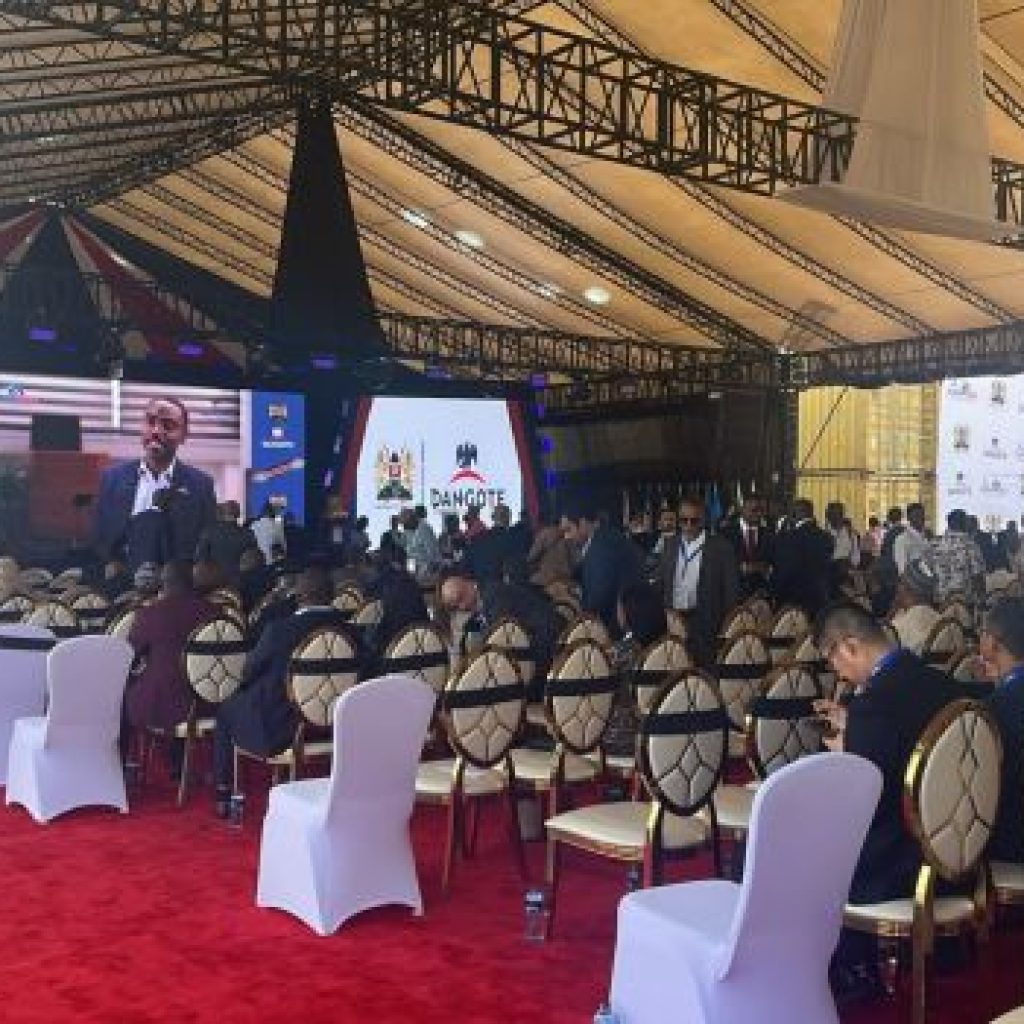
The ceremony, held on Wednesday, September 30, 2026, formally launches construction of the 700,000-barrel-per-day facility, which is set to become the largest refinery in East Africa and the second-largest on the continent after Dangote’s plant in Lekki, Nigeria. The project aims to replicate the success of the Nigerian refinery by processing crude for regional markets, reducing East Africa’s long-standing dependence on imported refined petroleum products, lowering fuel costs, and conserving scarce foreign exchange.
Several African leaders are attending the groundbreaking, including the presidents of Uganda and Ethiopia, along with other regional heads of state and former Nigerian President Olusegun Obasanjo. The event underscores growing continental efforts to process raw materials locally rather than exporting crude and importing finished fuels.
Once completed around 2030, the Lamu refinery is expected to supply Kenya and neighbouring countries such as Uganda, South Sudan, Rwanda, and others. Officials project it will create between 50,000 and 60,000 jobs and stimulate related industries, including petrochemicals and bitumen production. The complex will also feature a 1,000-megawatt power plant, with plans to sell a portion of the electricity to the Kenyan government.
Dangote has offered East African governments a combined 30% equity stake in the project. Financing is structured with roughly 70% debt and 30% equity. The facility is located near Lamu’s deep-water port, chosen for its strategic advantages in handling large-scale industrial operations.

While the project has faced some local land-related protests and a court order maintaining the status quo pending a hearing, the groundbreaking is proceeding as planned. Dangote has dismissed the challenges and reaffirmed that construction will move forward, with the plant targeted for completion in under four years.
The development is being hailed as one of Kenya’s biggest infrastructure investments since independence and a major step toward regional energy security and industrialisation.

The Malindi Environment and Land Court has declined to issue orders stopping the launch and construction of the planned KSh 2 trillion Dangote Oil Refinery in Lamu County.
In a ruling made public on Monday, 28 September 2026, the court instead directed both parties to maintain the status quo on the disputed land in the Hindi/Manda Magogoni area until the matter is heard on 14 October 2026.
The case was brought by 133 residents of Chandavai. They claim the land is their ancestral heritage, where their families have lived and farmed for generations. The residents say they do not oppose development but want their land rights recognised before the project proceeds.
The court ordered the government and other respondents to file their responses within 14 days. The application is scheduled for hearing on 14 October 2026.
The groundbreaking ceremony for the refinery is expected to go ahead as planned on Wednesday, 30 September 2026. While the court has not halted the ceremony at this stage, the status quo order means activities on the disputed site may be restricted pending the October hearing.
Business
Oil Rises As US Rejects Iran Proposal
Iran said it is waiting for a definitive US response to its seven-day proposal to reopen the strait and other demands, adding that it will not ease its conditions after Trump rejected Tehran’s latest plan.

Brent crude climbed above $106 per barrel on Monday, recovering losses from the previous session after President Donald Trump rejected Iran’s latest proposal to reopen the Strait of Hormuz, raising concerns that the restoration of oil flows through the critical waterway could face further delays.
Trump also said Tehran had overplayed its hand and expects negotiations to resume this week.
Meanwhile, Iran said it is waiting for a definitive US response to its seven-day proposal to reopen the strait and other demands, adding that it will not ease its conditions after Trump rejected Tehran’s latest plan.
Elsewhere in the Middle East, tensions remain high as Saudi Arabia intercepted Houthi drones heading toward Riyadh, along with a missile targeting Khamis Mushait in the south.
Alerts were also issued in Abha and Jazan, where Aramco operates energy facilities.
In the US, Trump is considering a ban on diesel exports as part of efforts to address elevated fuel prices.


Plane Makes Emergency Landing After Pilots Fight in Cockpit

Atiku Demands Release of 5 Arrested Over ‘Tinubu Must Go’ T-Shirts

ON-GOING: Dangote $16 billion refinery groundbreaking holds in Kenya (Images)

Tech Expert, Zuckerberg trains with UFC champions, Adesanya, Alexander

Organ Trafficking: Ekweremadu bags 10 years in UK prison

SAINT OBI: Between his marriage and his death
-

 Business3 days ago
NGX Debuts Invest WhatsApp Channel
-

 Business3 days ago
SEC Highlights Focus of National Capital Market Conference 2026
-

 Sports3 days ago
Flamingos win WAFU B U-17 women’s tournament
-

 Business3 days ago
Naira To Dollar, Pound, Euro …Today, September 28
-

 Entertainment3 days ago
Madonna and Taylor Swift win big at the MTV VMAs
-

 Business3 days ago
Ghana Moves to Cut Domestic Airfares as Ticket Prices Stay High
-

 News3 days ago
JUST IN: Fire Engulfs Lagos Customs Command Office
-

 News3 days ago
Nigeria is 66, Thursday October 1