
Business
Middle East War: Dangote Refinery Cushions Global Oil Costs By 20% For Nigerian Market
The Dangote Refinery will ensure that Nigeria is insulated from these supply shocks by prioritising supply to the domestic market. This is one of the many benefits of domestic refining.

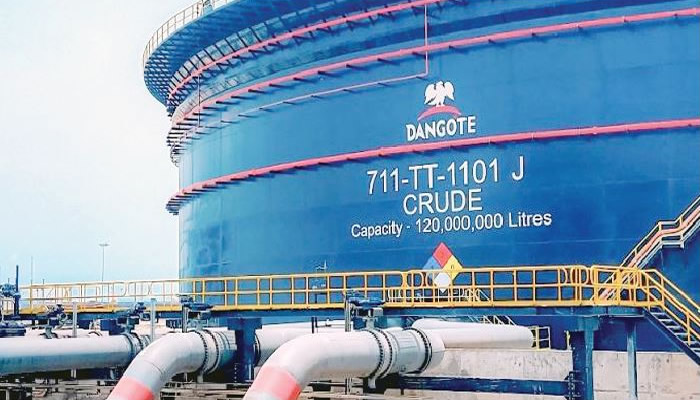
Dangote Refinery on Thursday said that it has absorbed 20 percent of the cost escalation of global oil price, for now, to cushion the domestic market.
In a statement on its official X , the company reassures Nigerians of its unwavering commitment to serving as a stabilising force amid recent shocks in the international oil market.
The conflict in the Middle East has led to the shutdown of some refineries and cut in refinery production across the world. This is leading to a global scarcity of petroleum products.
China has banned export of gasoline and diesel.
The Dangote Refinery will ensure that Nigeria is insulated from these supply shocks by prioritising supply to the domestic market. This is one of the many benefits of domestic refining.
The conflict has driven global crude and freight prices sharply higher, with benchmark Brent prices rising by about 26% within a short period to above $84.0 per barrel.
In response, the refinery implemented a measured adjustment of N100 per litre in its ex-depot price of Premium Motor Spirit, representing an increase of about 12%.
The refinery has absorbed 20% of the cost escalation, for now, to cushion the domestic market.
This is despite continuing to source crude at prevailing international market prices, whether purchased locally or from foreign suppliers.
It is worth noting that Nigerian crude oil is more expensive than the Brent benchmark price by $3 to $6 per barrel. After adding freight of $3.50 per barrel, crude oil will be landing in our tanks between $88 and $91 per barrel.
For context, crude oil was landing our tanks at about $68 per barrel when our ex-depot price was N774/litre.
Furthermore, while we receive about five cargoes a month from NNPC which we pay for in Naira, these cargoes are priced at international market prices + Premium and fall short of the 13 cargoes which we require to support sales into Nigeria.
We therefore, end up procuring foreign exchange at open market rates to pay for crude cargoes purchased from local and international traders.
The high crude cost is compounded by the fact that Nigeria upstream producers have failed to supply crude oil to the refinery as required under the PIA, forcing us to source a substantial portion through international traders who charge an additional premium.
As a private enterprise operating in a deregulated environment, Dangote Petroleum Refinery has remained responsive and has made significant sacrifices by aligning pricing with market realities to ensure sustainability, particularly as it sources all its crude at prevailing international market prices, whether locally or from foreign suppliers.
Selling below cost would undermine its ability to procure crude, sustain production and guarantee uninterrupted supply to Nigerians.
Despite these pressures, local refining at this scale continues to reduce exposure to international supply disruptions, moderate foreign exchange demand and protect the country from severe shortages during periods of global instability.
The refinery is also accelerating deployment of Compressed Natural Gas-powered trucks to cushion the impact of global shocks, enhance nationwide distribution efficiency, reduce logistics costs and improve delivery timelines across the downstream sector.
The rollout is scheduled to commence this month.
We remain committed to transparency, operational excellence and the long-term objective of securing sustainable energy security and stability for Nigeria at an affordable cost.
Business
WEF could appoint Lagarde as its next chair, sources say
The WEF’s Board of Trustees, which includes Lagarde herself, was due to meet on November 2 and could elect her as its next chair, said the people close to the organisation, who spoke on condition of anonymity due to the sensitivity of the matter.
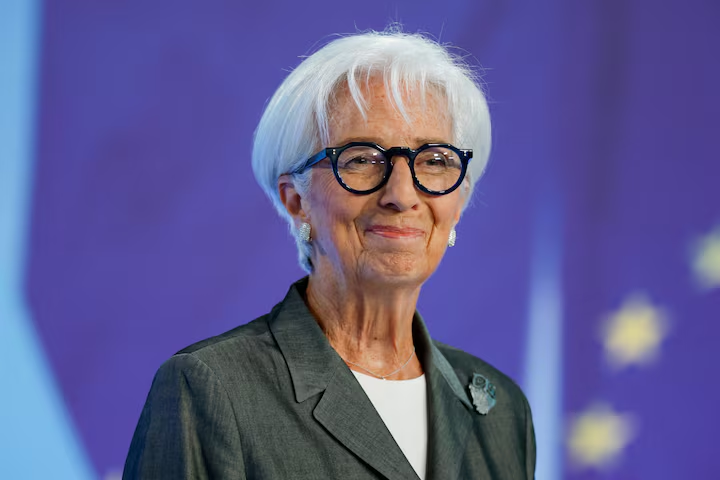
•European Central Bank President Christine Lagarde
The World Economic Forum could appoint Christine Lagarde as its next chair as soon as next month, four people close to the organisation told Reuters, meaning she would step down early as European Central Bank chief and trigger a wider reshuffle at the top of the ECB.Lagarde’s ECB term is scheduled to end in October 2027.
Leaving early would give European Union leaders a chance to pick a new ECB President before France’s spring presidential election, which opinion polls suggest the far-right could win, and could pave the way for a deal involving two other senior ECB roles.
The WEF’s Board of Trustees, which includes Lagarde herself, was due to meet on November 2 and could elect her as its next chair, said the people close to the organisation, who spoke on condition of anonymity due to the sensitivity of the matter.
No final decision has been taken yet, they said.
A spokesperson for the WEF said the forum could not confirm when the next full Board of Trustees meeting would take place, but that the aim was to hold one before the end of the year.
Business
Germany plans tax on sugary drinks
The tax is expected to generate additional revenue for the federal government of €690 million in 2027 and €925 million in 2028.
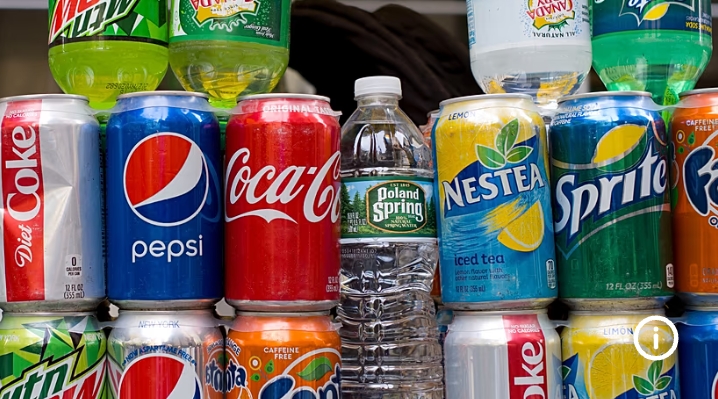
The German cabinet has approved draft legislation to tax sugary drinks in Europe’s biggest economy.
If passed by the German Bundestag, the tax will take effect on 1 July 2027.
The coalition aims to raise revenue for the federal budget while encouraging manufacturers to reduce sugar content and offer healthier products.
The levy is intended to ease pressure on the healthcare system, which faces costs of more than €2 billion every year linked to the high consumption of sugary drinks, which contributes to obesity, diabetes and tooth decay.
According to the federal government, Berlin is using the tax to implement “what associations from the fields of health, science, child protection, and consumer protection have long been demanding.”
The tax is expected to generate additional revenue for the federal government of €690 million in 2027 and €925 million in 2028.
BLACK (PARALLEL) MARKET RATES
₦1370 DOLLAR (USD
₦1800 POUND (GBP)
₦1500 EURO (EUR)
₦970 CANADIAN DOLLAR (CAD)
₦65 SOUTH AFRICAN RAND (ZAR)
₦350 UAE DIRHAM (AED)
₦190YUAN (CNY)
₦2300CFA F.(XOF)
₦2200CFA F.(XAF)
₦850AUSSIE (AUD)SELL₦1000
Official CBN Exchange Rates
DOLLAR (USD)₦1332.59
POUND (GBP)₦1765.55
EURO (EUR)₦1491.57
SWISS FRANC (CHF)₦1590.77
JAPANESE YEN (JPN)₦8.39
CFA FRANC (XOF)₦2.27
WEST AFRICAN UNIT OF ACCOUNT (WAUA)₦1802.33
CHINESE YUAN (CNY)₦199.10
SAUDI RIYAL (SAR)₦354.92
SOUTH AFRICAN RAND (ZAR)₦80.37


BREAKING: Explosion Rocks Rivers, Many Rushed to Hospital

“Mother of all bombs,” Trump Plans To Hit Iran

WEF could appoint Lagarde as its next chair, sources say

Tech Expert, Zuckerberg trains with UFC champions, Adesanya, Alexander

BREAKING: Lagos Govt Declares Today, Thursday Work-Free to Mark 2026 Ìṣẹ̀ṣe Day

Organ Trafficking: Ekweremadu bags 10 years in UK prison
-
 Business3 days ago
Dangote Refinery IPO Attracts N8.61trn in Subscriptions, Four Times Offer
-
Business3 days ago
Top 10 Highest-Paid CEOs in Nigeria
-
 Business3 days ago
Naira Exchange Rates To Dollar , Pound ,Euro, … Tuesday, October 13
-

 Business3 days ago
Global smartphone shipments fall 20% in Q3 2026, lowest in 14 years
-

 International3 days ago
Child marriage in southern Germany: Over 350 cases recorded, some brides as young as 11
-
Sports3 days ago
Rwanda to host F1’s first race in Africa since 1993
-
 News2 days ago
UNCTAD Warns Debt Burden Threatens Future of 3.7bn People
-
 News3 days ago
Nigeria, AfDB Agree Portfolio Review (Photos)