
Business
MAN Laments Effects of N77trn Govt’s Debts On Manufacturing Sector


The Manufacturers Association of Nigeria (MAN) is worried that the Federal Government’s debts which has ballooned to N77 trillion, is not doing good to the economy and the manufacturing industry.
Segun Ajayi-Kadir, the Director-General of MAN, shares detail of how the debts are affecting companies in the sector, and also proferrs the solutions for implementation by the government.
In a position document, he notes that as of December 2022, the country’s total debt had escalated to N46.25 trillion. This represents about 17 percent surge from the record of December 2021.
The debt composition revealed that while domestic debt stock accounted for 59.6% of the total debt, external debt stock contributed 40.4%.
Unfortunately, the country’s debt profile has ballooned to over N77 trillion following the approval of the securitization of the Ways and Means advances.
A whooping debt service-to-revenue ratio of over 100 percent may spell doom for the new administration leaving it to continue the borrowing spree or incapacitated to provide critical infrastructure needed to boost the manufacturing sector and kick start the recovery of the economy.
The domino effects of escalating public debt on the manufacturing sector are endless.
- To start with, rising domestic debt is highly crowding out private investment in the manufacturing sector by reducing credit availability and forcing hike in lending rates. External debts are mostly serviced in foreign currencies, hence high demand for foreign currencies further depreciates the naira and makes importation of non-locally produced critical inputs highly expensive for manufacturers.
- Moreover, higher debt servicing is consuming greater volume of forex and worsening the forex scarcity that has plagued the manufacturing sector for many years. Higher debt repayment requires increased revenue.
- The Nigerian government has continued to breed a harsh business environment by its indiscriminate imposition of high and multiple taxes on manufacturers all in a bid to generate revenue. A major point of reference is the recent exponential hike of the excise duties on beverage and tobacco goods.
- Huge public debt led to low foreign investment and foreign capital inflow which worsen the forex scarcity that has remained a bone in the throat of manufactures.
- As public debt continues to grow unsustainably, it becomes increasingly difficult to cover salary payments and other recurrent expenditure in the civil service.
The implication is more borrowing for government consumption or recurrent expenditure and less on infrastructure and other capital projects meant to boost manufacturing sector performance.
Contrary to the popular parlance in the government quarters that Nigeria has revenue problem, the country’s debt crisis is not a result of inadequate revenue and it is anti-growth to view manufacturing taxes as the last resort for curbing the debt problem.
The manufacturing sector which has always been at the receiving end has not felt any significant impact of the debt finance on the numerous challenges that have bedeviled its performance in many years.
- Infrastructure decadence, forex scarcity, credit crunch and naira depreciation have become bones in the throats of MAN members despite the humongous increase of over 410% in the country’s debt profile in the last eight years.
Amidst multiple taxes, Nigeria’s real problem is not revenue generation or collection but the siphonage of collected revenue so that they do not reflect in the records. - Contrary to popular believe, exorbitant taxes are also collected in the informal sector of the economy without adequate remittance into state coffers. MAN is of the view that debt worth of N77 trillion is an enormous burden to inherit and will most likely limit the achievements of the new administration unless the following recommendations are implemented:
•Increase the revenue base by widening the tax net through an enhanced data capture of business operators in the informal sector
•Strictly implement the Voluntary Assets and Income Declaration Scheme (VAIDS) through the Federal Inland Revenue Service (FIRS).
•Further identify and amend the loopholes in the tax laws in order to reduce the leakage of tax revenues
•Promote fiscal discipline by reducing the cost of governance and strictly complying with section 41 of the Fiscal Responsibility Act and section 38 (sub-section 2) of the CBN Act.
•Ensure proactive judicial investigation into allegations of oil theft and stamp duty fraud.
•Embark on mechanisms that promote coordination and confidence among creditors in order to be granted opportunity for debt restructuring.
•Prioritize debt management and transparency to control risks and reduce the need for restructuring, which stands to benefit both debtors and creditors
•Ensure proper management of capital and recurrent expenditure by determining the appropriate spending priorities that reflect the yearnings and aspirations of households and businesses within the limits of available resources.
•Establish incorruptible monitoring teams tasked to ensure effective budget implementation and detailed evaluation of budget performances.





BLACK/ PARALLEL MARKET RATES
₦1370 DOLLAR (USD)
₦1800 POUND (GBP)
₦1510 EURO (EUR)
₦970 CANADIAN DOLLAR (CAD)
₦65 SOUTH AFRICAN RAND (ZAR)
₦350 UAE DIRHAM (AED)
₦190 CHINESE YUAN (CNY)
₦100 GHANAIAN CEDI (GHS)
₦2300 WEST AFRICAN CFA F.(XOF)
₦2200 CENTRAL AFRICAN CFA F.(XAF)
₦850 AUSTRALIAN DOLLAR AUSSIE (AUD)
CBN OFFICIAL RATES
DOLLAR (USD)₦1331.61
POUND (GBP)₦1764.26
EURO (EUR)₦1490.48
SWISS FRANC (CHF)₦1608.23
JAPANESE YEN (JPN)₦8.4
CFA FRANC (XOF)₦2.27
WEST AFRICAN UNIT OF ACCOUNT (WAUA)₦1802.33
CHINESE YUAN (CNY)₦199.01
SAUDI RIYAL (SAR)₦354.83
SOUTH AFRICAN RAND (ZAR)₦80.49
Business
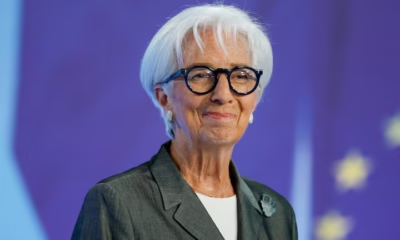
WEF could appoint Lagarde as its next chair, sources say
The WEF’s Board of Trustees, which includes Lagarde herself, was due to meet on November 2 and could elect her as its next chair, said the people close to the organisation, who spoke on condition of anonymity due to the sensitivity of the matter.

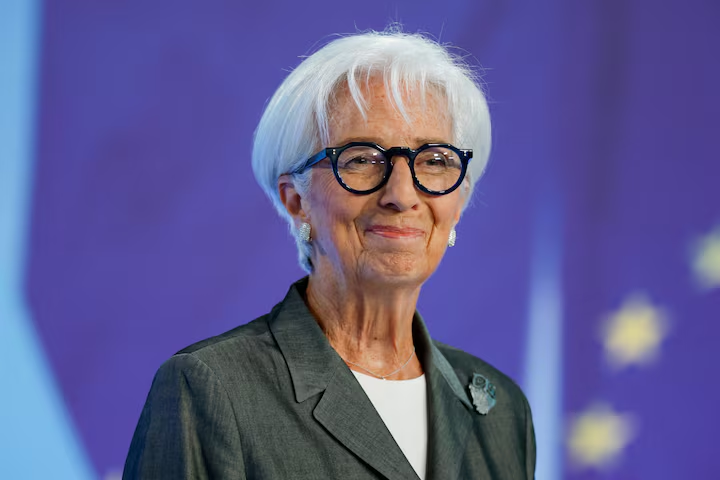
•European Central Bank President Christine Lagarde
The World Economic Forum could appoint Christine Lagarde as its next chair as soon as next month, four people close to the organisation told Reuters, meaning she would step down early as European Central Bank chief and trigger a wider reshuffle at the top of the ECB.Lagarde’s ECB term is scheduled to end in October 2027.
Leaving early would give European Union leaders a chance to pick a new ECB President before France’s spring presidential election, which opinion polls suggest the far-right could win, and could pave the way for a deal involving two other senior ECB roles.
The WEF’s Board of Trustees, which includes Lagarde herself, was due to meet on November 2 and could elect her as its next chair, said the people close to the organisation, who spoke on condition of anonymity due to the sensitivity of the matter.
No final decision has been taken yet, they said.
A spokesperson for the WEF said the forum could not confirm when the next full Board of Trustees meeting would take place, but that the aim was to hold one before the end of the year.
Business
Germany plans tax on sugary drinks
The tax is expected to generate additional revenue for the federal government of €690 million in 2027 and €925 million in 2028.
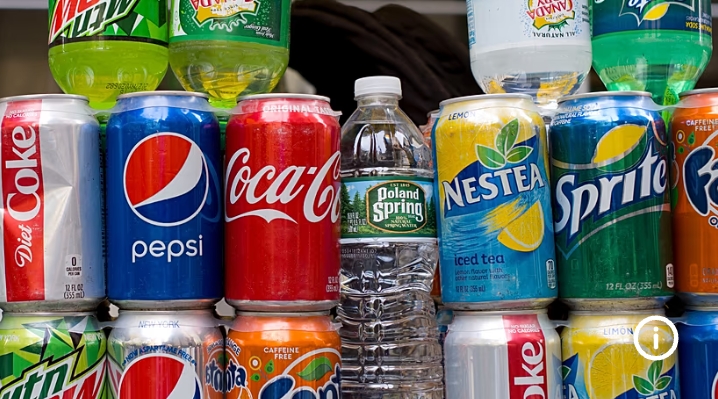
The German cabinet has approved draft legislation to tax sugary drinks in Europe’s biggest economy.
If passed by the German Bundestag, the tax will take effect on 1 July 2027.
The coalition aims to raise revenue for the federal budget while encouraging manufacturers to reduce sugar content and offer healthier products.
The levy is intended to ease pressure on the healthcare system, which faces costs of more than €2 billion every year linked to the high consumption of sugary drinks, which contributes to obesity, diabetes and tooth decay.
According to the federal government, Berlin is using the tax to implement “what associations from the fields of health, science, child protection, and consumer protection have long been demanding.”
The tax is expected to generate additional revenue for the federal government of €690 million in 2027 and €925 million in 2028.


JUST IN: Mob Sets BRT Bus Ablaze After Motorcyclist’s Death in Lagos

BREAKING: DSS Arrests Fugitive Maina Son, Hands Him to EFCC

BREAKING: 5 Arrested Over Imo NYSC Abduction

BREAKING: Lagos Govt Declares Today, Thursday Work-Free to Mark 2026 Ìṣẹ̀ṣe Day

Tech Expert, Zuckerberg trains with UFC champions, Adesanya, Alexander

Organ Trafficking: Ekweremadu bags 10 years in UK prison
-

 Business3 days ago
NAFDAC scolds fake manufacturers: “You are killing Nigerians in order to make money”
-
 Business2 days ago
Naira Exchange Rates For Thursday, October 15
-

 Business3 days ago
Oyedele Chairs G-24 Call for Fairer Global Financial System, Affordable Development Financing
-
 Sports2 days ago
CAF Increases Annual Funding for Member Federations to $700,000
-

 News2 days ago
ASCON To Be Rebranded “National School Of Government”
-

 Business2 days ago
Germany plans tax on sugary drinks
-
 Politics3 days ago
Exclusion of candidates from INEC list: CD cautions INEC against manipulation by politicians
-
 Business2 days ago
WEF could appoint Lagarde as its next chair, sources say