
International
JUST IN: Wikileaks founder freed after five years in prison


After a years-long legal saga, Wikileaks says that founder, Julian Assange has left the UK after reaching a deal with US authorities that will see him plead guilty to criminal charges and go free.
Mr Assange, 52, was charged with conspiracy to obtain and disclose national defence information.
For years, the US has argued that the Wikileaks files – which disclosed information about the Iraq and Afghanistan wars – endangered lives.
He spent the last five years in a British prison, from where he was fighting extradition to the US.
Mr Assange also faced separate charges of rape and sexual assault in Sweden, which he denied.
He spent seven years hiding in Ecuador’s London embassy, claiming the Swedish case would lead him to be sent to the US.
Swedish authorities dropped the case in 2019 and said that too much time had passed since the original complaint, but UK authorities later took him into custody. He was tried for not surrendering to the courts to be extradited to Sweden.
According to CBS, the BBC’s US partner, Mr Assange will spend no time in US custody and will receive credit for the time spent incarcerated in the UK.
Assange will return to Australia, according to a letter from the justice department.
On X, the platform formerly known as Twitter, Wikileaks said that Mr Assange left Belmarsh prison on Monday after 1,901 days in a small cell.
He was then “released at Stansted airport during the afternoon, where he boarded a plane and departed the UK” to return to Australia, the statement added.
Video shared online by Wikileaks appear to show Mr Assange, dressed in jeans and a blue shirt, being driven to Stansted before boarding an aircraft.
His wife, Stella Assange, tweeted thanks to his supporters “who have all mobilised for years and years to make this come true”.
She later told the BBC’s Today programme that the days running up to the US deal had been “touch-and-go” and “non-stop”, and that she was feeling “a whirlwind of emotions”.
The deal – which will see him plead guilty to one charge of the Espionage Act – is expected to be finalised in a court in the Northern Mariana Islands on Wednesday, 26 June.
The remote Pacific islands, a US commonwealth, are much closer to Australia than US federal courts in Hawaii or the continental US.
Stella said she was very limited in what she could say about the deal ahead of her husband’s court appearance. “I don’t want to jeopardise anything”, she said.
“The important thing here is that the deal involved time served – that if he signed it, he would be able to walk free. He will be a free man once it has been signed off by a judge.”
She said the priority for her husband is to “get healthy again”, be in touch with nature, and for the family to have “time and privacy”.
Stella also confirmed that the couple’s two children are in Australia with her, but she has not yet told them that he is to be freed, only that they were going to visit family and that there was “a big surprise” waiting for them.
“We’ve been very careful because obviously no one can stop a five and a seven-year-old from, you know, shouting it from the rooftops at any given moment,” she said.
Agence France Press quoted a spokesperson for Australia’s government as saying that the case had “dragged on for too long”.
His attorney, Richard Miller, declined to comment when contacted by CBS. The BBC has also contacted his US-based lawyer.
Mr Assangee and his lawyers had long claimed that the case against him was politically motivated.
In April, US President Joe Biden said that he was considering a request from Australia to drop the presecution against Assange.
In a victory the following month, the UK High Court ruled that Mr Assange could bring a new appeal against extradition to the US, allowing him to challenge US assurances over how his prospective trial would be conducted and whether his right to free speech would be infringed.
After the ruling, Stella told reporters and supporters that the Biden administration “should distance itself from this shameful prosecution”.
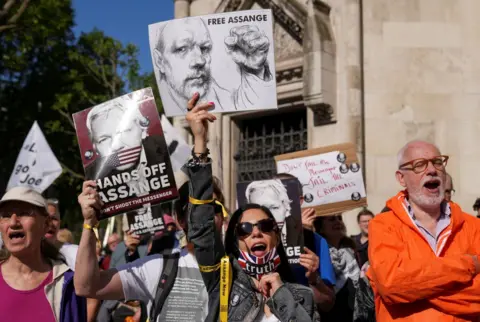
US prosecutors had originally wanted to try the Wikileaks founder on 18 counts – mostly under the Espionage Act – over the release of confidential US military records and diplomatic messages related to the wars in Afghanistan and Iraq.
Wikileaks, which Mr Assange founded in 2006, claims to have published over 10 million documents in what the US government later described as “one of the largest compromises of classified information in the history of the United States”.
In 2010, the website published a video from a US military helicopter which showed more than a dozen Iraqi civilians, including two Reuters news reporters, being killed in Baghdad.
One of Mr Assange’s most well-known collaborators, US Army intelligence analyst Chelsea Manning, was sentenced to 35 years in prison before then-president Barack Obama commuted her sentence in 2017.
Even amid long-running legal battles, Mr Assange has rarely been seen in public and for years has reportedly suffered from poor health, including a small stroke in prison in 2021.
Courtesy: BBC
International
“Mother of all bombs,” Trump Plans To Hit Iran
The 21,600-pound airburst weapon is designed to affect surface targets over a wide area and has so far not been deployed by the U.S. in previous strikes on targets inside Iran. It was used in Afghanistan in 2017 during the previous Trump administration.

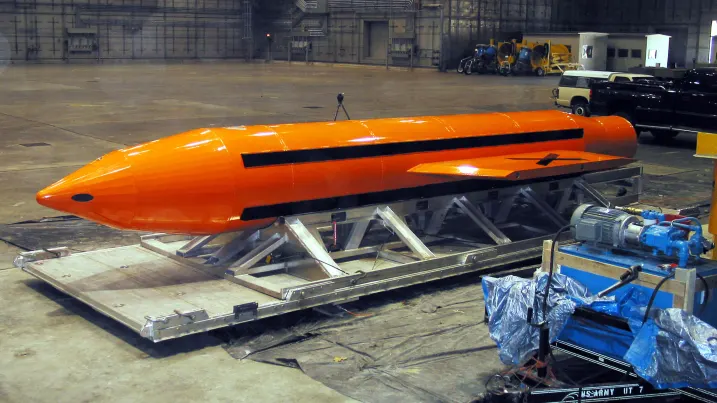
The U.S. military is considering use of the GBU-43/B Massive Ordnance Air Blast (MOAB) bomb if it resumes strikes inside Iran, CNN reported Thursday, citing U.S. officials.
The 21,600-pound airburst weapon is designed to affect surface targets over a wide area and has so far not been deployed by the U.S. in previous strikes on targets inside Iran. It was used in Afghanistan in 2017 during the previous Trump administration.
Trump said Oct. 8 that he would not resume U.S. strikes on Iran before the Nov. 3 midterm elections, while attacks on shipping near the Strait of Hormuz and deadly Houthi strikes in Saudi Arabia have raised regional tensions.
Iranian Parliament Speaker Mohammad Bagher Ghalibaf said Tehran will combine military capabilities and negotiations to press its demands.
International
Child marriage in southern Germany: Over 350 cases recorded, some brides as young as 11
The most recent entries in the overview relate to 2026. They include, among other things, marriages of 16- and 17-year-old girls to adult men.

• Child marriage / UNICEF
In the southwestern German state of Baden-Württemberg, a total of 358 so-called child marriages have been officially recorded since 2012.
Euro News reported that only eight of these forced marriages have so far been legally annulled.
According to authorities, the other 350 cases were brought to an end in other ways.
This alarming finding comes from a response by the Baden-Württemberg state government to a minor inquiry submitted by AfD state parliament members Nikolaos Boutakoglou and Emely Knorr.
The Tübingen regional authority is responsible for recording the data, the answer came from the Ministry of the Interior.
The eight final annulments took place between 2018 and 2024. Among the documented cases was the marriage of an 11-year-old girl from Iraq to a 17-year-old Iraqi, which was annulled in 2020.
As early as 2018, the marriage of a 14-year-old Afghan girl to a 30-year-old man had been ended.
In 2024 two further annulments were added: they concerned a 16-year-old German girl and a 25-year-old Pakistani man and a 16-year-old Syrian girl and a 27-year-old man from the same country.State parliament member Nikolaos Boutakoglou wrote on Facebook that the issue was “really awful” but was being treated as a taboo.
According to its own account, the ministry deals exclusively with such marriages entered into abroad.
Since summer 2017, the Act to Combat Child Marriages has been in force in Germany.
In 2024, the Bundestag adopted new rules to protect minors in marriages concluded abroad.
Hundreds of cases without state intervention
The significantly higher number of cases concluded in other ways raises questions about how these marriages continued.
For the period from 2015 to 2026, the regional authority lists a total of 350 proceedings under the heading “other disposals.”But what became of the other child marriages?
The state government cites, among other things, the death of a spouse, reaching adulthood, a decision not to seek annulment or a new marriage concluded abroad.
In these cases, there was therefore no legally binding annulment.
For 2023, the records include the case of a 12-year-old Afghan girl who was married to a 21-year-old Afghan man. Girls aged 13 and 14 also appear several times in the statistics.
The most recent entries in the overview relate to 2026. They include, among other things, marriages of 16- and 17-year-old girls to adult men.
The statistics record the age of the spouses at the time of marriage and their respective nationalities.

Pope Leo XIV has announced that he will undergo surgery in the coming days to remove a small, localized nodule found on his lung during a recent routine medical checkup.
The 71-year-old pontiff made the disclosure himself during his weekly Angelus prayer in St. Peter’s Square. “Doctors found a localized nodule in my lung,” he said. “It was detected at a very early stage and is well-contained.
The doctors believe it is advisable to intervene, so, following their advice, I have decided to undergo surgery to remove it.”
The Vatican confirmed the operation is scheduled for the first days of this week at Rome’s Gemelli Hospital, which has a dedicated papal suite. Holy See spokesman Matteo Bruni said the Pope is expected to need about a week to recover. On Monday, the Vatican added that Leo will be admitted Tuesday morning.
The nodule’s nature—whether benign or malignant—has not been specified. Medical experts note that most lung nodules are non-cancerous, and early detection generally carries a favorable outlook.
This marks the first significant health issue of Leo’s papacy since his election in May 2025. The American-born pope, known for remaining physically active, has continued his full schedule of audiences and is still expected to proceed with a planned trip to Latin America next month.


JUST IN: Mob Sets BRT Bus Ablaze After Motorcyclist’s Death in Lagos

BREAKING: DSS Arrests Fugitive Maina Son, Hands Him to EFCC

BREAKING: 5 Arrested Over Imo NYSC Abduction

BREAKING: Lagos Govt Declares Today, Thursday Work-Free to Mark 2026 Ìṣẹ̀ṣe Day

Tech Expert, Zuckerberg trains with UFC champions, Adesanya, Alexander

Organ Trafficking: Ekweremadu bags 10 years in UK prison
-

 Business2 days ago
Naira Exchange Rates For Thursday, October 15
-
 Sports2 days ago
CAF Increases Annual Funding for Member Federations to $700,000
-

 News2 days ago
ASCON To Be Rebranded “National School Of Government”
-

 Business2 days ago
Germany plans tax on sugary drinks
-

 News3 days ago
Sanwo-Olu Appoints Olatunbosun Ogunbanwo, 5 Others as Perm Secs
-

 Business2 days ago
WEF could appoint Lagarde as its next chair, sources say
-
 International2 days ago
“Mother of all bombs,” Trump Plans To Hit Iran
-
 Crime20 hours ago
BREAKING: 5 Arrested Over Imo NYSC Abduction