
Politics
(UPDATED) Governor Soludo Begins Second -Term (2026-2030)
The Chief Judge of the State, Justice Onochie Anyachebelu, administered the oaths of office and allegiance to the Constitution of the Federal Republic of Nigeria to the duo.

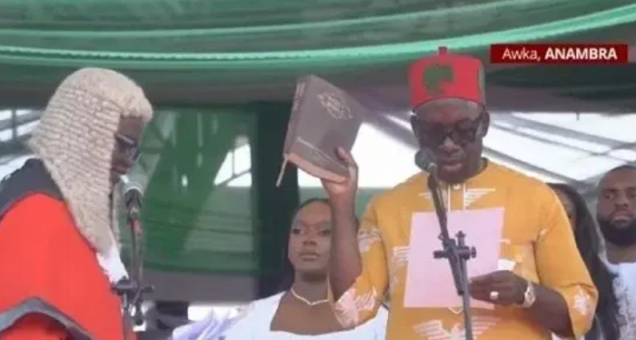
Anambra State Governor Charles Soludo, and his Deputy Governor Dr Onyekachukwu Ibezim, begin their second- term on Tuesday 17 March 2026.
The governor and his deputy marked the end of their first tenure on Sunday with an interdenominational thanksgiving service at the International Convention Centre.
Today’s inauguration ceremony was held at the newly renovated Alex Ekwueme Square, Awka.
They took the oath of office alongside his deputy at about 11:05 am.
The Chief Judge of the State, Justice Onochie Anyachebelu, administered the oaths of office and allegiance to the Constitution of the Federal Republic of Nigeria to the duo.
Both the governor and his deputy were accompanied by their wives and members of their families.The programme began on
Governor Soludo was re-elected on November 8, 2025, on the platform of the All Progressives Grand Alliance (APGA), which has mobilised members from all 326 political wards to attend the inauguration.
Already, Vice President Kashim Shettima, and former Presidents Olusegun Obasanjo and Goodluck Jonathan have arrived in Anambra State for the ceremony.
Several high-profile personalities, including elder statesmen such as former Commonwealth Secretary-General Emeka Anyaoku, were also expected to attend including traditional rulers from the 179 communities in the state, as well as monarchs from other parts of Nigeria, are in attendance.
Security has been tightened across the state, with personnel from the police, Nigeria Security and Civil Defence Corps, Federal Road Safety Corps, and other agencies deployed to strategic locations.

Politics
Exclusion of candidates from INEC list: CD cautions INEC against manipulation by politicians
The organisation maintained that it was deeply troubling that candidates who emerged through primaries monitored by INEC itself could be so brazenly excluded without immediate explanation.
• Demands untainted integrity ahead of 2027 elections
A leading pro-democracy group in Nigeria, the Campaign for Democracy (CD) has raised concerns over the omission of some political parties’ candidates from the list of candidates to contest in the 2027 general elections, particularly some governorship candidates.
The pro-democracy group warned the Independent National Electoral Commission against manipulation by desperate politicians, saying any threat to what it described as “political pluralism and participatory democracy” would be resisted.
In a strongly worded statement, signed by its President, Comrade Ifeanyi Odili, and released on Wednesday, CD wondered how the candidates’ names were excluded from the final list, without any immediate explanation, and when INEC, in its earlier list made available to the public on August 29, 2026, had cleared and published them.
The statement made particular reference to the Peoples Democratic Party’s governorship candidate in Gombe State, Isa Pantami; the party’s governorship candidate in Ogun State, Ladi Adebutu, and his deputy, Yemi Sowunmi-Kolapo.
The Campaign for Democracy said the development was particularly disturbing in Ogun State, where citizens had witnessed repeated boasts and triumphalism by members of the All Progressives Congress in the state that the PDP governorship candidate would be excluded from the final list.
According to CD, as if to validate that boast, INEC went ahead to publish a list that excluded both the PDP candidate, and his deputy, Hajia Yemi Sowunmi-Kolapo, without stating any reason for their omission.
CD said, “The timing of the omissions was even more disturbing, and this was where we became concerned and alarmed. A particular instance was that of Ogun State where the state’s citizens had witnessed repeated claims and apparent triumphalism by elements within the All Progressives Congress (APC) and their supporters that the PDP governorship candidate would be disqualified from participating in the forthcoming election.
“As if to validate that boast, INEC published a list that excluded both PDP candidates without stating the reason for their omission.”
“This troubling sequence of events raises legitimate questions about the independence and impartiality of the Commission that Nigerians cannot afford to ignore,” the pro-democracy group added.
It said, “Under your leadership, Mr. Chairman, INEC bears an enormous responsibility to demonstrate impartiality, transparency, and strict adherence to the law. Unfortunately, this development has raised serious doubts about the Commission’s preparedness to conduct a credible, transparent, and inclusive election in 2027.
“The clarification by the Commission published late yesterday, three days after the incident was belated.”
The group stated, “To the best of our knowledge, these are candidates that emerged through the primaries conducted by their various political Parties which were monitored by the Independent National Electoral Commission (INEC). Information in the public domain shows clearly that these candidates were on the earlier list published on the 29th of August, 2026.
“Even though the Commission has just published a belated clarification on the incident, we consider this development deeply troubling and a serious blow to public confidence in the electoral process, particularly because the published list provided no immediate explanation for the omissions of the governorship and other candidates.”
CD, which was formed in 1991 and was among the prominent civil society organisations that fought the military for restoration of civil rule in 1999, said it decided to intervene because the omission threatens Nigeria’s democratic credentials, warning INEC Chairman, Joash Amupitan, to avoid orchestrating anything that could set the nation on fire.
The organisation maintained that it was deeply troubling that candidates who emerged through primaries monitored by INEC itself could be so brazenly excluded without immediate explanation.
The group warned that an electoral umpire must not only be independent but must be seen to be independent.
CD said information from the affected states already showed heightened anxiety that could have exploded into intractable violence before the Commission’s belated clarification, describing the delay as inexcusable tardiness.
The pro-democracy body further demanded an immediate investigation into allegations circulating in the public that some candidates’ names were electronically removed after they were duly submitted.
It vowed that as a committed pro-democracy group, it would not hesitate to mobilise citizens and pro-democracy organisations across the nation for lawful mass civic action against any threat to political pluralism and participatory democracy.
“We remind INEC that elections belong to the Nigerian people, not to any political party, individual, or governing interest.
No institution should take actions that create the impression that opposition participation can be determined by administrative discretion without transparent, constitutional justification and due process,” CD stated.
Politics
APC Makes Wike, Soludo, Adeleke State’s Campaign Coordinator
Wike belongs to the Peoples Democratic Party (PDP), Soludo is a member of the All Progressives Grand Alliance (APGA), while Adeleke won re-election as Osun governor in 2026 under the Accord Party.
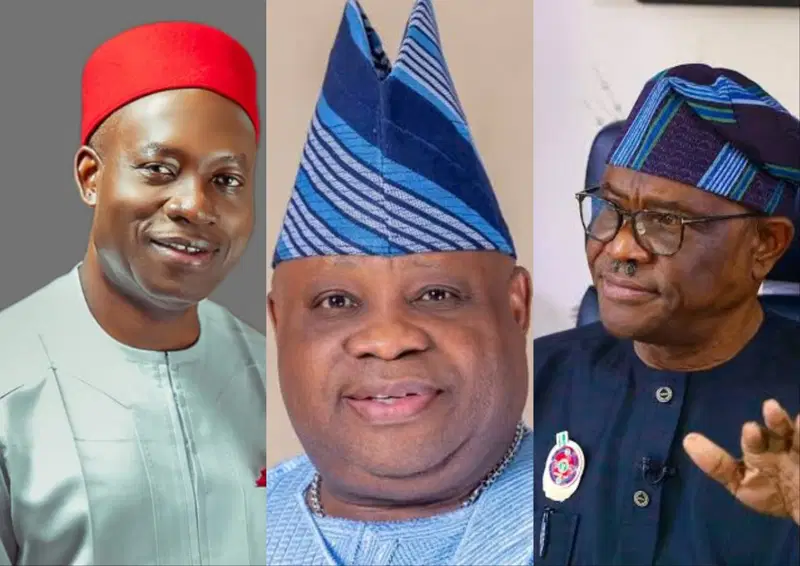
• [L-R] A collage of Soludo, Adeleke and Wike
The All Progressives Congress (APC) has named Nyesom Wike, minister of the Federal Capital Territory (FCT); Ademola Adeleke, Osun governor; and Chukwuma Soludo, Anambra governor, as state campaign coordinators in its expanded presidential campaign council for the 2027 general election.
This is despite their affiliations with other political parties.
Wike belongs to the Peoples Democratic Party (PDP), Soludo is a member of the All Progressives Grand Alliance (APGA), while Adeleke won re-election as Osun governor in 2026 under the Accord Party.
Under the new arrangement, Wike will coordinate the APC campaign in Rivers State and the FCT, Soludo will oversee Anambra, while Adeleke will coordinate the campaign in Osun.
The expanded list is scheduled for inauguration by President Bola Tinubu at the Presidential Villa in Abuja on Wednesday.
The APC initially released its campaign council list on August 22, naming Abdulaziz Yari, former Zamfara governor, as director-general. Senate President Godswill Akpabio, House of Representatives Speaker Tajudeen Abbas and Yobe Governor Mai Mala Buni were appointed deputy director-generals.

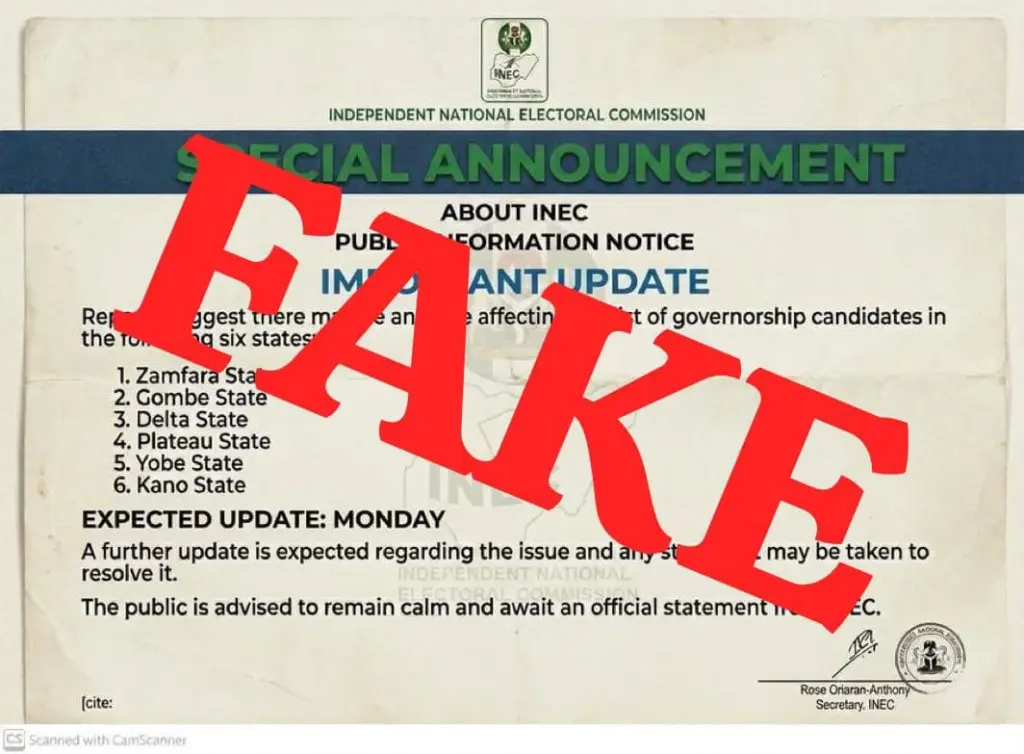
The Independent National Electoral Commission (INEC) has raised the alarm over a fraudulent publication circulating online that claims to be a special announcement about governorship candidates for the 2027 elections.
In a public notice issued on Monday, October 12, 2026, the electoral body described the document as “FAKE” and stressed that it did not originate from the Commission.
The circulating material purports to address issues affecting the list of governorship candidates in six states: Zamfara, Gombe, Delta, Plateau, Yobe, and Kano.
“The Commission wishes to categorically inform the general public that the publication is FAKE and did not originate from INEC. INEC therefore urges members of the public to disregard the fraudulent publication and refrain from sharing it,” the notice stated.
INEC further clarified that any information suggesting it has issued a special announcement concerning governorship candidates in those states is false.
The warning comes just days after the Commission published the final lists of candidates for the February 6, 2027 governorship elections.
The electoral umpire advised Nigerians, political parties, and candidates to rely solely on official notices, press releases, and information released through its verified channels.
These include the INEC website (inecnigeria.org), its Facebook page (INEC Nigeria), X and Instagram handles (@inecnigeria), and the INEC News Portal.
INEC reiterated its commitment to providing accurate electoral information and called on the public to remain vigilant against misleading publications as preparations for the 2027 elections intensify.


JUST IN: Mob Sets BRT Bus Ablaze After Motorcyclist’s Death in Lagos

BREAKING: DSS Arrests Fugitive Maina Son, Hands Him to EFCC

BREAKING: 5 Arrested Over Imo NYSC Abduction

BREAKING: Lagos Govt Declares Today, Thursday Work-Free to Mark 2026 Ìṣẹ̀ṣe Day

Tech Expert, Zuckerberg trains with UFC champions, Adesanya, Alexander

Organ Trafficking: Ekweremadu bags 10 years in UK prison
-

 Business3 days ago
Naira Exchange Rates For Thursday, October 15
-
 Sports3 days ago
CAF Increases Annual Funding for Member Federations to $700,000
-

 News3 days ago
ASCON To Be Rebranded “National School Of Government”
-

 Business3 days ago
Germany plans tax on sugary drinks
-

 International2 days ago
“Mother of all bombs,” Trump Plans To Hit Iran
-
 Business3 days ago
WEF could appoint Lagarde as its next chair, sources say
-

 Business2 days ago
Naira Exchange Rates Friday, October 16
-
 Crime1 day ago
BREAKING: 5 Arrested Over Imo NYSC Abduction