
Business
Dangote inducts youth in technical skills acquisition as Ravindra says Merger of Dangote food subsidiaries will benefit stakeholders

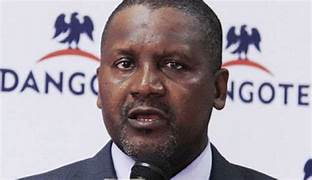
As part of its commitment to Corporate Social Responsibility (CSR), the Dangote Cement Plc, Obajana Plant, Kogi State, has commenced the training of youth in technical skills under the tutelage of technical units of Dangote Cement Transport, Obajana. The participating youth were selected from the host communities of Oyo, Iwaa, Apata, and Obajana.
The Technical Skills Acquisition programme, according to the Plant Director, Dangote Cement Plant, Obajana, JV Gungune, is aimed at empowering the youth and developing entrepreneurial skills around its catchment areas.
Mr. Gungune told newsmen that the youths which also included female trainees, were mostly secondary school leavers.
Speaking at the inauguration of the scheme, General Manager, Community Affairs /Special Duties, Mr. Ademola Adeyemi, said the trainees are being paid monthly stipends while the training lasts. “When completed, the youth will add great value to their communities, Kogi State, and Nigeria,” Mr. Adeyemi said.
Reacting, Divisional Director Transport of the Dangote Cement Plc, Mr. Ajay Singh, said some of the areas of training include: auto mechanic, auto electrical, welding and panel beating/fabrication.
The Workshop Manager, Engineer Alfa Adamu, said the trainees were shared into different engineering sections based on their strengths and interest, adding that the trainees have so far spent three months.
In the same vein, the Chief Executive Officer of Dangote Sugar Refinery Plc, Ravindra Singhvi has assured stakeholders that the proposed merger between Dangote Sugar Refinery, NASCON Allied Industries, and Dangote Rice to form Dangote Foods Plc is expected to yield many benefits, solely for the growth of the business and high returns to all the key stakeholders.
Speaking last week on the Business Morning Programme of Channels Television, Ravindra said that the merger when completed will bring economies of scale to the business. He maintained that the merger would lead to cost reduction as the evolved company will gain with an increase in production. The cost, according to him, will now be spread over many goods.
According to him, Dangote Foods will have operational efficiencies, as there would be a reduction in the time needed to obtain raw materials, fuel, manpower, etc for production. Husk and biomass from Rice and Sugar Units will be useful to generate power for the running of the plants. Also, it is expected that the merger will result in improvement in the supply side of the food industry as many products will roll out of the one-stop food company. The Dangote Sugar Refinery helmsman opined that the merger will further advance the backward integration strategy of the Group as resources, machinery, and skilled manpower are to be harnessed to drive the process.
Dangote Foods Plc, he stated will have the potential for more geographical spread than the legacy companies as the products will be readily available in all the niche markets of the former and even more given the combined assets in terms of manpower, product range, transport, and warehouses.
The company will have a stronger business case for access to capital as the combined business will be bigger and more attractive to lenders, he added.
Speaking on the impact of deregulation of the foreign exchange market, he lamented that many manufacturing companies have sustained forex-linked losses in the period as they made provisions for the slump in the value of the Naira against the dollar. Manufacturers, he noted are making provisions monthly to take care of the fluctuations in the value of the Naira.
He said, ‘The headwinds are really there. So, we have to be careful in provisioning for changes in the value of the local currency. The floating of the Naira led to a massive fall in its value. This has affected our operations in the sugar industry.’





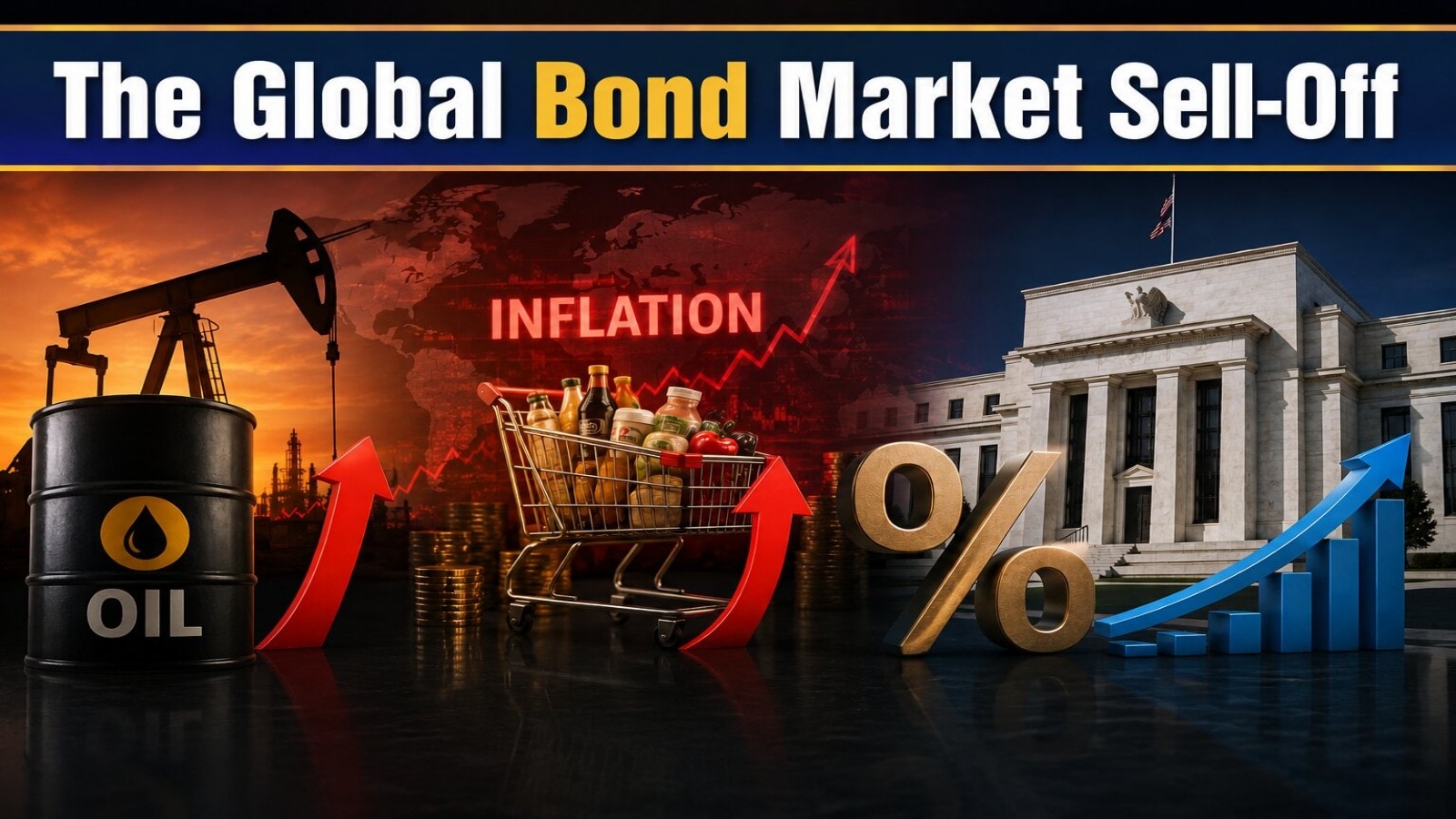
A sharp selloff in the US bond market has driven the benchmark Treasury yield above 5%, sending shockwaves through equity markets and heightening investor anxiety.
The surge in yields, particularly on the 10-year Treasury note, reflects growing concerns over persistent inflation, the outlook for interest rates, and the broader path of monetary policy. As bond prices fell, yields climbed past the psychologically important 5% threshold, marking a significant move that has unsettled risk assets.
US stock markets reacted with broad declines, as higher yields increased the attractiveness of fixed-income investments relative to equities and raised borrowing costs for companies. Major indices came under pressure, with investors reassessing valuations amid the rising cost of capital.
Market analysts note that the rapid move higher in yields has intensified volatility across asset classes. Traders are closely watching upcoming economic data and any signals from the Federal Reserve for clues on whether the upward pressure on yields will persist.
The development underscores the sensitivity of both bond and equity markets to shifting expectations around inflation and monetary policy in the world’s largest economy.
Business
Dangote at IPO Listing, Charges Public,”I don’t want to be called richest man in Africa”
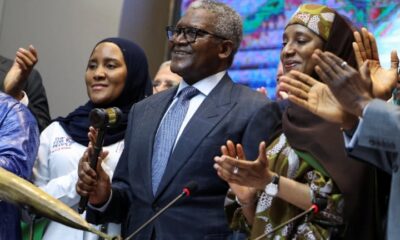
“I don’t want anybody again to call me the richest man in Africa. I want to be called the wealthiest man in Africa so that I can create wealth for others,” he said.

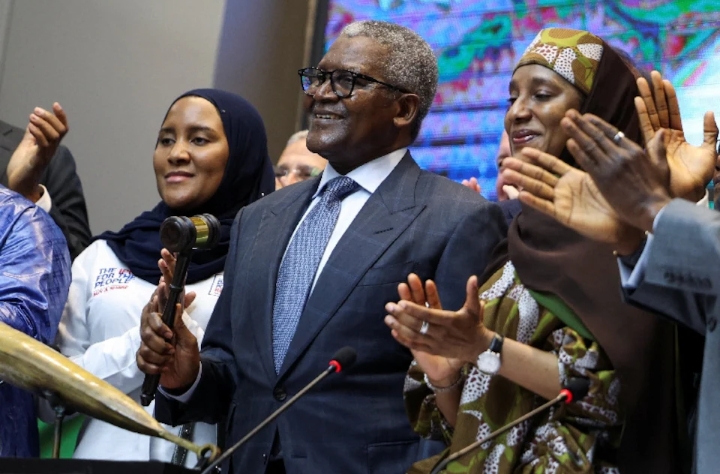
The trading floor of the Nigeria Exchange Limited (NGX) is agog this morning as billionaire industrialist,Aliko Dangote, declared opened trading activities for the day.
“I don’t want anybody again to call me the richest man in Africa. I want to be called the wealthiest man in Africa so that I can create wealth for others,” he said.
Dangote made the remarks on Monday while sounding the gong at the Nigerian Exchange (NGX) in Lagos to formally launch the Initial Public Offering (IPO) of Dangote Petroleum Refinery and Petrochemicals.
The billionaire businessman said the IPO provided an opportunity for investors to participate in what he described as a transformational phase for Nigeria and Africa’s economies.
“Today, we are not merely offering shares. We are offering an opportunity to participate in the transformational chapter of not only Nigeria’s economy, but Africa’s economy,” Dangote said.
He urged Nigerians to deepen the capital market and promote wider ownership of wealth.
“Together, let us deepen our capital market. Together, let us create prosperity through ownership. Together, let us build a stronger Nigeria. Together, let us ensure prosperity for Africa,” he said.
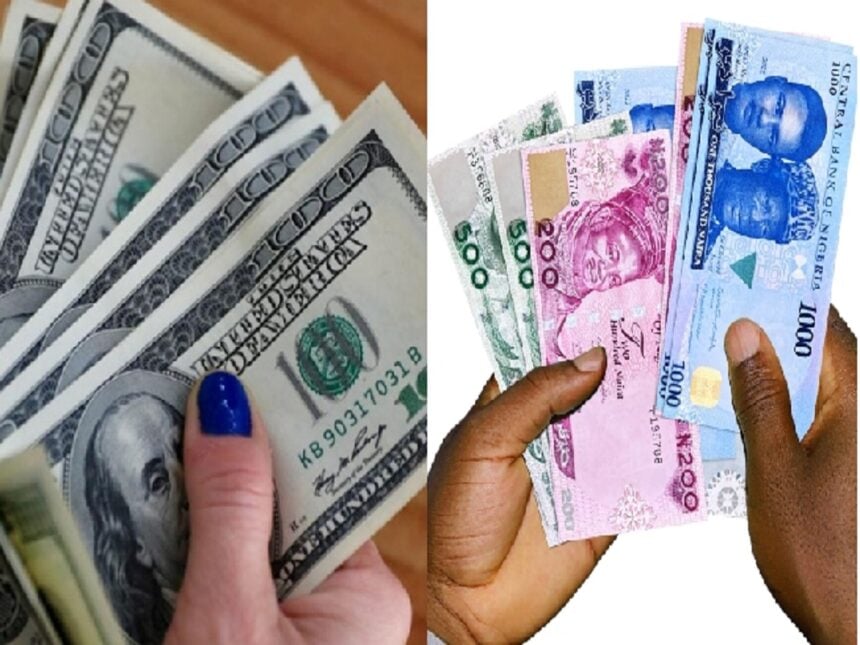
BLACK MARKET
US DOLLAR ₦1385
POUND (GBP) ₦1880
EURO (EUR) ₦1580
CANADIAN DOLLAR (CAD) ₦1000
SOUTH AFRICAN RAND (ZAR) ₦90
UAE DIRHAM (AED) ₦370
CHINESE YUAN (CNY) ₦190
GHANA CEDI (GHS) ₦100
Central Bank of Nigeria Rates
DOLLAR (USD)₦1326.52
POUND (GBP)₦1794.52
EURO (EUR)₦1540.22
SWISS FRANC (CHF)₦1627.83
JAPANESE YEN (JPN)₦8.64
CFA FRANC (XOF)₦2.34
WEST AFRICAN UNIT OF ACCOUNT (WAUA)₦1811.58
CHINESE YUAN (CNY)₦197.74
SAUDI RIYAL (SAR) ₦353.20
SOUTH AFRICAN RAND (ZAR) ₦82.24


US Bond Selloff Pushes Benchmark Yield Past 5%, Stocks Rattled

Protests Rock Syria Over Sharp Fuel Price Increase

Boko Haram Attacks Adamawa Community, Kills Residents

Tech Expert, Zuckerberg trains with UFC champions, Adesanya, Alexander

Organ Trafficking: Ekweremadu bags 10 years in UK prison

SAINT OBI: Between his marriage and his death
-
 News3 days ago
Bamanga Tukur, former Adamawa gov, ex-PDP Chair dies at 90
-
 Business1 day ago
Filling Stations Selling Petrol, Diesel Higher Driven By Global Crude Prices
-
 Business1 day ago
Dangote Refinery’s IPO Officially Opens Today On NGX
-
 Business24 hours ago
Naira Exchange Rates To Dollar, Pound , Euro… September 14
-

 News2 hours ago
Boko Haram Denies Ceasefire with FG, Vows Continued Attacks
-
 Business23 hours ago
Dangote at IPO Listing, Charges Public,”I don’t want to be called richest man in Africa”
-

 News2 hours ago
Police Raise Alarm Over Terrorists and Informants Spying on Schools, Other Targets
-
 Politics21 hours ago
Again, Desmond Elliot begs political mentor,Gbajabiamila , “I’m sorry, Daddy”