News
BREAKING: IPOB: Nnamdi Kanu’s case adjourned to Sept 14


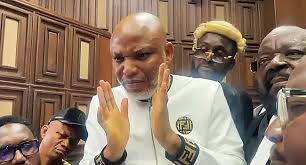
The hearing in the suit filed by the Indigenous People of Biafra for the release of their leader, Nnamdi Kanu, has been adjourned to September 14, by Supreme Court on Thursday.
Lead lawyer for IPOB and human rights activist, Ifeanyi Ejiofor, had in a statement said, “We have appealed to the Supreme Court, to set aside the ruling of the Court of Appeal, staying the execution of the court’s judgment discharging him, and placing a further bar to any further detention and prosecution of Nnamdi Kanu on any charge/indictment before any court in Nigeria.
“Recall that on October 28, 2022, a three-person panel of Learned Justices of the Court of Appeal (Abuja Judicial Division), granted an application for the stay of execution of the judgment of the Court of Appeal, pending the determination of the appeal filed before the Supreme Court by the Federal Government.
“After a thorough review of the said ruling by our defence team, eminently led by foremost leading Senior Advocate of Nigeria, Chief Mike Ozekhome (SAN), an informed decision was taken by the erudite Senior Advocate, and the entire team, that the said ruling, which has no foundation in law or facts, placed before the court, should be immediately appealed against, for it to be set aside by the Apex Court.
“Our well-informed position was given a final nod by our indefatigable client, Nnamdi Kanu, during my last visit to him.
“We therefore, by this medium, inform the general public, and Umuchineke in particular, that we have filed an appeal against the said ruling of the Court of Appeal delivered on October 28, 2022, and will proactively follow up on the administrative process to ensure that both appeals are given accelerated hearings in line with the extant fast-track rules of the Supreme Court.
Prior to the hearing, Kanu’s special counsel, Aloy Ejimakor, had urged the Supreme Court to ensure justice in the trial of his client.


Former Delta State Governor Dr. Emmanuel Eweta Uduaghan is dead. He passed away on the morning of Monday, October 19, 2026, at the age of 71, after a period of illness.
A family statement announced his death, describing it as a devastating loss. Uduaghan, a medical doctor, served as Delta State Commissioner for Health (1999–2003) and Secretary to the State Government (2003–2007) before becoming governor from 2007 to 2015. He was known for contributions to infrastructure and human capital development in the state.
Delta State Governor Sheriff Oborevwori has expressed deep sadness over the passing. In a condolence message, he described Uduaghan as a detribalised leader whose service left a lasting mark on Delta State.
Oborevwori extended heartfelt condolences to Uduaghan’s wife, Roli, his children, the Uduaghan family, the Itsekiri nation, and the people of Delta State, praying for the peaceful repose of his soul.
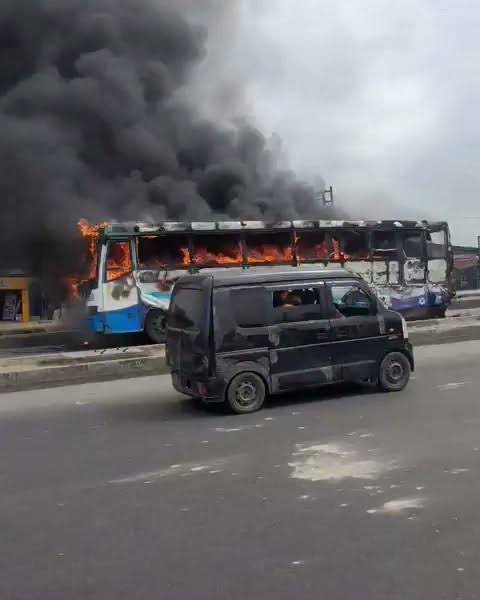
An angry mob has set a Bus Rapid Transit (BRT) bus on fire after it reportedly crushed a commercial motorcyclist to death at Ogolonto Bus Stop along Ikorodu Road in Lagos State.
The incident occurred on Friday, October 16, 2026. Eyewitness accounts and social media reports indicate that the motorcyclist was riding alone along the restricted BRT lane when the collision happened. He died at the scene.
Enraged residents and youths then attacked the bus driver and set the vehicle ablaze. Police officers and officials of the Lagos Neighbourhood Safety Corps (LNSC), who were nearby, intervened promptly and rescued the driver unharmed.
The identity of the deceased motorcyclist and the exact circumstances of the crash had not been officially confirmed at the time of filing this report. It was also unclear whether any arrests had been made in connection with the burning of the bus.
News
ARISE News Wins Seven Honours At Nigerian Broadcasters Merit Awards
The awards recognised the network’s achievements in television journalism and programming, with ARISE News winning the Best TV Channel (Viewer’s Choice) category.


• ARISE News Anchor and host of What’s Trending Ojy Okpe was named Best Newscaster (TV – Female)
ARISE News has emerged as one of the major winners at the just ended Nigerian Broadcasters Merit Awards (NBMA).
ARISE News won seven honours across television broadcasting, news reporting, presentation and production during the ceremony.
The awards recognised the network’s achievements in television journalism and programming, with ARISE News winning the Best TV Channel (Viewer’s Choice) category.
The network’s flagship breakfast programme, The Morning Show, also won the Best TV Talk Show award, further strengthening its recognition in television broadcasting.
ARISE News Anchor and host of What’s Trending Ojy Okpe was named Best Newscaster (TV – Female).
Rufai Oseni was named Nigerian Broadcaster of the Year (Male), while Vimbai Mutinhiri-Ekpeyong received the Nigerian Broadcaster of the Year (Female) award.
The recognition extended to the network’s newsroom, with Ovieteme George winning Best TV News Reporter (Male) for his contributions to television news reporting.
Behind the camera, Sam Adeyemi received the Best Camera Operator/Cinematographer award, recognising his work in television production and visual storytelling.


BREAKING: Nigeria Confirms First Ebola Case

Mbappé wins Onze d’Or award for 2025/26 season

Ronaldo Gets 30-Day Suspension For Portugal Camp Walkout

BREAKING: Lagos Govt Declares Today, Thursday Work-Free to Mark 2026 Ìṣẹ̀ṣe Day

Tech Expert, Zuckerberg trains with UFC champions, Adesanya, Alexander