
Business
BREAKING : FCCPC Wins $220million Case Against Meta (Facebook & WhatsApp)
While expressing delight at the landmark judgement, FCCPC Executive Vice Chairman/CEO, Mr. Tunji Bello, thanked the Commission’s legal team for their exceptional diligence and forensic skills in assembling evidence and marshalling their argument.


Friday, April 25, 2025:
The Competition and Consumer Protection Tribunal today delivered its judgment in the appeal filed by Meta Platforms Incorporated (Facebook) and WhatsApp LLC against the Federal Competition and Consumer Protection Commission (FCCPC), affirming the Commission’s authority and actions in nearly all the contested issues.
The Tribunal specifically determined that the Commission complied with prevailing laws, discharged its mandate, and exercised its powers within the confines of the 1999 Constitution (as amended).
It ruled that the multiple actions by WhatsApp and Meta, for which the Commission made findings of violations, were correctly identified, and that the Commission did not err in making those findings.
In addition to upholding the major aspects of the FCCPC’s Final Order, the Tribunal awarded the sum of $220 million against Meta Platforms Incorporated and WhatsApp LLC as an administrative penalty, and further awarded $35,000 to the FCCPC as cost of investigation.
The tribunal’s three-member panel was led by Honorable Thomas Okosun.
WhatsApp and Meta’s legal team was led by Professor Gbolahan Elias (SAN) while the FCCPC’s legal team was led by Mr. Babatunde Irukera.
Both teams had made their final arguments on behalf of their respective clients on January 28, 2025.
The FCCPC had on July on July 19, 2024, issued a Final Order imposing a $220 million administrative penalty after concluding that the companies engaged in discriminatory and exploitative practices against Nigerian consumers.
The investigation started in 2020.
The case arose from a 38-month joint investigation initiated by the FCCPC and the Nigeria Data Protection Commission (NDPC) into the conduct, privacy practices, and consumer data policies of Meta Platforms and WhatsApp.
Dissatisfied with the Order last year, Meta and WhatsApp appealed to the Tribunal, challenging both the legal basis and the findings of the Commission.While ruling on Meta’s appeal, the Tribunal also validated the Commission’s investigative procedures and processes.
The Tribunal resolved Issues 1 to 7 largely in favour of the FCCPC, dismissing the appellants’ objections to the Commission’s findings, orders, and legal competence.
The FCCPC had on July on July 19, 2024, issued a Final Order imposing a $220 million administrative penalty after concluding that the companies engaged in discriminatory and exploitative practices against Nigerian consumers.
One of the central issues (Issue 3) which alleged a breach of fair hearing, was decided in favour of the Commission, with the Tribunal affirming that the FCCPC fully discharged its quasi-judicial responsibilities by affording the appellants ample opportunity to respond.
The Tribunal found no violation of constitutional due process.On Issue 4, which questioned the Commission’s powers in matters of data protection and privacy, the Tribunal held that the FCCPC acted within its statutory mandate, reaffirming its authority under Section 104 of the FCCPA to regulate competition and consumer protection even in regulated industries.On Issue 5, which challenged the Commission’s findings regarding Meta’s privacy policies, the tribunal also resolved in the FCCPC’s favour.
The Tribunal found no error in the Commission’s conclusions and held that the privacy policy in question did, in fact, offend Nigerian law.While Issue 7 was largely resolved in favour of the Commission, the Tribunal set aside Order 7 of the Commission’s Final Order, stating that it lacked sufficient legal basis.
While expressing delight at the landmark judgement, FCCPC Executive Vice Chairman/CEO, Mr. Tunji Bello, thanked the Commission’s legal team for their exceptional diligence and forensic skills in assembling evidence and marshalling their argument.
He restated FCCPC’s unwavering commitment to not only championing the rights of Nigerian consumers but also ensuring fair business practices in the country in accordance with FCCPA (2018) and consistent with the Renewed Hope Agenda of President Bola Ahmed Tinubu.



Business
Dangote Refinery’s IPO Ends Tomorrow
“The level of investor interest reflects growing confidence in our business and in the strong financial results we have delivered,” the company said.

[File photo] Opening ceremony of Dangote Refinery’s IPO on the NGX, September 14,2026
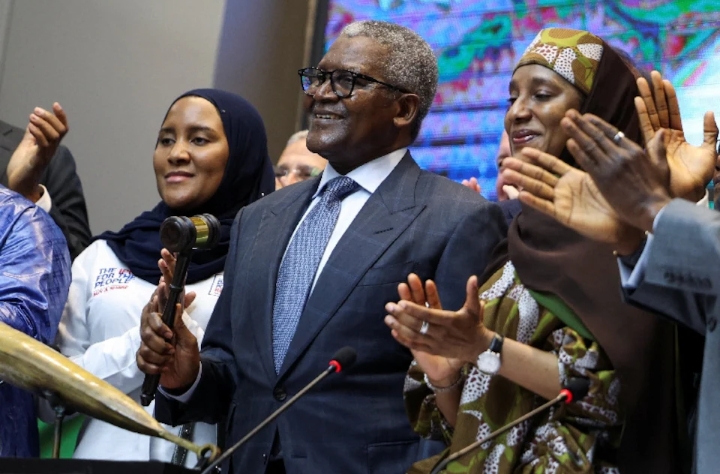
Dangote Petroleum Refinery & Petrochemicals has confirmed that its Initial Public Offering (IPO) will close on Tuesday, 27 October 2026 as scheduled, with no extension.
In a statement, the management said that the IPO has become a historic ownership moment, an opportunity for Africans at home and abroad to own a stake in one of the continent’s most strategic industrial assets.
“Investors recognise that this refinery is not merely an energy asset. It is a platform for industrial growth, foreign-exchange generation, regional trade, energy security and economic development across Africa,” management said.
The offer was structured to ensure ordinary investors participate alongside institutions, broadening ownership of the world-class asset.
“The level of investor interest reflects growing confidence in our business and in the strong financial results we have delivered,” the company said.
Business
Dangote Visit London Stock Exchange Ahead of November Cement Listing
Unlike an initial public offering, a secondary listing would let Dangote Cement, already listed on the Nigerian Exchange, set up an additional presence in London.

Aliko Dangote visited the London Stock Exchange on Friday, October 23, 2026, as Dangote Cement Plc prepares a proposed $1 billion share sale and a secondary listing in the United Kingdom.
The company is reportedly targeting November 2026 for the listing, subject to market conditions and regulatory approval.
A video circulating on social media captured the visit, with exchange officials and attendees welcoming Africa’s richest man.
The trip is part of efforts to pull international investment into his business empire.
The proposed deal could see Dangote Cement offer about 10% of its equity to international investors, potentially raising roughly $1 billion.
The final timetable is not fixed and remains subject to market conditions and regulatory requirements.
Unlike an initial public offering, a secondary listing would let Dangote Cement, already listed on the Nigerian Exchange, set up an additional presence in London.
That could raise the company’s visibility with international institutional investors, including pension funds, asset managers and other investment firms.
The share sale has not been completed. Its final structure, valuation and pricing are still subject to confirmation.
Business
Olagunju to head JPMorgan’s Proposed Nigerian Merchant Bank
The proposed bank would expand JPMorgan’s presence beyond its representative office in Lagos. It could undertake a broader range of regulated banking activities after securing a final licence.

The Central Bank of Nigeria has granted JPMorgan approval-in-principle to establish a merchant bank in Nigeria.
The regulator also approved Adedapo Adedayo Olagunju as Managing Director of the proposed JPMorgan Merchant Bank Nigeria Limited.
The approval came on Friday, October 23, 2026. The bank has not received its final operating licence.
Olagunju has led JPMorgan’s West African operations since 2018.
He is an Oxford-trained banker with more than two decades of experience in treasury management, financial markets, institutional banking and structured finance.
His appointment puts him in line to head the American bank’s proposed Nigerian merchant bank once final licensing is completed.
The CBN also approved four non-executive directors and three independent non-executive directors for the proposed institution.
The proposed bank would expand JPMorgan’s presence beyond its representative office in Lagos. It could undertake a broader range of regulated banking activities after securing a final licence.


Nigeria’s First Imported Ebola Patient Moved to Switzerland

Dangote Refinery’s IPO Ends Tomorrow

Ebola: Nigeria Sends Back Swiss Woman Via Medivac Plane

BREAKING: Lagos Govt Declares Today, Thursday Work-Free to Mark 2026 Ìṣẹ̀ṣe Day

Tech Expert, Zuckerberg trains with UFC champions, Adesanya, Alexander

Organ Trafficking: Ekweremadu bags 10 years in UK prison
-

 Politics3 days ago
2027 presidential election: Tinubu’s Northern test begins today
-

 News20 hours ago
BREAKING: Former Arise News Anchor, Constance Ikokwu Appointed NDC National Campaign Council Spokesperson
-

 Health3 days ago
Ebola patient in Abuja showing signs of recovery – FG
-

 Health1 day ago
EBOLA: Lagos Heightens Watch at Airports After Abuja Case
-

 Business20 hours ago
Naira To Dollar, Pound, Euro…Rate Monday, October 26
-
 Business19 hours ago
Dangote Visit London Stock Exchange Ahead of November Cement Listing
-

 Entertainment3 days ago
JUST IN: Another Nollywood Actor, Dies After Brief Illness
-

 International3 days ago
JUST IN: Four Pilots Die After Mid-Air Collision of Military Planes in Philippine