
News
ADC Responds to Trump Over Designation of Nigeria as a Country of Particular Concern


In response to the action taken by U.S. President Donald Trump on October 31, 2025, designating Nigeria as a country of particular concern, the ADC has released its statement.
According to the statement signed by Bolaji Abdullahi, the National Publicity Secretary African Democratic Congress (ADC), the party stated as follows:
1. We are guided by the painful reality that what is really at stake on this issue are the thousands of human lives that have been lost to insecurity in Nigeria, irrespective of their tribe, religion or region.
We therefore seize this moment to pay tribute to the memory of all the victims and express our deepest sympathies to their families.
2. The statement by President Trump reminds us of the greater global concern about the sanctity of human life and the cardinal responsibility of national governments to protect the lives of people who live within their borders.
It reminds us that in the modern world, concern for human rights, for which right to life is the most fundamental, transcends national boundaries and that the dignity and respect of nations are no longer measured by their economic strength alone, but also by their willingness and capacity to protect their own citizens.
3. It is sad to note that it is in this most sacred mandate of government that this administration of President Bola Ahmed Tinubu has failed most. Available reports indicate that nearly 15,000 lives have been lost to sundry violent activities since this administration assumed office in 2023.
These deaths have occurred across regions and religions, underlining a national crisis that cuts across all divides and still endangers us all, regardless of tribe, region or religion.
Entire communities have been sacked, worshippers have been slaughtered in religious spaces, and bandits now control large territories in our country, waging war at will and levying taxes on citizens with impunity.
Boko Haram, once declared as “technically degraded,” is once again growing in strength, while another international terror group make open claims of carrying out successful attacks on Nigerian soil.
4. Under this administration, terror and violence have expanded their reach, from the extreme east and west of the north to its central part.
On October 31, 2025, the very day that President Trump announces his concern about Nigeria, another terror group, JNIM, an Al-Qaeda affiliate which had been active in the Sahel region, announced a successful attack in Kwara State, which serves as a gateway to the southern part of the country.
The crisis that we face is therefore not about any ethnic or religious group being targeted for killing; it is an existential crisis that imperils all Nigerians.
Quite significantly, it is also not about which region or religion has lost more lives; it is about every individual’s right to life. Life and death are absolutes and they must never be reduced to statistics.
The ADC believes that one life lost that could have been saved, is one death too many. 5. The problem of insecurity in Nigeria did not start with President Tinubu.
The problem is that President Tinubu has refused to acknowledge that the crisis has got worse under his watch and has refused to accept responsibility.
Instead, Nigerians have been met with excuses, cruel silence or utter indifference, and political posturing that mocks the tragedy of victims and their families.
7. The ADC will also like to draw attention to the structural and diplomatic failures that continue to deepen Nigeria’s vulnerability on the international stage.
We would like to ask, why has the Nigerian government failed to appoint ambassadors to key countries, more than two years into its term?
How can a government that has been boasting of unprecedented revenue success continue to give lack of fund as excuse for not appointing ambassadors?
Why has our foreign policy become so deeply personalised, focused on the image of the president and his interests, rather than the image of Nigeria and the interests of the Nigerian people?
Why are there still no unified national security strategy, no regional coordination, and no meaningful engagement with the communities most affected?
8. Under President Tinubu, Nigeria has declined both as a continental and a regional leader. Nothing underlines this decline more than the fracturing of the ECOWAS under his watch.
A region that once looked up to us for direction and leadership on issues of democratization and security now doesn’t think we matter anymore as smaller countries watch us fumble aimlessly with our own domestic crisis. These failures are not isolated.
They are all connected, pointing to a government that is so incompetent, so narrow-minded, and yet so blindly arrogant.
9. If this government had been less obsessed with politics, propaganda and self-celebration, it would have taken every single violent attack seriously.
It would have documented every single one of them, and in every single case, it would have demonstrated to Nigerians and to the world what it was doing to bring perpetrators to justice, it would have acknowledged its weaknesses, it would have asked for help; it would rallied Nigerians for the great challenge and it would have showed the world that it truly cared about every Nigerian life.
And perhaps, this situation would have been averted.
10. In conclusion, the African Democratic Congress would like to recommend the following:
i. A full overhaul of the national security apparatus, including an independent audit of operations, leadership, and strategy.
ii. Immediate appointment of qualified ambassadors, to restore Nigeria’s diplomatic presence and strategic influence.
iii. A reset of foreign policy, grounded in national interest, not personal promotion, with renewed engagement across ECOWAS, the AU, and the UN.
iv. Urgent economic reforms, focused on price stability, a credible plan to ease inflation, and verifiable social welfare system to ease the suffering of the poor across the country.
v. An end to the personalization of public institutions, and a return to accountable, citizen-focused governance.
11. We appreciate the American president and other world leaders for their concern about the security situation in our country.
We will however urge that such concerns should be translated into supporting Nigeria to grow her democracy and develop its capacity to solve its own problems.
We believe that mobilizing armed troops or even a mere threat of doing so would do more harm than good and ultimately prove counter-productive to our democratic aspiration and the long-term unity and stability of our country.
Nigeria is not beyond saving, but time is running out. We must act now, with courage, clarity, and a commitment to protect the lives and dignity of every Nigerian. Certainly, Nigeria can not continue like this.






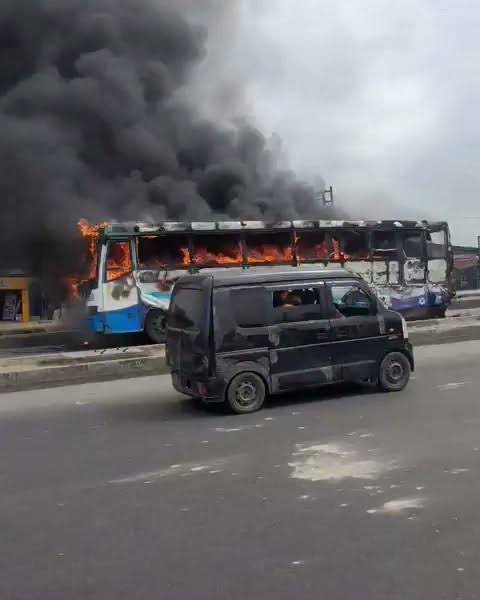
An angry mob has set a Bus Rapid Transit (BRT) bus on fire after it reportedly crushed a commercial motorcyclist to death at Ogolonto Bus Stop along Ikorodu Road in Lagos State.
The incident occurred on Friday, October 16, 2026. Eyewitness accounts and social media reports indicate that the motorcyclist was riding alone along the restricted BRT lane when the collision happened. He died at the scene.
Enraged residents and youths then attacked the bus driver and set the vehicle ablaze. Police officers and officials of the Lagos Neighbourhood Safety Corps (LNSC), who were nearby, intervened promptly and rescued the driver unharmed.
The identity of the deceased motorcyclist and the exact circumstances of the crash had not been officially confirmed at the time of filing this report. It was also unclear whether any arrests had been made in connection with the burning of the bus.
News
ARISE News Wins Seven Honours At Nigerian Broadcasters Merit Awards
The awards recognised the network’s achievements in television journalism and programming, with ARISE News winning the Best TV Channel (Viewer’s Choice) category.


• ARISE News Anchor and host of What’s Trending Ojy Okpe was named Best Newscaster (TV – Female)
ARISE News has emerged as one of the major winners at the just ended Nigerian Broadcasters Merit Awards (NBMA).
ARISE News won seven honours across television broadcasting, news reporting, presentation and production during the ceremony.
The awards recognised the network’s achievements in television journalism and programming, with ARISE News winning the Best TV Channel (Viewer’s Choice) category.
The network’s flagship breakfast programme, The Morning Show, also won the Best TV Talk Show award, further strengthening its recognition in television broadcasting.
ARISE News Anchor and host of What’s Trending Ojy Okpe was named Best Newscaster (TV – Female).
Rufai Oseni was named Nigerian Broadcaster of the Year (Male), while Vimbai Mutinhiri-Ekpeyong received the Nigerian Broadcaster of the Year (Female) award.
The recognition extended to the network’s newsroom, with Ovieteme George winning Best TV News Reporter (Male) for his contributions to television news reporting.
Behind the camera, Sam Adeyemi received the Best Camera Operator/Cinematographer award, recognising his work in television production and visual storytelling.
News
Meta removes 3.7 million accounts in West Africa scam crackdown
The joint operation led to 28 arrests, identified more than 30 suspected scam centres and rescued 117 people allegedly trafficked and forced to work in scam compounds in Ghana.
Meta, the parent company of Facebook and Instagram, has removed more than 3.7 million Facebook and Instagram accounts, pages and groups linked to suspected scam networks operating in West Africa.
The joint operation led to 28 arrests, identified more than 30 suspected scam centres and rescued 117 people allegedly trafficked and forced to work in scam compounds in Ghana.
The company announced the crackdown in a statement on Tuesday, October 13, 2026. It involved 14 technology companies and law enforcement agencies from 10 countries.
The United Kingdom’s National Crime Agency coordinated the operation with the US Department of Justice, the Federal Bureau of Investigation and other agencies. Nigerian authorities were involved.
Other countries included Ghana, Australia, Canada, New Zealand and India.Tech companies that took part included Google, Microsoft, OpenAI, Coinbase, Starlink and Adobe.
Meta said the partnership let participants share intelligence across digital platforms, countries and financial systems to identify criminal networks.


JUST IN: Mob Sets BRT Bus Ablaze After Motorcyclist’s Death in Lagos

BREAKING: DSS Arrests Fugitive Maina Son, Hands Him to EFCC

BREAKING: 5 Arrested Over Imo NYSC Abduction

BREAKING: Lagos Govt Declares Today, Thursday Work-Free to Mark 2026 Ìṣẹ̀ṣe Day

Tech Expert, Zuckerberg trains with UFC champions, Adesanya, Alexander

Organ Trafficking: Ekweremadu bags 10 years in UK prison
-
 Business2 days ago
Naira Exchange Rates For Thursday, October 15
-
 Sports2 days ago
CAF Increases Annual Funding for Member Federations to $700,000
-
 News2 days ago
ASCON To Be Rebranded “National School Of Government”
-

 Business2 days ago
Germany plans tax on sugary drinks
-
 Politics3 days ago
Exclusion of candidates from INEC list: CD cautions INEC against manipulation by politicians
-
 Business2 days ago
WEF could appoint Lagarde as its next chair, sources say
-
 International2 days ago
“Mother of all bombs,” Trump Plans To Hit Iran
-

 News3 days ago
Sanwo-Olu Appoints Olatunbosun Ogunbanwo, 5 Others as Perm Secs