
Health
Brain drain: FG moves to attract Nigerian health workers abroad

The Federal Government said it is making efforts to ensure that healthcare workers who have left the country to seek greener pastures return to contribute to the development of the health sector.
The Special Adviser to the President on Health, Dr. Salma Anas-Ibrahim made this known on Tuesday at the joint World Health Organisation stakeholders’ feedback workshop on the evaluation of the third WHO-Nigeria country cooperation strategy (2018-2022), and development of the fourth WHO-Nigeria cooperation strategy (2023-2027).
Dr. Anas-Ibrahim said the attainment of health for all programmes through an efficient and effective Universal Health Coverage system using the continuum of care model where no one is left behind as contained in the Sustainable Development Goals, is the main aim of the present administration led by President Bola Tinubu.
According to her, President Tinubu’s health sector agenda, tagged “Healthcare: A matter of right and urgency” of the APC’s ‘Renewed Hope’ mantra has an action plan for a better Nigeria.
She said the healthcare reforms policy agenda would align with the existing national health plan to improve the health fortunes of Nigerians through investment in governance and leadership, health financing, human resources, equitable, safe, quality service delivery, primary healthcare, secondary and tertiary care facilities, preventive care services, public health emergency preparedness and response, and increased partnership with non-governmental organisations.
“This government shall address the lingering nation’s health healthcare challenges including inadequate health infrastructure, fragmentation, an overburdened workforce, poor insurance coverage, high maternal mortality, inadequate preventative care, and dependence on imported medicines, commodities, equipment, and vaccines.
“There will be a governance and leadership structure for the health sector which makes it more responsive and accountable with proper coordination and alignment mechanisms across the levels of care that has both political and institutional commitment. There will be health financing through increased budgetary allocations to high-impact health interventions and national health insurance cover for at least 40 per cent of the population in the first two years of the administration that would be augmented with the Basic Healthcare Provision Fund and Vulnerable Group Fund,” she said.









Health
Millions of bedbugs crawl out of mattresses and walls in huge outbreak
Bedbugs can enter homes on clothes, luggage, or second hand furniture – and “hide” in mattresses or walls, according to the NHS.


Millions of bedbugs were crawling out of mattresses in what a pest controller said was the worst outbreak he had seen in 38 years.
They were even in the walls and under the wallpaper, with the mattresses and bed frames needing to be incinerated.
Cardiff pest controller Gareth Davies had to wear full protection as his team tackled the problem in the Canton area of the city, using a specialist vacuum cleaner to collect millions of the bugs.
It came after they had tackled a large cockroach outbreak last month in a scene he likened to a horror movie.
“This house was just horrific,” he told BBC Radio Wales Breakfast.
“Hundreds of thousands of them when you lifted the mattresses up.
“They were coming out of the wallpaper, it was horrendous.”
Bedbugs can enter homes on clothes, luggage, or second hand furniture – and “hide” in mattresses or walls, according to the NHS.
Credit: BBC
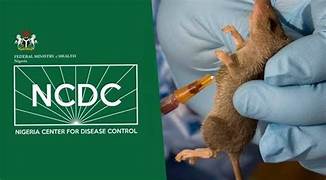
The Nigeria Centre for Disease Control and Prevention (NCDC) has confirmed that Lassa fever has claimed 259 lives and infected 1,086 people across 24 states and 118 local government areas so far in 2026.
In its latest Lassa Fever Situation Report for epidemiological week 36 (August 31 to September 6), the agency said the figures represent a case fatality rate of 23.9 percent — significantly higher than the 18.6 percent recorded during the same period in 2025.
Twelve new confirmed cases were recorded in week 36, a decline from the 18 cases reported the previous week. The fresh infections were detected in Ondo, Edo and Kogi states.
Five states continue to bear the heaviest burden, accounting for 87 percent of all confirmed cases this year: Bauchi, Ondo, Taraba, Benue and Edo. People aged 21 to 30 remain the most affected age group.
The NCDC noted that no new infections among healthcare workers were recorded during the latest reporting week. The agency continues to urge the public to maintain hygiene, avoid contact with rodents and their droppings, and seek early medical care if symptoms appear.
Health
Nigerian hospital successfully performs kidney cancer surgery via tele-robotic
The development could reduce the need for Nigerians to travel abroad for specialised medical treatment, thereby reducing expenditure on international travel, accommodation and medical services.
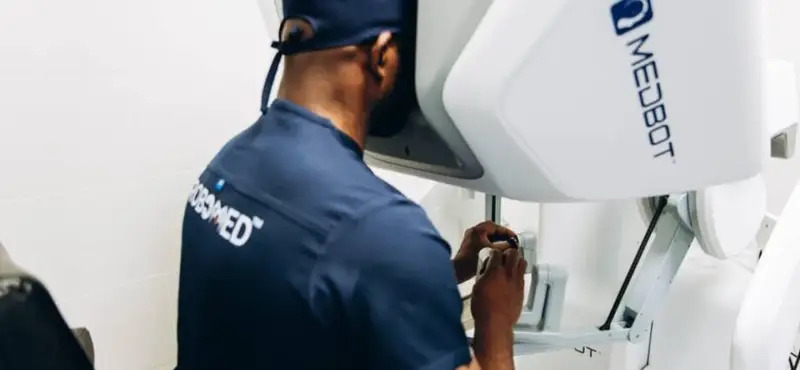
• A surgeon performing tele-robotic surgery.
Nisa Premier Hospital, Abuja, has partnered with RoboMed Global and The Redeemer’s Health Village (RHV) to successfully perform what the hospital described as the first tele-robotic surgery in Nigeria and West Africa.
The landmark kidney cancer surgery was performed on a patient at Nisa Premier Hospital, Abuja, while the surgeon, Professor Obi Ekwenna-Davis, remotely controlled the robotic surgical platform from Redeemer’s Health Village in Lagos.
The procedure, which lasted approximately three hours, was performed to remove a kidney affected by a cancerous tumour.
The hospital said the patient had been discharged following the successful procedure, although details about the patient’s identity and condition were withheld for privacy reasons.
Speaking during an event to mark the milestone, the Chief Executive Officer of Nisa Premier Hospital, Dr Ibrahim Wada, said the development demonstrated the potential of tele-robotic surgery to connect specialist surgical expertise with patients across Nigeria.
Wada said the procedure was carried out using the MicroPort robotic surgical platform installed at Nisa Premier Hospital, with the remote surgeon controlling the system from Lagos.
He said the development could reduce the need for Nigerians to travel abroad for specialised medical treatment, thereby reducing expenditure on international travel, accommodation and medical services.
According to him, the technology also creates an opportunity for Nigerians to access specialised expertise from doctors located in other parts of the world without requiring the doctors to travel physically to Nigeria.
Source: Daily Trust


FAO Names 22 African Women Agrifood Heroes, Nigeria Missing

NAF Crash: Residents Fear Disease as Body Parts Foul Community River

UNCTAD Warns Debt Burden Threatens Future of 3.7bn People

Tech Expert, Zuckerberg trains with UFC champions, Adesanya, Alexander

Organ Trafficking: Ekweremadu bags 10 years in UK prison

BREAKING: Lagos Govt Declares Today, Thursday Work-Free to Mark 2026 Ìṣẹ̀ṣe Day
-

 Business1 day ago
Nigeria’s ₦33bn Fruit Import Bill Exposes Missed Opportunities in Jos
-

 Business2 days ago
Naira To Dollar, Pound ,Euro …Rates For Monday, October 12
-

 International2 days ago
‘Up to our people’ to pick leader, Zelenskyy responds to Trump’s pledge for new elections in Ukraine
-

 Politics1 day ago
2027: 119 Women Jostle For State’s Governors
-

 Opinions2 days ago
Human Capital Africa Statement For International Day of the Girl Child 2026
-

 News2 days ago
Forbes Scores GTBank Best Employers 2026
-

 Business12 hours ago
Dangote Refinery IPO Attracts N8.61trn in Subscriptions, Four Times Offer
-

 Politics1 day ago
BEWARE: Fake 2027 Gov’ Candidates List Circulating Online — INEC Raises Alarm