
Business
Why Tax Reforms Benefits Will Be More Than The Shocks – Kupoluyi, LCCI President
…The harmonisation of taxes will be a relief to companies that have been paying over 16 taxes.


The newly elected President of Lagos Chamber of Commerce and Industry (LCCI), Mr Leye Kupoluyi, spoke with ThisdDay Newspaper about the chamber’s advocacy focus during his tenure for the next two years. Excerpt:
What will be the direction of LCCI’s advocacy under your leadership?
Thank you so much for this question. As you know advocacy is one of our major mandates as a chamber because of the different interests that we are representing.
Under my leadership we will carry on advocacy as usual as evidence based engagement on how to strengthen Nigeria’s productive capacity and enhancing business generally.
Our advocacy will be for competitiveness of Nigerian businesses beyond the borders of Nigeria.
The chamber will focus on advocacy that will enable Nigerian companies to be very well competitive within Nigeria and in Africa because it is now a borderless economy.
Do Nigerian companies have the muscle to push their competitiveness beyond the country?
If we do not have the muscle then we have to develop it. But truly we have the muscle to push it. Nigeria is the hope of Africa.
Arguably Nigeria is the largest economy in Africa. I do not want to go into the statistics of people saying which country has the largest economy because there is no country in Africa that is bigger than Nigeria.
Therefore, if we cannot take the lead in Africa then there is no one to do it. There is no doubt that Nigeria is the arrow head of Africa.
What’s your reaction to the shrinking West African market for Nigerian products due to the exit of Burkina Faso, Mali and Niger Republic from ECOWAS?
There are challenges in terms of organised legal exports to these countries even though most of the manufactured goods they require still come from Nigeria.
But definitely there are challenges in terms of doing business the way we know it at this chamber, which is formal, legal and legitimate trade and not through smuggling.
Informally, Nigerian goods are reaching these countries but there are challenges when it comes to formal trade. And we know that ECOWAS leaders are doing everything possible to bring these countries back into the fold.
What do you think will be the immediate impact of the implementation of the new tax laws from January 1, 2026?
Thank you very much. For every reform like Nigeria’s tax reform there must be some shocks and benefits.
But with the tax reforms we know that the benefits will be more than the shocks. It is a very good relief that the low income earners have been removed from the tax net.
The multiple taxations that have been an epidemic in Nigeria’s business environment for many years will be taken care of.
The tax reform must not be a burden to the people. It will unlock lots of revenues for the government because the tax net has been widened and strengthened. Also the harmonisation of taxes will be a relief to companies that have been paying over 16 taxes.
The reform will make the environment predictable because we will know where we are going. Its implementation will be transparent as we move along and be beneficial to both the government and the tax payers.
But we should wait to see how it goes in January. In our own case we keep enlightening our members and sending the feedback to the government.
Under my leadership we will carry on advocacy as usual as evidence based engagement on how to strengthen Nigeria’s productive capacity and enhancing business generally.
What’s your take on public apprehensions regarding the implementation of the tax reform?
Those of us in the orgnised private sector are looking at it as a relief because those multiple taxation will go, low income earners exempted, the tax net expanded and that the tax system made more transparent and harmonised. If these are achieved it will bring big relief to the organised private sector.
What does 2026 hold for Nigerian the economy?
The past two years tried our resilience but from all indications 2026 will be a year of growth.
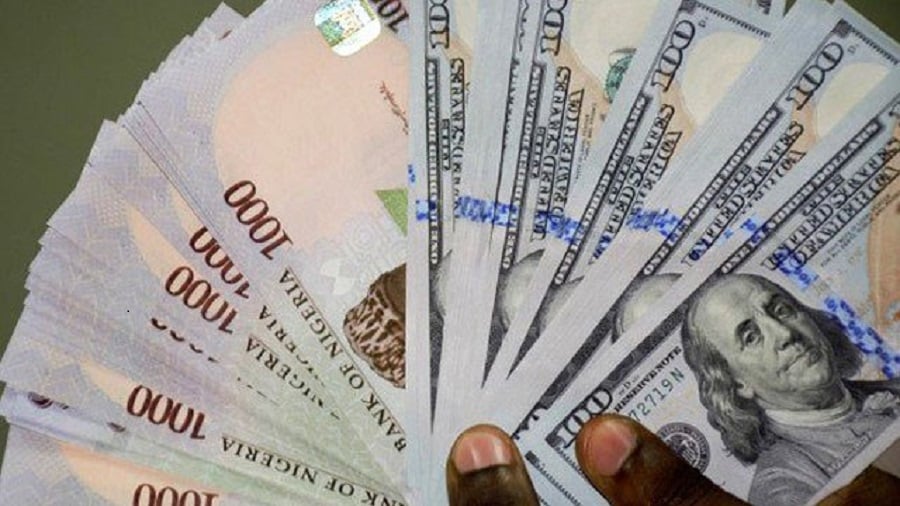
BLACK MARKET RATES
US DOLLAR (USD) Buy ₦1,416 Sell ₦1,423
GREAT BRITISH POUND (GBP) Buy ₦1,890 Sell: ₦1,910
EURO (EUR) Buy ₦1,590 Sell ₦1,610
CANADIAN DOLLAR (CAD) Buy ₦1,020 Sell ₦1,080
SOUTH AFRICAN RAND (ZAR) Buy ₦75 Sell ₦90
UAE DIRHAM Buy ₦350 Sell ₦370 CHINESE YUAN Buy ₦190 Sell ₦205
GHANA CEDI (GHS) Buy ₦95 Sell ₦110
WEST AFRICAN CFA Buy ₦2, 300 Sell ₦2, 400
CENTRAL AFRICAN CFA Buy ₦2,150 Sell 2,250
AUSTRALIAN DOLLAR Buy ₦800 Sell ₦900
CBN Exchange Rates
US DOLLAR (USD) ₦1,357. 65
GREAT BRITISH POUND (GBP) ₦1,834.04
EURO (EUR) ₦1,567.00
SWISS FRANC (CHF) ₦1,671. 98
JAPANESE YEN (JPN) ₦8.53
CHINESE YUAN (CNY) ₦201. 34
WEST AFRICAN CFA (XOF) ₦2. 39
WEST AFRICAN UNIT ACCOUNT (WAUA) ₦1,858.02
SAUDI RIYAL (SAR) ₦361.62
SOUTH AFRICAN RAND (ZAR) ₦84.23
Business
Traders shut down Enugu ‘s Obollo-Afor market over N25,000 haulage levy
However, Chairman of ESIRS, Emmanuel Nnamani, in a letter to the traders, said the haulage levy was not paid by traders buying or selling goods in the markets, but was applicable strictly to truck drivers plying interstate routes.
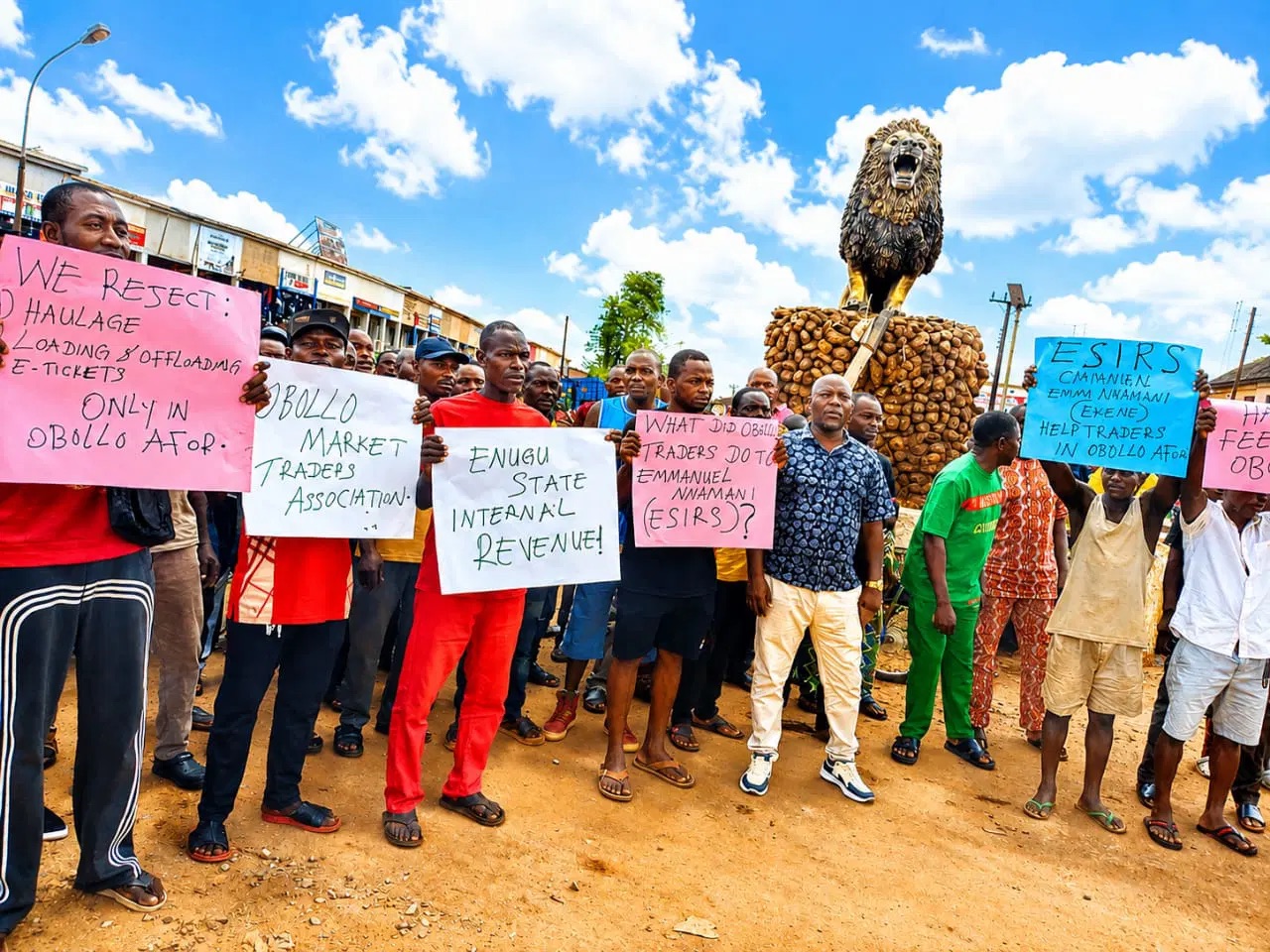
All shops and markets at Obollo-Afor, Udenu Local Government Area of Enugu State were shut yesterday, as traders staged a peaceful protest against alleged selective collection of a N25,000 haulage levy in the market.
The traders, who locked their shops and took to the streets in large numbers, carried placards with various inscriptions, alleging that the Enugu State Internal Revenue Service (ESIRS) had singled out Obollo-Afor Market for the collection of N25,000 haulage fee on every truckload of goods loaded or offloaded in the market.
However, Chairman of ESIRS, Emmanuel Nnamani, in a letter to the traders, said the haulage levy was not paid by traders buying or selling goods in the markets, but was applicable strictly to truck drivers plying interstate routes.
Addressing officials of the Udenu Local Government Council at the council secretariat, where the protesters marched to present their grievances, Chairman, Obollo-Afor Market Traders Association, Charles Eze, lamented that truck operators bringing foodstuffs, building materials, and other commodities to the market had stopped coming because of the levy.
Business
Nigeria’s oil production dropped by 4% in July – NUPRC
“In the month under review, the daily peak production of crude oil and condensate was 1.78mbpd, while the lowest daily production was 1.57mbpd.”

The Nigerian Upstream Regulatory Commission (NUPRC) data has shown Nigeria’s average daily oil production fell by four percent in July, 2026.
According to the NUPRC, Nigeria produced 1.505 million barrels per day (bpd) of crude oil and 0.17 million bpd of condensate, bringing the combined daily production to 1.67 million bpd.
The commission said the country met and exceeded its Organisation of the Petroleum Exporting Countries (OPEC) quota of 1.5 million bpd for the third consecutive month.
“In the month under review, the daily peak production of crude oil and condensate was 1.78mbpd, while the lowest daily production was 1.57mbpd.”


Zambia’s Hichilema leads presidential vote count

Tinubu Hails Adeleke’s Re-Election as Proof Democracy Is Thriving

BREAKING: INEC declares Adeleke winner of Osun gov poll

Tech Expert, Zuckerberg trains with UFC champions, Adesanya, Alexander

Organ Trafficking: Ekweremadu bags 10 years in UK prison

SAINT OBI: Between his marriage and his death
-

 Politics3 days ago
Osun Election: President Tinubu mobilises Voters “Go Out to Vote Candidate of Your Choice on Saturday Without Fear
-
 Politics3 days ago
The Top Three Gladiators Locking Horns For Osun Governorship
-
 Politics3 days ago
Accord says Imumolen has no electoral value
-
 Business3 days ago
Naira Exchange Rates Friday, August 14
-
 Politics3 days ago
Osun governorship election will be transparent, says INEC
-

 News3 days ago
NMMA shortlist 972 entries for 2026 awards
-

 Sports3 days ago
Committees hit the ground running for 8th Kwara State Sports Festival
-

 Health2 days ago
Gov Mbah Invest in world-class Enugu International Hospital