
Health
BREAKING: Lassa fever: UK visitor tests positive as death toll hits 98 in 2 months

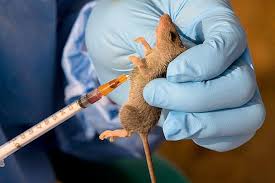
The Nigeria Centre for Disease Control and Prevention (NCDC) has confirmed a Lassa fever case with a travel history to the United Kingdom.
The Director General of the NCDC, Dr Jide Idris, in a public advisory on Monday, said the agency was notified on 5th of March of a confirmed case of Lassa fever by the Ondo State Ministry of Health, in a 31-year-old physician managed at a private health facility in Ondo State after returning from a trip abroad (UK).
Lassa fever is an acute viral haemorrhagic fever (VHF) caused by the Lassa virus. The natural reservoir for the virus is the multimammate rat (also known as the African rat). Other rodents can also act as carriers of the virus.
Dr Idris said the patient departed Nigeria on February 19 and returned February 27, adding that samples were taken late on Friday, February 28 on a suspicion of Lassa fever, but the patient unfortunately passed away in the early hours of Saturday, March 1.
He said the laboratory investigation returned a result that was Lassa Fever positive on PCR on Tuesday March 4, adding that “The patient was said to have visited his fiancée in Edo State, as well as family and friends before travelling. “
The NCDC DG said to enhance state and international level coordination of all control and management efforts, some steps had been taken.
“Ondo State Ministry of Health has bolstered control and management efforts through contact tracing and line listing of contacts of the confirmed case.
“All necessary in-country structures have been mobilized to ensure all possible contacts are traced and monitored. Communicated to the Port Health Services to support contact tracing and line listing of contacts and bolster surveillance efforts at the point of entries and exits (information include patient’s biodata, flight details etc. shared).
“Information shared with all relevant authorities in line with the International Health Regulations (2005), and contact tracing efforts also on-going in the UK,” he stated.
The NCDC boss explained that a total of 2728 Lassa fever suspected cases; 535 confirmed cases and 98 deaths have been recorded across 14 states in Nigeria (Case Fatality Rate 18.3%) since the beginning of this year.
He said five states account for 91% of confirmed cases: Ondo: 31%, Bauchi: 24%, Edo: 17%, Taraba: 16% and Ebonyi: 3%.
He said, “Ten (10) LGAs make up 68% of confirmed cases, namely Owo, Akure South, Etsako West, Kirfi, Akoko South West, Bali, Esan North East, Bauchi, Toro and Jalingo. “
He said while NCDC leads the prevention, preparedness, and response to public health emergencies, state governments are also critical in implementing their outbreak response plans tailored to their specific geographical needs.
“And we will continue to support them. However, this responsibility, being a collective one, members of the public also have a role to play,” he said.
He further advised members of the public to
always keep their environment clean, especially their homes, markets, dump sites to reduce breeding grounds for rats
He said, “Block all holes in your house to prevent the entry of rats and other rodents.
“Cover your dustbins and dispose of refuse or waste properly. Communities should set up dump sites far from their homes to reduce the chances of the entry of rodents into their homes.
“Safely store food items such as rice, garri, beans, corn/maize, etc., in tightly sealed or well-covered containers. And avoid open drying of food stuff. Properly process or prepare rats (bushmeat) before consumption. Avoid drying food stuff outside on the ground or roadside, where it is at risk of contamination.
“Discourage bush burning and Deforestation as these can destroy the homes and food sources of rodents, driving them to migrate from the bushes to human residences to find food.
“Eliminate rats in homes and communities by setting rat traps and other appropriate and safe means. Practice good personal and hand hygiene by frequently washing hands with soap under running water or using hand sanitizers when necessary.”
While advising people to avoid overcrowded living areas as overcrowding leads to poor sanitation, he said they should also avoid self-medication to ensure proper diagnosis and early treatment.
“Visit the nearest health facility if you notice any of the signs and symptoms associated with Lassa fever mentioned earlier or call the State Ministry of Health hotline and 6232 (NCDC),” he added.







Health
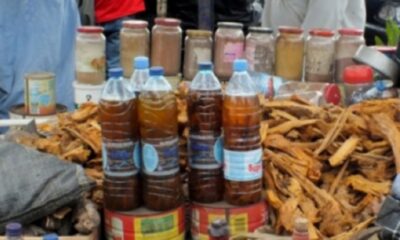
Ondo ‘Monkey Tail’ herbal drink kills 49
The Commissioner for Health in the State, Dr Banji Ajaka, who disclosed this on Wednesday night, said the number of affected persons has now climbed to 170.


A locally produced herbal concoctions known as ‘Monkey Tail’ in Ondo State has killed 49 people .
The Commissioner for Health in the State, Dr Banji Ajaka, who disclosed this on Wednesday night, said the number of affected persons has now climbed to 170.
He explained that the latest deaths were recorded in Irele Local Government Area of the state, where eight persons have died from suspected poisoning.
Ajaka disclosed that health authorities had deployed response teams to Irele LGA and other affected communities to conduct surveillance, manage cases and trace the source of the suspected toxic substance.
Health
Bayelsa deploying 19 doctors, 210 nurses to strengthen primary healthcare centres
The commissioner said the deployment of doctors, nurses and midwives would make primary healthcare centres more attractive to residents and encourage women to seek professional care during childbirth.

| Bayelsa State Commissioner for Health, Prof. Seiyefa Brisibe
The Bayelsa State Government has said it will deploy 19 doctors, 210 nurses and midwives, 185 pharmacy technicians and about 50 laboratory medical technicians to primary healthcare centres across the state to strengthen clinical services at the grassroots.
The State Commissioner for Health, Prof. Seiyefa Brisibe, disclosed this on Friday while speaking on the government’s efforts to improve healthcare delivery at the grassroots during a training organised by the Health Emergency Initiative, under the sponsorship of FIRST E&P, tagged First Respondent First Respondent Training and Medical Intervention Programme.
Brisibe said, “We are deploying 19 doctors, 210 nurses and midwives, 185 pharmacy technicians and about 50 laboratory medical technicians to strengthen the clinical component of our primary healthcare centres.”
He said the deployment was aimed at strengthening the clinical component of primary healthcare centres, which, according to him, were often largely run by community health extension workers and environmental health officers.
The commissioner said the deployment of doctors, nurses and midwives would make primary healthcare centres more attractive to residents and encourage women to seek professional care during childbirth.
Health
Gov Mbah Invest in world-class Enugu International Hospital
The hospital, equipped with state-of-the-art medical equipment and advanced digital and electronic systems, is expected to attract top medical professionals from Nigeria and around the world.

Enugu State Governor, Peter Mbah, says the Enugu International Hospital is designed to provide world-class healthcare services to people across all socioeconomic classes.
The Enugu International Hospital is located at Rangers Avenue, Independence Layout, Enugu.
Mbah stated this during a pre-launch tour of the facility ahead of its official commissioning.
The hospital, equipped with state-of-the-art medical equipment and advanced digital and electronic systems, is expected to attract top medical professionals from Nigeria and around the world.
The governor expressed satisfaction with the quality of the equipment installed at the facility, saying the investment would help position Enugu as a medical tourism hub in Nigeria.
He said the hospital would also help reduce the number of Nigerians travelling abroad for specialist medical treatment while creating an environment that would encourage Enugu-trained medical professionals to return home.
According to Mbah, several Enugu-qualified medical practitioners based abroad have already reached out to express interest in working at the international hospital and contributing to the development of the state’s health sector.
The governor further said the facility would create job opportunities for medical graduates, healthcare professionals and other workers, with the potential to boost economic activity in the state.
During the tour, Mbah inspected several specialist units, including the Precision Oncology and Nuclear Medicine Unit, specialised surgery theatres, intensive care units, advanced diagnostics and imaging, and renal care and dialysis facilities.
He also toured the cancer, heart and vascular, nuclear medicine and molecular imaging, neuroscience, and renal centres.
Accompanied by the Director of the facility, Professor Sam Agwu, and other specialists, the governor received briefings on the various services and specialist care the hospital is expected to provide.
The Enugu International Hospital operates as a comprehensive quaternary care facility with more than 300 beds and was established to provide world-class specialist healthcare.
The facility is expected to strengthen access to advanced medical care, support medical professionals, create employment and contribute to Enugu State’s emergence as a destination for medical tourism.


Macron Hosts Tinubu for Private Dinner at Élysée Palace (Photos)

Madonna Returns To MTV Video Music Awards, After 23 years

Emir Sanusi mobilises Kano People “Buy Dangote Refinery’s Shares Now”

Tech Expert, Zuckerberg trains with UFC champions, Adesanya, Alexander

Organ Trafficking: Ekweremadu bags 10 years in UK prison

SAINT OBI: Between his marriage and his death
-
 Health3 days ago
Ondo ‘Monkey Tail’ herbal drink kills 49
-

 Business3 days ago
Nigerians Speak As Petrol sells N1,500/litre
-
 Business2 days ago
Emir Sanusi mobilises Kano People “Buy Dangote Refinery’s Shares Now”
-

 News3 days ago
Digital Economy Minister Says NDPC Now Properly Functional With New HQ
-

 News2 days ago
UK court jails Nigerian man for masturbating in front of a woman
-
 Entertainment2 days ago
Madonna Returns To MTV Video Music Awards, After 23 years
-
 International2 days ago
Macron Hosts Tinubu for Private Dinner at Élysée Palace (Photos)