
Politics
PDP reacts to Supreme Court’s Emergency Rule judgement
PDP, in its reaction, describe the judgement as “a dangerous democratic bend,” saying , “While we respect the authority of the apex court and recognise its finality within our jurisdiction…


The People’s Democratic Party (PDP) has reacted to the apex court’s judgement today which upheld that the President has the constitutional power to impose a state of emergency, in this case Rivers State.
PDP, in its reaction, describe the judgement as “a dangerous democratic bend,” saying , “While we respect the authority of the apex court and recognise its finality within our jurisdiction, we are nevertheless compelled to draw attention to the grave dangers that can emanate from the interpretation of the reasoning in this judgement on the political landscape of our country.”
In a statement signed by Comrade Ini Ememobong, National Publicity Secretary of the party, noted :
” Earlier today, a full panel of the Supreme Court finally delivered a split judgment (six to one) in the suit filed by the Attorney-General of Adamawa State and others against the Attorney-General of the Federation and the National Assembly.
The suit marked SC/CV/329/2025, challenged the powers of the President to suspend democratically elected officials like the Governor and Deputy Governor, and democratic institutions such as the Rivers State House of Assembly.
The Apex Court struck out the suit based on an absence of a cause of action but, went on to comment on the issues raised in the suit therein.
Their comments have been largely interpreted as upholding President Bola Tinubu’s declaration of a state of emergency in Rivers State earlier this year.
Our concern is anchored on the age-long principle of law that the express mention of one thing excludes others (expressio unius est exclusio alterius), and the clear constitutional position that no person or institution(other than the State House of Assembly or a court of law), is empowered to remove a Governor from office, even temporarily, during the subsistence of a constitutional term.
To hold otherwise is to create a pathway by which a President, with the active support of the National Assembly, can compel political alignment or compliance through the instrumentality of emergency powers in ways not envisaged by the Constitution.
We submit that the interpretation of this judgment has the potential to reverse the hard-won democratic gains by unwittingly making state governments completely subservient to the Federal Government, forcing them to seek to ‘connect to the centre’ by joining the ruling party, as we are already witnessing.
More troubling is the fact that the logical extension of this reasoning based on the provision of Section 305(3)(c) “extraordinary measures to restore peace and security” could, in the future, be interpreted to justify the suspension of other constitutional institutions, including the judiciary itself.
We cannot reconcile how in a federation (not a unitary state) an elected President can be empowered to dismantle the democratic structures of a federating unit, sack elected officials and appoint leaders there, without consciously promoting authoritarianism and entrenching tyranny.
As a political party wholly committed to the protection and consolidation of democracy in Nigeria, we hereby call on the National Assembly to urgently initiate constitutional and legislative safeguards that clearly define and limit the scope of emergency powers of the president, to prevent imminent abuse and preserve Nigeria’s federation.
We also urge Nigerians, civil society organisations, the media, and the international democratic community to remain vigilant in the defence of constitutionalism, federalism, and the sanctity of the electoral mandate.
We remain hopeful that, at the next opportunity, the Supreme Court will have cause to extensively clarify the constitutional boundaries of emergency powers, in the overriding interest of justice, democracy, and the long-term stability of our Republic.”


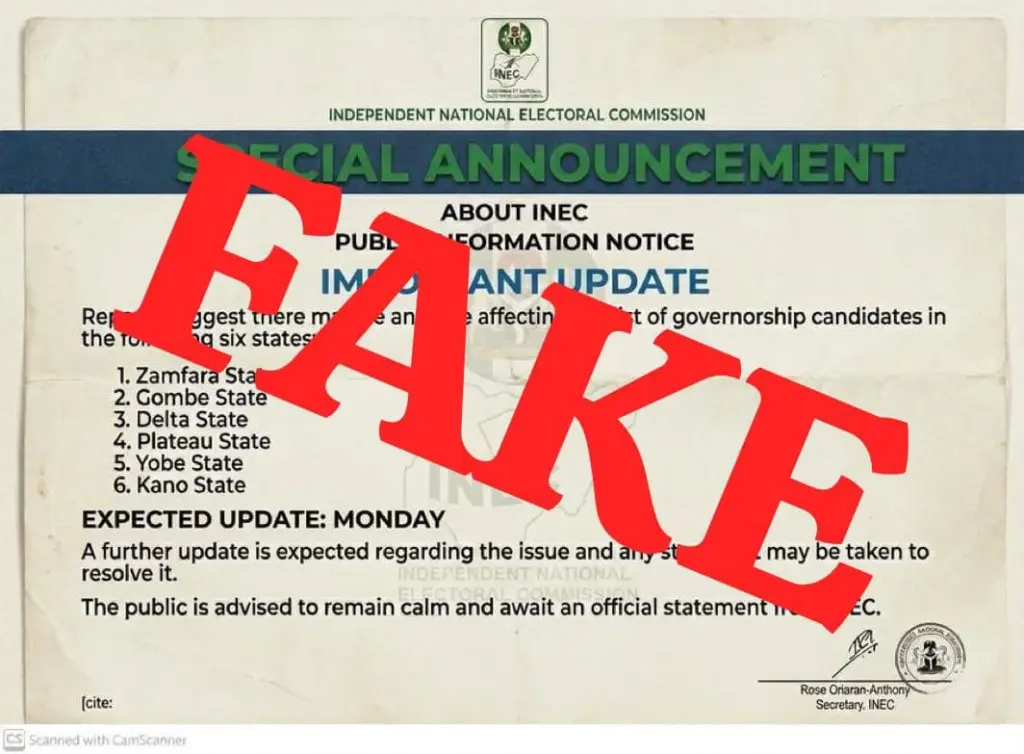
The Independent National Electoral Commission (INEC) has raised the alarm over a fraudulent publication circulating online that claims to be a special announcement about governorship candidates for the 2027 elections.
In a public notice issued on Monday, October 12, 2026, the electoral body described the document as “FAKE” and stressed that it did not originate from the Commission.
The circulating material purports to address issues affecting the list of governorship candidates in six states: Zamfara, Gombe, Delta, Plateau, Yobe, and Kano.
“The Commission wishes to categorically inform the general public that the publication is FAKE and did not originate from INEC. INEC therefore urges members of the public to disregard the fraudulent publication and refrain from sharing it,” the notice stated.
INEC further clarified that any information suggesting it has issued a special announcement concerning governorship candidates in those states is false.
The warning comes just days after the Commission published the final lists of candidates for the February 6, 2027 governorship elections.
The electoral umpire advised Nigerians, political parties, and candidates to rely solely on official notices, press releases, and information released through its verified channels.
These include the INEC website (inecnigeria.org), its Facebook page (INEC Nigeria), X and Instagram handles (@inecnigeria), and the INEC News Portal.
INEC reiterated its commitment to providing accurate electoral information and called on the public to remain vigilant against misleading publications as preparations for the 2027 elections intensify.
Politics
2027: 119 Women Jostle For State’s Governors
States with female governorship candidates are Akwa Ibom (five candidates), Ebonyi (three) Cross River, Adamawa, Delta, Lagos (two each), while Plateau, Abia, Bauchi, Benue, Kaduna, Kano, Kwara, Ogun and Rivers have one female candidate each.
Twenty one political parties are fielding 119 women for governorship elections in next year’s poll, data from the INEC reveals
However, 936 governorship candidates and running mates are on the ballot for the February 6, 2027 poll across 28 states.
Also, out of 10,020 candidates for the House of Assembly, 1,016 are women.
The Nigeria Democratic Congress (NDC) candidate in Adamawa state, Senator Aishatu Dahiru Binani, is the highest ranking woman on the list.
According to the list, 25 women are contesting for governor in 15 states, while there is no female candidates in 13 states.
The statistics show that 94 women across 26 states are running mates.
But there is no female governorship and deputy governorship candidate in Jigawa and Katsina states.
States with female governorship candidates are Akwa Ibom (five candidates), Ebonyi (three) Cross River, Adamawa, Delta, Lagos (two each), while Plateau, Abia, Bauchi, Benue, Kaduna, Kano, Kwara, Ogun and Rivers have one female candidate each.
Ogun State takes the lead with 10 deputy governorship candidates, followed by Plateau and Lagos with nine women, Akwa Ibom; eight Rivers; six, Oyo, Kaduna, Enugu with five each; Abia, Adamawa, Ebonyi, Taraba; four each, Niger and Delta; three each, Gombe, Kebbi, Sokoto and Zamfara; two each, while Bauchi, Benue, Borno, Kano, Kwara, Nasarawa and Yobe have one each.
The women governorship candidates are Doris Uzumma Umezurike (AAC, Abia), Chigbe Chioma Vivian -NRM and Joelyne Ita Hogan Bassey – ADP (Cross River); Bingel Hurung Philomina- ADP (Plateau); Aishatu Dahiru Binani-NDC and Samuel Faith Monday-NRM (Adamawa); Achibong Inimbom Nsikak-ADP, Jimmy Stella Monday-APGA, Emem Umoh-APP, Effiong Asuomo Rosemary-SDP and Umo Blessing Okon-ZLP (Akwa Ibom) and Babageidam Lami- ZLP (Bauchi).
Others are Ujah Mercy Engole-APP (Benue); Mohammed Jemila-YPP (Kaduna); Ahmed Furera-BP (Kano); Jayeola Monturayo-APM (Kwara); Adeyemi Abiola-APP and Peter Helen Ojoyule-ZLP (Lagos), Layi Labode Halima-APP (Ogun); West Ivy-AAC (Rivers); James Esther-LP and Iyovwaye Chris-NDC (Delta); Nwodum Lucy Chinwe-APGA, Nwankwo Martha Ebere-APP and Nwinyinya Juliet-ZLP (Ebonyi).

The Independent National Electoral Commission (INEC) has begun the nationwide display of the preliminary register of voters and the distribution of Permanent Voter Cards (PVCs) today, Friday, October 9, 2026, as part of preparations for the 2027 general elections.
The seven-day exercise, which runs until October 15, will take place simultaneously across registration areas and wards in all states. It allows registered voters to verify their details on the register, raise claims or objections, and collect PVCs from the first phase of the Continuous Voter Registration (CVR) conducted between August and December 2025. Collection hours are from 9am to 3pm daily, including weekends.
INEC Chairman, Prof. Joash Amupitan, confirmed that Nigeria’s National Register of Voters now stands at over 103 million following the completion of the three-phase CVR exercise and a final Automated Biometric Identification System (ABIS) cleanup. The exercise recorded 10,772,421 new registrations.
Phase 1 PVCs have already been processed and distributed to local government collection centres. After the seven-day ward-level exercise, further collection will continue at INEC Local Government Area offices. The commission stressed that PVCs cannot be collected by proxy, in line with the Electoral Act.
The display of the preliminary register is required under Section 19(1) of the Electoral Act 2026, which mandates INEC to exhibit the voter register not less than 90 days before the general elections.
Presidential and National Assembly elections are scheduled for January 16, 2027, while governorship and State House of Assembly elections will hold on February 6, 2027.
INEC has urged eligible voters to check their status online via its voter verification portal and to collect their cards promptly to avoid disenfranchisement.


FG Withdraw Charges Against PFIPC DG Adeyemi

CJN Kekere-Ekun swears in 68 new SANs

BREAKING: Fire Engulfs First Bank Branch Along Abuja-Keffi Road

Tech Expert, Zuckerberg trains with UFC champions, Adesanya, Alexander

Organ Trafficking: Ekweremadu bags 10 years in UK prison

SAINT OBI: Between his marriage and his death
-

 Business9 hours ago
Nigeria’s ₦33bn Fruit Import Bill Exposes Missed Opportunities in Jos
-

 Business10 hours ago
Naira To Dollar, Pound ,Euro …Rates For Monday, October 12
-

 International23 hours ago
‘Up to our people’ to pick leader, Zelenskyy responds to Trump’s pledge for new elections in Ukraine
-

 Opinions17 hours ago
Human Capital Africa Statement For International Day of the Girl Child 2026
-
 Politics4 hours ago
BEWARE: Fake 2027 Gov’ Candidates List Circulating Online — INEC Raises Alarm
-

 International23 hours ago
Time for Ukraine to get a new president’, says Trump
-

 News10 hours ago
Forbes Scores GTBank Best Employers 2026
-

 Business9 hours ago
Afreximbank Hails Africa Credit Rating Agency